
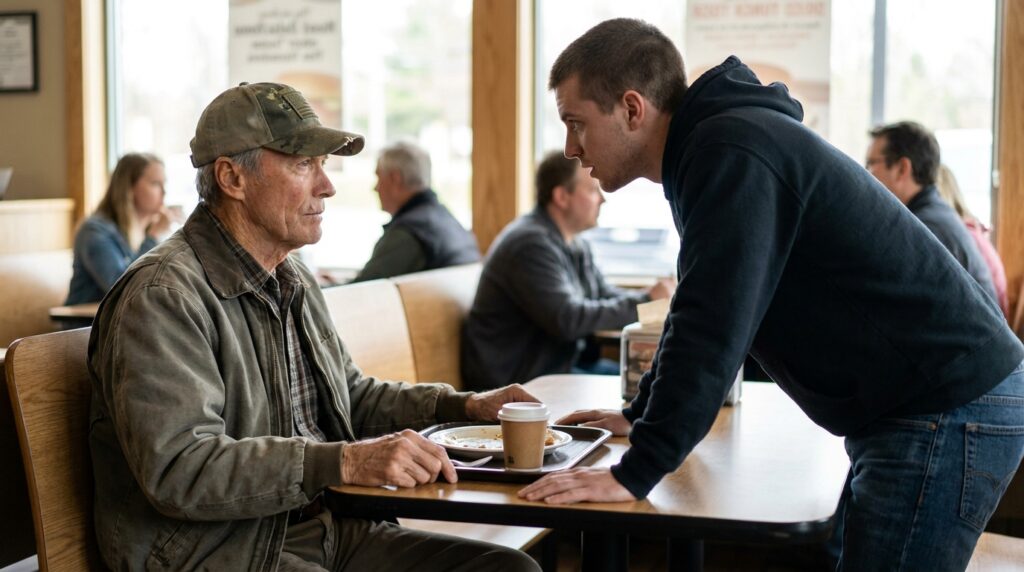
CHAPTER 2: THE TERRITORIAL SHADOW
The brass-capped pen didn’t bounce. It rolled with a heavy, uneven wobble across the salt-filmed formica, its metal clip catching the yellow tint of the diner’s overhead lights before it wedged itself beneath the lip of the plastic meal tray. The three numbers engraved on the side—704—stared upward, clean and deep against the scratched metal casing.
The young man didn’t reach for it. His hand remained flat on the table, but the weight had shifted back to his heels. The aggressive lean that had defined his posture a few seconds ago had dissolved into something stiff and awkward, like a rusted gear forced into reverse. He looked down at the pen, then up at the veteran’s face, his mouth slightly open but entirely dry.
“The pen,” the veteran said. His voice didn’t rise above the low, constant murmur of the refrigerator units behind the counter, but it held the room like an anchor. “You dropped something, son.”
The boy’s throat moved as he swallowed. His chest rose and fell in short, shallow jerks beneath the heavy cotton of his hoodie. Around them, the silence of the diner was absolute now. The spatula on the griddle remained static; the grease sizzled once, a sharp, spitting sound that made a customer in the second booth flinch. The collective weight of twenty pairs of eyes was no longer on the older man’s fraying collar. It had shifted, heavy and critical, onto the boy’s shoulders.
“I don’t…” The young man started, his voice cracking on the first syllable before he managed to drop it an octave. He tried to pull his hand off the table, but his palm seemed stuck to the formica, a thin film of cold sweat leaving a gray smudge on the faux-wood pattern as he finally slid it back into his pocket. “It’s just a pen.”
“It’s an armorer’s tool,” the veteran corrected. His gaze didn’t leave the boy’s eyes. He didn’t blink. His posture remained perfectly square, his spine a straight line of iron that seemed to absorb the dim, greasy light of the room. “Specifically, a specialized gauge for a bolt-carrier group. The kind they stopped issuing when the logistics chains changed after the valley campaign. You don’t buy those at a hardware store on the interstate.”
The boy shifted his weight from his left foot to his right, his rubber soles squeaking against the unwashed linoleum with a sound like a small animal trapped under a floorboard. The confidence that had brought him to the edge of the shared table was completely gone, replaced by a restless, defensive confusion. He looked at his two friends near the cigarette machine, but they had already turned their backs, suddenly fascinated by the reflection of the streetlights in the dark glass of the entryway.
“My granddad gave it to me,” the boy muttered. The words came out defensive, a small shield raised against the crushing presence of the older man. He reached out with two fingers, his hand trembling slightly as he hooked the clip of the pen and pulled it back toward his side of the table. “He said it was from his time in the motor pool. It ain’t yours.”
“I didn’t say it was mine,” the veteran said. He adjusted his right hand, his thumb sliding over the white crescent scar on his skin. The touch was mechanical, a repetitive habit born from years of measuring the clearance of heavy machinery before the ignition turned. “But the inventory stamp on that brass belonged to a specific logistics battalion out of Fort Meade. A unit that didn’t leave many people behind to talk about the inventory.”
The boy pulled the pen entirely into his pocket, his fingers bunching the fabric around it as if he could hide the numbers from the room. He took a single step backward, his hip clearing the corner of the table by less than an inch. The bravado had completely drained from his face, leaving only the pale, sharp features of a local kid who had tried to push an old man and accidentally hit a stone wall.
“We’re leaving,” the boy said, though he didn’t look at his friends when he said it. He kept his eyes locked on the veteran’s chest, watching the steady, unhurried rhythm of the older man’s breathing. He didn’t want to turn his back.
The veteran didn’t follow him with his body. He stayed right where he was, a vertical pillar of weathered canvas and quiet authority, but his eyes followed the boy as he began to slide toward the exit. The air between them remained thick with the smell of iron, old oil, and the cold draft coming through the door frame.
As the boy reached the threshold, his hand fumbled with the glass door, his fingers slipping twice on the metal push-bar before he got it open. The bell above the frame gave a single, tinny ring that shattered the remaining tension in the room. But before the door swung shut, a small piece of dark, tarnished metal slipped from the loose pocket of his hoodie, hitting the rubber mat at the entrance with a dull, heavy thud. It didn’t roll. It lay there, a small rectangle of weathered brass with a raised edge, glinting against the dirty floor.
The veteran didn’t call out. He waited until the door settled into its frame, then turned his gaze down to his tray, where his dark coffee had finally stopped moving.








