
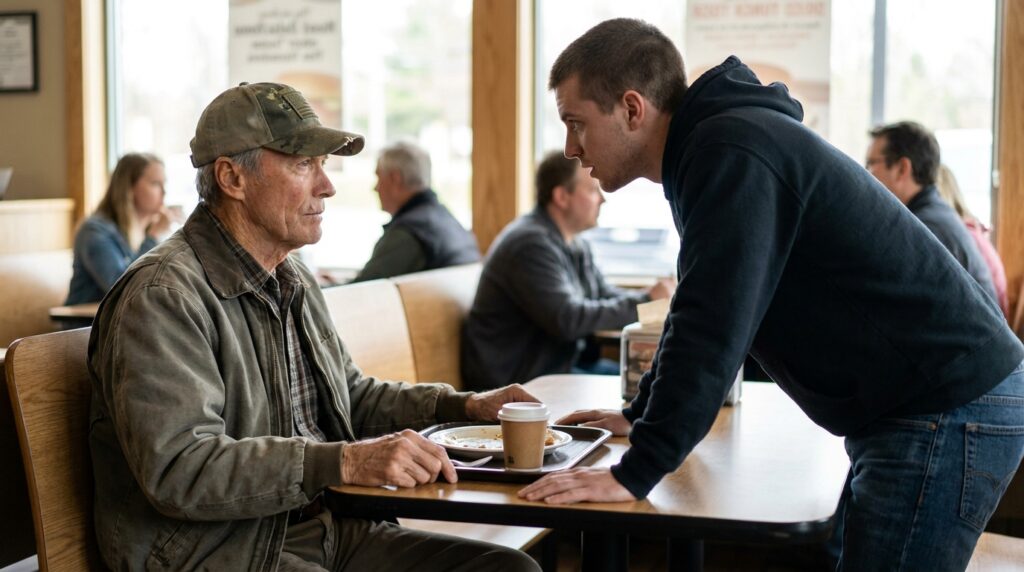
CHAPTER 3: THE MOCK BY THE COUNTER
The dull, flat hit of the metal on the ribbed rubber mat was the loudest sound left in the building. It lacked the bright, ringing resonance of clean steel; it was a heavy, dense thump that indicated high copper content and decades of oxidation.
The veteran didn’t jump to his feet. He didn’t rush the doorway like a scavenger chasing a coin. His boots, stiffened by salt stains and years of wear, ground against the grit beneath the table as he executed a slow, ninety-degree rotation of his torso. The frayed hem of his canvas trousers dragged across the top of his laces with a dry, rhythmic hiss. Every movement was budgeted, a precise expenditure of energy that kept his center of gravity perfectly locked over his heels.
The diner around him began to inhale again. The waitress dropped the pitcher of iced tea onto a plastic tray with a wet clatter, and the low, thick mutter of the lunch crowd returned, though it remained pitched lower than before, a low drone of murmurs sliding between the vinyl booths. They were looking at him now, evaluating the curve of his shoulders, trying to figure out how an old man with a lined face and an old shirt had managed to deflate a hundred and eighty pounds of aggressive local muscle without changing his pulse.
He ignored them. His attention was pinned entirely to the threshold.
He rose from the booth for the second time, but this time his hands were empty. He didn’t touch the heavy mug or the handle of his fork. He walked with an unhurried, measured stride toward the front door, his eyes tracking the dark little square resting on the mat. Up close, the setting daylight cut across its pitted surface, revealing the serrated border and the faint, compressed shapes of an insignia that had been polished so many times the sharp details had melted into smooth, rounded ridges.
He bent down from the hip, his knee joints releasing a small, dry pop that was swallowed by the hum of the overhead vents. His fingers closed over the brass. The metal was cold, holding the chill of the street outside, and it carried the distinct, unmistakable grease of a motor pool—sulfur, diesel stabilizer, and old iron.
When he turned it over in his palm, his thumb immediately found the three raised numerals stamped into the reverse side, right beneath the broken pin mount: 704.
He stood there in the doorway, the glass door vibrating slightly against his shoulder as a heavy logging truck rolled past on the state route outside, its diesel exhaust rattling the frame. The numbers matched the armorer’s tool in the boy’s pocket. It wasn’t a coincidence. A logistics company out of Fort Meade didn’t throw two separate, non-standard pieces of field-modified gear into the same small town thirty years after the battalion records were buried in an administrative fire.
He walked back to the shared table, his thumb resting over the numbers, pressing the cold brass into the center of his old bolt scar. The small, white-rimmed crescent of tissue on his skin throbbed with a dull, familiar rhythm—a physical reminder of the heavy machinery he used to balance before the world broke.
“Arthur,” a voice called out from behind the cash register.
The veteran stopped, his boots locking against the unwashed linoleum. He didn’t look back immediately. He knew the voice. It belonged to Miller, the man who spent twelve hours a day behind the formica counter, punching numbers into a mechanical register that had been out of date when the valley campaign was still a series of gray maps in a command tent.
“That kid,” Miller said, his hand reaching into a glass jar to retrieve a handful of paper napkins. His fingers were stiff, the knuckles swollen into pale knots from forty years of handling heavy porcelain and cold grease. “That’s the Miller boy from down by the old tannery. No relation to me. His people came out of the valley after the water went bad in ’92. They don’t do much but fix old trucks and look for things that aren’t tied down.”
Arthur turned his head slightly, his profile cutting a sharp, dark wedge against the bright window. “He carries his grandfather’s tools, Miller.”
“His grandfather died in a ditch outside of Sector Four,” Miller spat, his voice dropping into a dry, paper-thin rasp that didn’t cross the distance to the nearest booth. He leaned over the register, the old wood of the counter creaking under his palms. “Left nothing but a box of oxidized brass and a house with a hole in the roof. The boy thinks that box makes him someone. He thinks because his old man’s name is on a copper plaque at the courthouse steps, he owns the sidewalk.”
Arthur’s hand closed tighter around the piece of metal in his pocket. He could feel the specific edges of the insignia, the broken pin pricking the skin of his palm. He knew the name on that copper plaque. He had written the report that put it there, using a mechanical typewriter with a sticky ‘E’ key while the rain turned the mud outside the command post into a gray soup.
“He doesn’t own the sidewalk,” Arthur said softly. “But he’s carrying the wrong history.”
He didn’t wait for Miller to finish his next sentence. He walked back to his booth, his long canvas coat settling around his legs with the heavy, dry drag of a wet tarp. He sat down, adjusted his meal tray by less than an eighth of an inch until it aligned perfectly with the scratched corner of the formica, and reached for his coffee. The dark liquid had gone lukewarm, a thin, oily skin forming across the surface, reflecting the dead yellow tubes of the ceiling.
He took a sip anyway, the bitter, burnt taste clearing the dry dust from his throat. The boy would come back. Not because he was brave, but because people who lived on the edge of an old tannery didn’t lose an armorer’s gauge and a unit crest without someone noticed the inventory was short. The tools were part of a ledger that had never been balanced, and Arthur was the only man left in the county who knew how to read the line items.








