
CHAPTER 5: THE LOW WARNING
The iron frame of the old Ford didn’t cushion the transition from the state asphalt to the unpaved shoulder of the lime kiln road. It slammed down onto its bump stops, a harsh, metal-on-metal crack that sent a violent tremor straight up through the steering column and into the meat of Arthur’s palms. The loose lug wrenches in the bed box behind the cab erupted into a heavy, rhythmic clatter against the rusted sheet metal, a jagged noise that sounded like loose shale sliding down a chute.
Arthur didn’t ease his boot off the throttle. He kept his right foot buried, the stiff, unyielding resistance of the accelerator pedal cutting into the thin leather sole of his boot. His knuckles, white-rimmed and thick with old engine grease, locked around the cracked vinyl of the steering wheel. He adjusted his focus to the two dark ribbons of chewed-up mud left by the young man’s utility truck. The tracks were fresh; the water in the deeper ruts hadn’t settled yet, the surface still swirling with thick, yellow silt that reflected the dying purple light of the timberline.
The road narrowness forced the branches of the low pines to scrape the passenger side of the cab, a continuous, dry shreem-shreem that sounded like heavy wire brushes cleaning a cylinder head. Arthur kept his gaze dead center, tracking the high, square silhouette of the ridge.
The engine block beneath his feet vibrated at a pitch that shook his teeth in their sockets—a low, mechanical groan that told him the universal joint on the driveshaft was dry and working itself to death. He knew exactly how many miles that joint had left before the needles flattened out and dropped the shaft onto the gravel. It was a matter of tolerances. Everything in the world had a threshold where the friction became greater than the design could bear.
He rounded the final bend before the old kiln site, his headlights cutting through a dense, cold wall of mist that smelled of old wood ash and sulfur. The utility truck was there, idling fifty yards ahead with its tail gate dropped open. The exhaust pipe was spitting thick, blue-gray diesel smoke that hung low to the ground, clouding the view of the dark clearing behind the cab.
Arthur let his truck roll to a stop, his boots pressing the unassisted brake pedal down until his calf muscle tightened into an iron knot. He didn’t turn off the ignition. The old engine kept chugging, a slow, heavy heartbeat that threw a steady vibration through the frame.
He opened the door, the hinges releasing a sharp, ungreased shriek that died instantly in the wet air. As his boots hit the shale, the dry crunch of stone under his weight was answered by a metallic clack from the gray fog ahead. It was the sound of an iron slide locking into place on a pump-action receiver.
“You should’ve stayed in your booth, old man,” a voice called out through the smoke. It wasn’t the boy. This voice was older, thick with the dry, gravelly rasp of a career spent breathing the dust from the lime crushers.
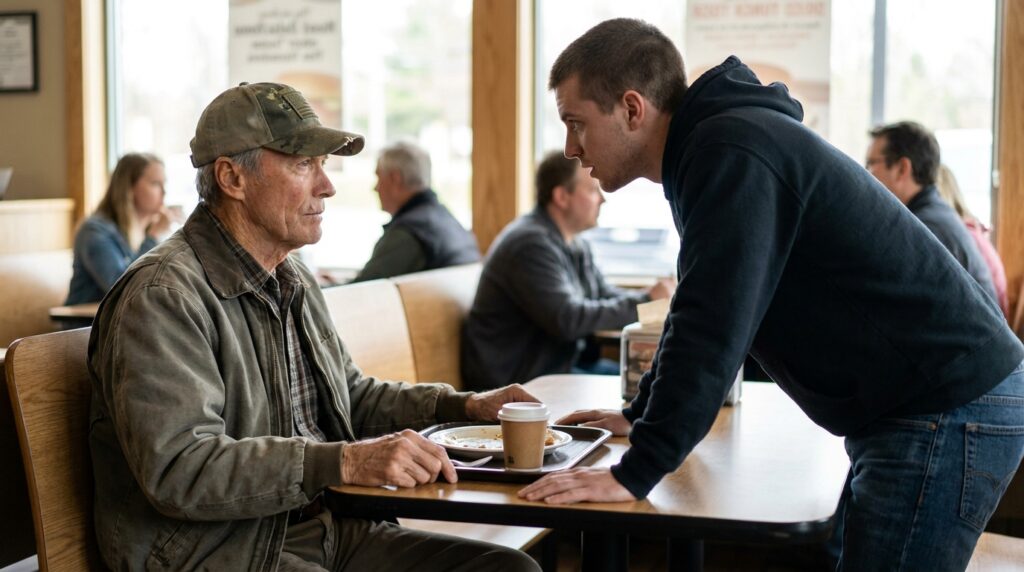
A figure stepped through the headlights’ glare. He wore a grease-blackened denim coat that hung low on his frame, his hands hidden behind the receiver of an old twelve-gauge field gun. His hair was a thin, white bristle that matched the color of the salt scale on Arthur’s fenders. Beside him, the young man from the diner stood by the truck bed, his arms crossed over his chest, his mouth set into a thin, tight line that tried to hide the lingering twitch in his jaw.
Arthur didn’t pull his hands from his canvas coat pockets. His fingers stayed wrapped around the cold brass crest, the broken mounting pin pressing so hard into his old bolt scar that he could feel the pulse in his thumb beating against the numbers 704.
“The boy left his receipt on the floor,” Arthur said, his voice dropping below the steady rumble of the idling trucks. It was the same tone he had used in the command tent at Sector Four, a dead, flat delivery that left no room for interpretation or bargain.
“We don’t do business by your receipts anymore, Captain,” the older man spat. He didn’t raise the barrel of the gun, but his finger moved until it rested flat against the curved metal of the trigger guard. The steel of the receiver was pitted with dark, orange rust along the ejection port. “The valley is closed. The records are burned. What’s out here in the woods belongs to whoever has the tools to haul it out.”
Arthur took one step forward, his boot sole grinding a piece of rotted limestone into a white paste against the gravel. He didn’t look at the gun. He looked straight past the older man’s shoulder into the open bed of the utility truck, where three heavy, oil-soaked crates of military inventory sat beneath a wet canvas tarp. The crates were marked with the same yellow stencil letters he had checked off every morning during the final winter: 704-BATT-SUP.
The physical decoy secret was right there, laid bare in the light of his high beams—the stolen supply ledger from his old command, the proof of an illegal salvage ring that had kept this town’s scrap yards alive for thirty years. But as Arthur’s eyes tracked the serial numbers on the side of the lead crate, his heart seemed to drop into his stomach. The number wasn’t a standard parts registry. It was 04-0012-ERR—the identifier for the faulty navigation components that had caused the artillery coordinates to shift during the final night in the valley.
The room in his head went cold. The boy’s family hadn’t just been stealing scrap iron from an old motor pool. They had been hoarding the specific mechanical evidence that proved Arthur’s own final order wasn’t just a mistake—it was an intervention that had been guided by flawed gear he had personally signed into service. The realization hit him with the physical weight of an iron slug, but his face didn’t change color. He kept his posture perfectly square, though the ground beneath his feet felt like it was sliding into the ditch.
“You’re hauling the wrong freight, Miller,” Arthur said softly, his voice barely carrying across the vibrating hoods of the trucks. “And you’re running out of road.”








