
CHAPTER 4: THE ANCHOR INCIDENT
Arthur let the cold weight of the brass insignia rest against his palm for three full expansion cycles of his lungs. The metal absorbed none of his body heat; it stayed stubborn, cold as a well-head casing in late November, oily to the touch. With a deliberate, unhurried precision, he slid his thumb into his vest pocket, retrieved a small linen rag stiffened with dried mineral oil, and wiped the face of the crest until the oxidized green scale gave way to the flat, unpolished yellow beneath.
The design emerged through the grime. It was a winged wheel silhouette pinned behind a broken saltire—the distinctive, non-standard unit crest of the 704th Logistics Battalion.
“You shouldn’t keep that on the table, Arthur,” Miller muttered from across the room. The cash register drawer closed with a heavy, ungreased chunk, the bell inside vibrating for a second before the silence took over again. Miller didn’t look over his shoulder while he wiped down the chrome espresso machine with a gray cloth that smelled of old milk. “That’s bad luck. That’s valley luck.”
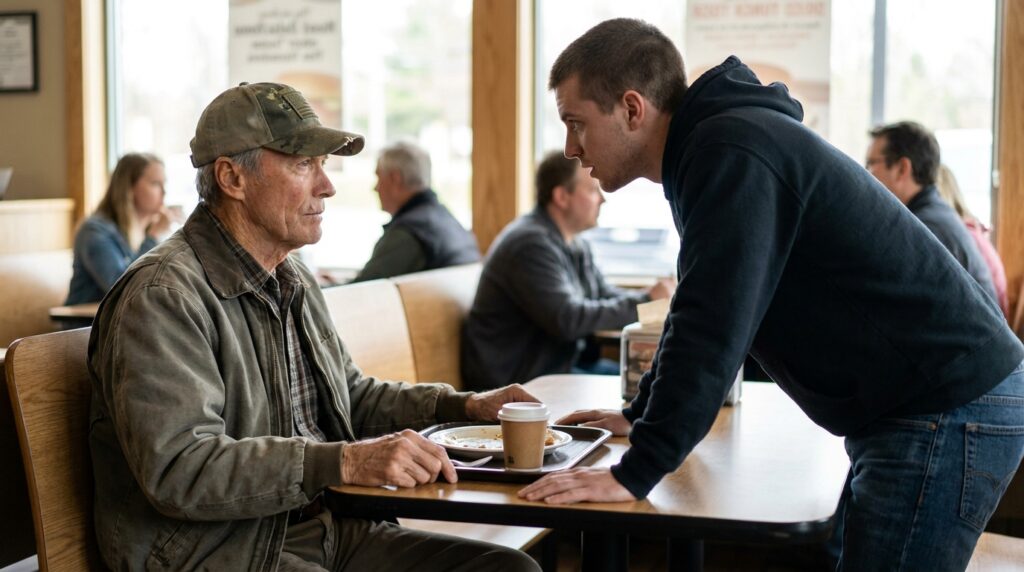
“Luck has very little to do with parts numbers, Miller,” Arthur said, his voice level, carrying the slow, dry rhythm of a standard maintenance log. He picked up his fork, using the tines to scrape a tiny, dried nodule of old solder from the corner of his plastic meal tray. “The boy didn’t find this in a scrap heap. The pin on the back isn’t rusted off; it was clipped with a pair of double-edged wire cutters. Side-action cutters. The kind they issued to the vehicle recovery teams in Sector Four.”
He didn’t need to look at the paperwork to know who had filled those tool rolls. He had initialed the requisitions himself during the third month of the withdrawal, when the mud was so deep the heavy haulers were splitting their differentials just trying to turn around in the assembly area.
He stood up, his canvas coat dragging across the vinyl seat with a dry, sand-paper rasp. His body didn’t complain about the movement, but the heavy iron weight in his chest seemed to grow denser, pulling his shoulders into a rigid, horizontal plane. He walked across the unwashed linoleum toward the front window, his eyes scanning the empty gravel lot where the young man’s truck had been idling minutes before. The oil pool left behind by the worn oil pan was still dark and wet against the dry stone, a black circle slowly widening in the dust.
The boy had left in a hurry, but he hadn’t left alone. Two parallel lines of deep, aggressive tread marks cut into the shoulder of the state route, the rubber tearing the weeds from the ditch. It was the mark of a heavy utility vehicle—something with dual rear wheels and a frame that didn’t bounce when it hit the transition to the asphalt.
“He’ll go back to the yard,” Miller said, his voice coming closer as he walked toward the door with a broom. The straws of the broom were worn down to uneven, dirty stubs that scratched the floorboards with a dry, irritating hiss. “His uncle runs the yard behind the old lime kiln. They got four hundred tons of unrecorded military iron sitting back in the woods. Stuff that never went through the county auction. Stuff that came over the ridge in the middle of the night while the fire was still burning in the valley.”
Arthur looked down at his own right hand, the white crescent of the old bolt scar standing out sharp against his weathered skin. His fingers didn’t shake. He had spent thirty years teaching them not to move unless they were clearing a jam or setting a torque wrench.
“The yard is inside the old boundary line,” Arthur said softly.
“It is,” Miller replied, stopping his broom right at the edge of the rubber mat where the insignia had fallen. He didn’t look down at the floor; he looked straight through the glass at the dark line of the ridge three miles away. The pine trees on the crest looked like black teeth against the graying sky. “And nobody goes past the kiln without a bill of lading from the state office. Or a shotgun in the gun rack.”
Arthur didn’t answer. He reached into his coat pocket, retrieved a single, worn brass key with a filed notch along the spine, and laid it on the counter next to the cash register. The metal key was smooth from years of being turned in the same lock—the padlock of an old green footlocker currently bolted to the bed of his own truck outside.
“If the boy comes back before I clear the ridge, Miller, tell him his grandfather’s ledger is still open,” Arthur said.
He turned toward the exit, his heavy boots making no sound against the rubber mat as he pushed the glass door open. The tinny ring of the bell above the frame was cut short by the rush of cold, diesel-scented air from the road. The daylight was dying fast now, the orange tint on the horizon turning into a thin, violet bruise that offered no heat. He walked toward his vehicle, his hand already reaching for the handle of the tool box behind the cab, his fingers searching for the specific cold friction of the iron bars he had kept greased for three decades.








