Chapter 1: The Crash That Silenced the Cemetery
The pearl-white golf cart tore across the cemetery lawn, its electric motor whining as Karen Wilson pressed the accelerator to the floor.
At fifty-five, Karen was accustomed to getting her way. As president of the Willow Creek Homeowners Association, she had spent six years enforcing rules with a determination that bordered on obsession. She had ordered fences removed, threatened elderly homeowners with fines, and once demanded that a disabled veteran take down the American flag from his front porch because the pole exceeded the association’s approved height.
But that Thursday morning, Karen was about to cross a line she could never uncross.
She wore a bright yellow blouse, fitted white pants, oversized sunglasses, and expensive sandals entirely unsuitable for walking through a cemetery. Her blonde hair was carefully styled, and her expression carried the familiar irritation of a woman who believed the world existed to accommodate her.
Ahead stood a row of old granite headstones beneath towering oak trees.
Karen considered them an eyesore.
The cemetery occupied nearly twelve acres along the eastern boundary of Willow Creek Estates. Most of the graves were decades old, some dating back to the 1940s. Families still visited regularly, leaving flowers, small American flags, and handwritten notes.
Karen saw something different.
She saw valuable land.
For months, she had pushed a proposal to transform the cemetery’s western edge into an exclusive landscaped entrance for Willow Creek Estates. The project would include decorative gates, a private walking trail, and an ornamental fountain.
The cemetery trustees had refused.
The county planning office had rejected her preliminary request.
Even several HOA board members had warned her that disturbing burial grounds could bring serious legal consequences.
Karen had dismissed every objection.
That morning, she arrived determined to prove that the old headstones were unstable and should be removed.
Near the cemetery’s oldest section, seventy-two-year-old groundskeeper Thomas Bennett noticed the speeding golf cart.
He stepped away from a flower bed and raised his arm.
“Ma’am! Slow down!”
Karen ignored him.
She aimed directly toward a large gray granite headstone standing near the edge of the proposed development area.
In her mind, knocking over one deteriorating monument would demonstrate how dangerous the old cemetery had become.
She pressed harder on the accelerator.
The golf cart surged forward.
Then came a terrible crash.
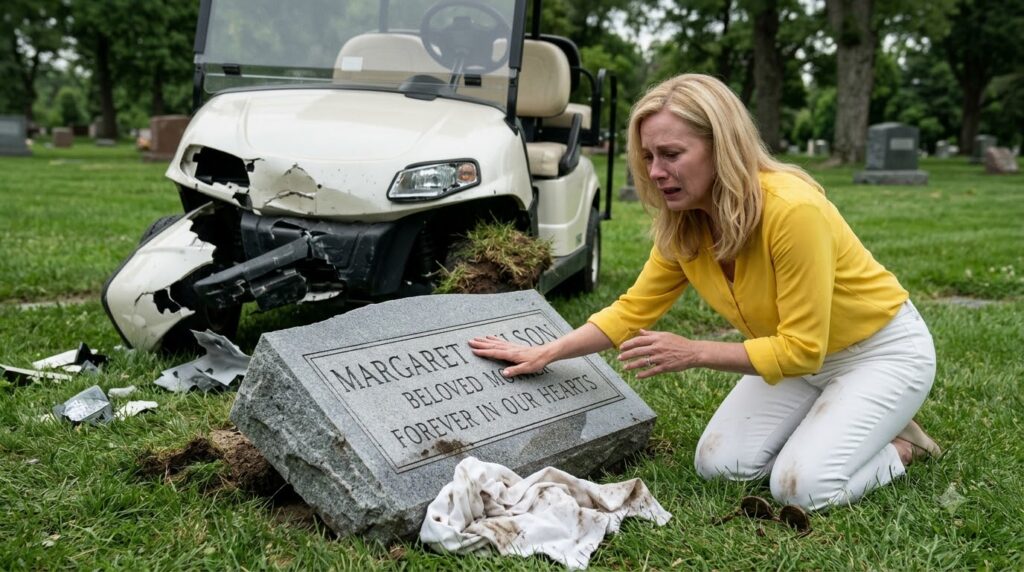
The front bumper struck the granite headstone with a sharp, explosive crack. White plastic shattered across the grass. The front panel buckled inward, exposing twisted supports beneath the hood.
The heavy monument lurched backward, tearing loose from its base before settling at a dangerous angle.
Karen’s body slammed against the steering wheel.
Her sunglasses flew onto the passenger seat.
For a moment, everything went silent.
Then a flock of birds erupted from the nearby oak trees.
Thomas dropped his gardening tools and hurried toward the wreckage.
Karen sat stunned behind the wheel. Her hands trembled, but anger quickly replaced her shock.
She pushed herself out of the damaged cart, brushing dirt from her white pants.
“These things shouldn’t even be here!” she shouted.
Thomas stopped several feet away.
“Are you hurt?”
Karen ignored the question.
A white protective cloth had been draped over the headstone during recent cleaning work. The impact had pulled it partly loose, leaving the monument covered at an awkward angle.
Karen marched toward it.
“I want this entire row cleared!”
She grabbed the cloth and ripped it away.
The fabric fell across the grass.
Beneath it, the freshly cleaned inscription caught the morning sunlight.
MARGARET WILSON
BELOVED MOTHER
FOREVER IN OUR HEARTS
Karen stopped breathing.
For several seconds, she simply stared.
The name seemed impossible.
Her mother’s name.
The same woman who had raised her, comforted her, and spent the final years of her life begging Karen to become kinder.
Karen stepped closer.
Her eyes moved toward the smaller inscription beneath the dedication.
1934–2018.
The dates matched.
Her knees weakened.
“No,” she whispered.
She reached toward the stone, touching the familiar name with trembling fingers.
“Mom?”
Behind her, Thomas stood motionless.
Karen had visited her mother’s grave only twice since the funeral. Both visits had been brief, hurried affairs. She remembered the cemetery’s main entrance but had forgotten exactly where the grave stood among the older monuments.
The cemetery had recently rearranged its maintenance access routes. Karen had entered through a side gate she rarely used.
Now the consequences of her arrogance stood before her in broken stone and scattered plastic.
Karen sank to her knees.
“What have I done?”
Tears slipped down her cheeks.
Thomas approached slowly.
He had cared for Margaret Wilson’s grave for eight years, including the months before her death when Margaret still visited the cemetery to tend her husband’s resting place.
He knew the family.
He knew Karen.
And he knew something Karen had never bothered to learn.
Her mother had left instructions concerning this particular section of the cemetery.
Instructions that Karen’s development proposal threatened to destroy.
Thomas looked at the damaged monument, then at the devastated woman kneeling beside it.
“Mrs. Wilson,” he said quietly, “your mother spent the last years of her life trying to protect these graves.”
Karen looked up.
For the first time that morning, she had no answer.