
The Cold Gray Line of Cedar and Turf Where Suburban Sovereignty Is Bought with Proof

CHAPTER 1: OVER THE FENCE

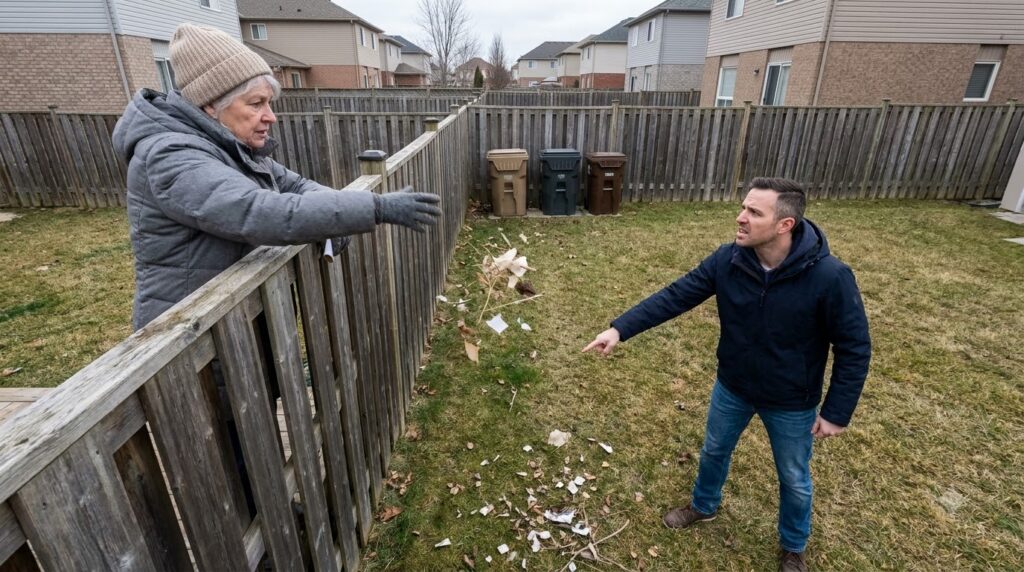
The damp turf gave beneath Mark’s work boots with a heavy, wet compression that tasted of cold iron and stagnant winter rain. Two paces past the back porch, the smell reached him before the visual clutter did—decaying pine needles, crushed lime shale, and the sour tang of wet garden waste that had no business sitting on his lawn.

He stopped three feet short of the weathered cedar privacy fence. On the ground rested a fresh, pale heap of torn drywall scrap and clipped hemlock branches, still settled lightly over the dark blue-green blades of his grass.

Looking up, he caught her mid-motion.

Evelyn was pitched forward over the six-foot wooden rail, her shoulders bunched inside an oversized gray wool coat that smelled faintly of mothballs and woodsmoke. Her hands were encased in thick, stiff dark gloves—one gripping the cap rail for balance, the other still extended over his side of the boundary line, frozen in the split-second following a release. Underneath a beige knit beanie pulled tight over gray hair, her eyes were wide, caught in the stark, unvarnished geometry of broad daylight.

Mark snapped his right arm down toward the mess on his grass, the sleeve of his navy hooded jacket taut against his forearm. He stepped into a hard, squared stance, his boots planting deep into the cold soil. His finger pointed sharply into the center of the pale debris.

“Stop throwing that into my yard,” Mark said, his voice flat, low, and cut down to bare muscle. “Keep your mess on your side!”

The backyard went rigid. Across the alleyway, a crow rattled on a cold telephone wire, but between the two houses, nothing moved. Evelyn’s chin twitched upward. For three long seconds, she stayed hitched over the top rail, her dark gloves clinging to the cedar like iron clamps while her face hardened into a scowl of defensive irritation.

Slowly, with a tight, deliberate friction, she dragged her extended hand back across the fence line. Her coat rustled heavily against the wood. Her pride, raw and brittle from forty years of believing she owned the soil beneath both their homes, flared instantly across her mouth.

“Fine,” Evelyn snapped, her voice clipped and raspy against the quiet neighborhood air. She pulled her chest back behind the cedar boundary, leaving only her head visible above the rail. “I won’t throw anything else into your yard!”

She didn’t look down at the debris. She stared straight into Mark’s eyes, her jaw locked, waiting for him to back down first.

Mark didn’t move. He held his ground beside the scattered pale mess, his navy jacket cold against his shoulders, his boots sunk into the damp turf. High above them, tucked beneath the overhang of his rear roofline, the dark glass lens of a newly mounted camera caught every millimeter of the fence rail, the fresh debris, and the empty space where her gloved hand had just been.

Beside his boot, half-buried in the wet grass near the corner post, a glint of oxidized orange caught the pale winter light—the head of a rusted iron survey pin, buried decades ago, waiting in the dirt.


CHAPTER 2: DIGITAL SENTINELS AND BURIED IRON

The monitor’s pale blue glare cut through the dark of the back porch like a scalpel, illuminating the fine layer of winter dust on the plastic housing. Mark leaned against the doorframe, the cold air seeping through his navy jacket, his thumb tracing the seam of the handheld display unit wired directly to the roof-line feed.

On the six-inch screen, the backyard was stripped of color, rendered in high-contrast gray and black.

He didn’t scrub forward to the confrontation he had just lived through. He scrubbed backward.

The digital timeline was a series of thin blue notches spanning fourteen weeks. Mark dragged his thumb across the scrub wheel, watching the high-angle lens replay the slow, silent siege of his property line in six-second bursts.

Tuesday, November 12th, 3:14 AM: A shadow in a bulky wool coat steps to the cedar rail. A dark-gloved hand extends. A heavy canvas bag tilts. A dark cascade of crushed brick and sour oak mulch spills across the turf, landing precisely four inches past the fence line.

Friday, December 6th, 11:42 PM: The same silhouette. The same methodical reach over the top rail. This time, a plastic jug of winter lawn acid poured in a deliberate, dripping line parallel to his flower bed.

Sunday, January 19th, 4:05 AM: A heavy, rusted iron bracket dropped straight into the grass near the corner post.

Mark paused the frame. He zoomed in until the pixels broke into jagged squares of gray noise.

Evelyn wasn’t dumping trash out of convenience. The waste was grouped in specific zones, always crowding the exact three-foot radius around the corner fence post where the ground dipped into a shallow, moss-lined depression. She wasn’t trying to clear her own yard; she was trying to weigh down his.

A faint metallic clink sounded high above his head.

Mark froze, the monitor still humming in his palm. He looked up toward the eaves.

The camera housing, mounted to the fascia board with three heavy-duty lag bolts, vibrated slightly in the rising wind. Tucked into the small gap between the steel mounting bracket and the soffit wood was something that hadn’t been there when he mounted the rig three weeks ago: a small, rectangular key, oxidized orange and bound with a loop of cracked yellow twine.

He stepped onto the porch railing, his boot heel digging into the damp wood, and reached up into the dark eaves. His cold fingers brushed the iron. The key was long, flat-bitted, and heavy—an old skeleton key, coated in a sticky film of grease and soot.

It hadn’t fallen from the roof. Someone had reached up from the narrow gap between his garage wall and Evelyn’s overgrown arborvitae hedge and wedged it high into the hardware.

The back porch door creaked as he stepped down, his boots hitting the decking with a hollow thud. He slipped the rusted key into his jacket pocket, the iron burning cold against his hip through the denim.

He turned back to the screen.

On the live feed, across the dark expanse of wet lawn, a light flickered on in Evelyn’s side kitchen window. The yellow beam cut through the dark, reflecting off the damp cedar pickets of the privacy fence. A hand pulled the lace curtain back an inch.

Mark didn’t look at the window directly. He kept his eyes locked on the monitor, watching her watch him through the digital eye mounted high on his roof.

She had seen him reach into the eaves.

On the screen, her silhouette shifted. She didn’t drop the curtain. Instead, her hand rose, her gloved index finger pressing flat against the glass, pointing straight at the ground beneath his corner fence post—the exact spot where the rusted survey pin lay buried under the damp, shifting soil.

Mark closed the monitor’s plastic flip-lid with a sharp snap. He stepped off the porch and walked back toward the fence, his boots sinking into the dark, wet earth. He didn’t stop until his toe caps brushed the pale debris she had dropped hours before.

He bent down, picked up a heavy chunk of the thrown drywall, and felt its weight. It wasn’t modern gypsum board. It was thick, horsehair plaster backed by cedar lath—the kind of wall torn out of a house built in 1950.

Evelyn hadn’t remodeled her home in thirty years. This wasn’t waste from her house. It was old structure, dug up from somewhere else, delivered to his turf one handful at a time.

He gripped the plaster until it crumbled into white dust between his fingers, falling onto the dark grass right beside the hidden iron pin.

CHAPTER 3: THE DRIVEWAY AMBUSH AND LEGACY LORE

The diesel clatter of a heavy delivery truck rattled the cold morning air, its exhaust hanging in gray, fuel-heavy ribbons over the damp asphalt. Mark stepped off his porch with a thermos in one hand and a steel clipboard in the other, his boots crunching over the crushed limestone skirt of his driveway.

A flatbed contractor truck had pulled up along the curb, its air brakes hissing loudly. In the driver’s lane stood Evelyn, her oversized gray wool coat buttoned to her throat, her beige beanie pulled down so low her eyebrows were hidden. She held a rolled cylinder of heavy butcher paper under her arm like a weapon, her dark-gloved hand resting on the tailgate of the idling flatbed.

Beside her, a young driver in an orange hi-vis vest stood holding a clipboard, looking thoroughly exhausted before eight in the morning.

“You can’t dump the gravel on the easement,” Mark said, his voice cutting through the rumble of the diesel engine. He didn’t slow his stride until he reached the property line where his gravel met Evelyn’s cracked concrete driveway. “The utility easement runs six feet back from the curb. Leave the load on her side of the apron, or take it back.”

The driver looked between them, adjusting his mesh cap. “Look, man, the lady said this driveway was shared up to the fence post—”

“It isn’t,” Mark said flatly. He didn’t look at the driver. He looked straight at Evelyn. “The property line was surveyed three years ago when I bought the parcel. My lot extends eighteen inches past the gravel edge.”

Evelyn didn’t flinch. She took one deliberate step toward him, her boot heels dragging across the wet pavement with a harsh, grating sound. She unrolled the butcher paper with a sharp snap of her wrists, revealing a faded blue-and-black grid drawing drawn in thick India ink.

“Three years ago means nothing in this township,” Evelyn said, her voice raspy, laced with a cold, unyielding conviction that had spent decades hardening. She slammed her gloved palm against the center of the paper, pinning it against the hood of his parked truck. “My husband laid the drainage tile under this drive in 1974. My father built the original cedar fence two feet inside our boundary line as a courtesy to the city so the snowplows wouldn’t tear it down. You think a little piece of paper from a title company changes fifty years of physical occupation?”

Mark leaned down, his eyes scanning the faded blue lines. The ink was old, feathered at the edges where moisture had seeped into the paper. It showed a rough hand-drawn map of the two parcels, complete with measurements written in cursive pencil. But right along the boundary line separating their lots, a section of the cedar fence had been drawn in red ink with a bold annotation: Temporary Fence Line – 2ft Encroachment Allowed for Runoff Control.

It was a classic decoy map—a piece of informal neighborhood lore crafted by former owners to justify informal arrangements.

“This isn’t an official recorded plat,” Mark said, his fingers tracing the cold metal edge of his clipboard. “This is a hand-drawn sketch without a surveyor’s stamp or a county register seal. It holds zero legal weight.”

“My family built this block,” Evelyn snapped, stepping closer until her breath puffed white in the space between their faces. Her gloved finger jabbed into his chest, hard enough to feel through the layers of his navy jacket. “Before your house was framed, this whole section was a orchard owned by my uncle. You come in here with your cameras, your concrete borders, and your city attitude, thinking you can erase the way things have been run for half a century? That fence sits two feet on my land, Mark. Every blade of grass you’ve been mowing along that cedar line belongs to me.”

Mark didn’t push her hand away. He stood perfectly still, letting the cold wind whip the gray diesel fumes between them.

“If that fence is on your land,” Mark said softly, his voice dropping into a lethal, quiet register, “then why did you put a skeleton key in my roof camera bracket last night? Why are you trying to dig up the corner post?”

Evelyn’s jaw twitched. For a fraction of a second, the iron certainty in her eyes wavered, replaced by a sharp, darting anxiety that flickered toward the back corner of his yard before she smothered it with anger.

“I don’t know what garbage you’re talking about,” she said, her voice tightening as she rolled the butcher paper back into a tight cylinder. “You’re operating out of bounds. You think you’re protecting your home, but you’re standing on borrowed dirt. Ask the township about the 1974 drainage easement before you talk to me about property lines.”

She turned on her heel and motioned sharply to the flatbed driver. “Dump the gravel on my side. Right against his border.”

As the driver engaged the hydraulic lift, the truck’s bed tilted, spilling a heavy cascade of angular gray limestone onto Evelyn’s driveway. The stone hit the concrete with a deafening roar, dust rising in a choking cloud.

When the dust cleared, Mark noticed a dark, heavy object that had been displaced by the weight of the fresh gravel at the edge of the lawn. Half-buried in the mud near the property marker was a heavy brass valve head, green with age and stamped with deep block letters: M. VANCE – 1974.

Mark reached down, his dark gloves sinking into the wet mud, and pried the heavy brass fitting out of the earth. It wasn’t connected to a water pipe. It was a blank, heavy shut-off valve that had been driven into the ground like a stake—a fake landmark designed to mimic a utility marker.

He slipped the heavy brass fitting into his coat pocket alongside the rusted skeleton key. The weight in his jacket pulled heavily to the left, a cold, metallic reminder that every piece of history Evelyn claimed to protect was built on a calculated fabrication.

CHAPTER 4: STEEL AND FROST AT MIDNIGHT

The heavy steel head of the ten-pound sledgehammer struck the orange-topped iron stake with a dull, subterranean thud that vibrated through the soles of Mark’s boots.

Midnight had flattened the neighborhood into shades of charcoal and frost. The temperature had dropped to twenty-two degrees, locking the top inch of turf into a brittle crust that cracked like glass beneath his weight. Mark swung the hammer again, bringing it down with a short, controlled arc that forced the cold-rolled steel stake another three inches into the frozen mud along the cedar fence line.

Beside his knee rested a heavy canvas tool bag containing three more stakes, a magnetic locator, and a hundred-foot reel of yellow mason’s string.

He didn’t use a flashlight. The pale blue backscatter from the roof-mounted security camera gave him just enough light to trace the property line.

To anyone watching from the dark windows along the alley, it looked like a man driven to obsession by a neighbor dispute. But Mark wasn’t acting on anger. He was establishing a physical, measurable boundary before the ground froze solid until March.

He set the third stake four inches from the corner fence post—right where the ground dipped into the soft, spongy hollow. As the steel tip bit six inches deep into the soil, it didn’t hit clay. It didn’t hit limestone.

It struck hollow iron with a loud, ringing clack.

Mark paused, his hands locked around the rubber grip of the hammer, his breath blooming white in the freezing darkness. The sound wasn’t the dense, solid thud of a natural rock. It was the sharp resonance of a metal container or a buried pipe cap.

He dropped to his knees on the frozen grass, his dark gloves instantly soaking up the ice-cold moisture from the turf. He pulled a short steel trowel from his pocket and scraped back the frost-hardened sod.

Two inches below the grass roots, tucked right beside the official rusted iron survey pin, lay a rectangular iron box lid. It was roughly six inches wide, coated in flaking black enamel, and secured with a heavy, rusted brass padhasp.

Mark wiped the mud off the plate. Stamped directly into the iron face were the same faint block letters he had seen on the brass valve head hours earlier: M. VANCE – PROPERTY & DRAINAGE – 1974.

His fingers went cold—not from the winter air, but from the realization.

Evelyn hadn’t just drawn a fake map on butcher paper. Her husband had buried physical decoy markers all along the lot line fifty years ago. This iron box was the physical anchor of the Layer 1 decoy—the “proof” Evelyn intended to show any city official or surveyor who came digging. If opened or uncovered during a shallow inspection, it would appear to be a legitimate historical utility junction box, seemingly confirming her claim that a two-foot easement belonged to her family.

Mark pulled the rusted skeleton key out of his jacket pocket. The cold iron key, which he had pulled from his camera bracket the night before, fit the padhasp’s keyway with a tight, gritty click.

He turned the key. The rusted tumbler gave way with a sharp snap.

He lifted the iron lid.

Inside the shallow box lay a folded sheet of oilskin paper, stiff and yellowed with age. Mark unfolded it carefully under the dim camera light. It was a formal, typed document bearing a notary seal from 1975—an agreement between M. Vance and the original developer permitting the installation of a “temporary surface overflow drain” across the northern two feet of the lot.

On the surface, it was a bulletproof document. It was the physical reality Evelyn’s entire legal strategy rested on: a documented, notarized easement showing her family had possessed rights to this two-foot strip of land for half a century.

Mark stared at the yellowed paper, his mind calculating every angle. If this document was admitted during a code enforcement inspection, it would force a months-long legal freeze, tying his property up in municipal arbitration and giving Evelyn total control of the fence line.

Then he noticed the bottom corner of the oilskin sheet.

The paper was damp—not with recent groundwater, but with a thick, dark, oily residue that smelled faintly of creosote and rotting wood. He reached down into the iron box beneath where the document had rested.

The bottom of the box wasn’t solid metal. It had no floor. The iron frame was simply a collar set over a deep, dark shaft that plunged far below the shallow two-inch mark.

Mark slid his gloved finger down into the dark gap beside the box. His fingertips didn’t touch clean soil or drainage gravel. They brushed against jagged, crumbling edges of decaying asphalt shingles, crushed tin cans, and soft, rotting wood timber buried deep in the subsoil.

The iron box wasn’t just holding a decoy document. It was acting as a vent cap for a massive, buried layer of illegal construction refuse that spanned the deep subsoil along the entire fence boundary—a hidden hazard that had been slowly settling and causing the yard to sink for decades.

A soft click sounded from the dark side of the cedar fence.

Mark didn’t jump. He stayed on his knees, his trowel held loose in his right hand, his eyes shifting toward the top rail of the fence.

Evelyn was standing on a wooden crate on her side of the boundary, her head and shoulders silhouetted against the cold stars. She didn’t have her beanie on. Her gray hair was wispy in the night wind, her face pale and sharp.

In her hands, she held a dark plastic landline phone receiver connected to a long coiled cord that stretched back into her dark kitchen window.

“I see you digging,” Evelyn whispered, her voice carrying across the frozen yard like dry leaves scraping over concrete. She held the phone receiver up to her ear. “The city officer is already dispatched, Mark. I filed the report twenty minutes ago. Hazardous waste, illegal night excavation, and destruction of a historical utility easement.”

She smiled—a cold, thin expression devoid of warmth or hesitation.

“They’ll be here at seven in the morning,” she added, her gloved finger tapping the plastic receiver. “Bring your surveyor, Mark. Bring your cameras. Let’s see what the city says when they open that box.”

Mark stood up slowly, his boots crunching on the frozen turf. He didn’t close the iron box. He didn’t hide the paper. He stepped over the line of orange stakes he had driven into the earth, his shadow long and dark under the roof light.

“I’ll be waiting for them, Evelyn,” Mark said, his voice completely level. “Make sure you’re outside when they pull the tape.”

CHAPTER 5: THE MUNICIPAL SUMMONS

The yellow strobe of the city utility truck flashed against the frosted windows of Mark’s kitchen at precisely 6:58 AM.

Mark didn’t wait for the doorbell. He pulled on his dark work boots, grabbed his tablet containing the roof-camera archives, and stepped out onto the porch. The morning air was thin, brutal, and smelled of cold diesel and wet asphalt.

A municipal sedan marked CITY OF OAK RIDGE – CODE ENFORCEMENT & ZONING sat idling at the curb behind the truck. Stepping out from the driver’s side was a man in his late forties, wearing a navy municipal parka over a high-visibility lime vest. In his right hand, he held a heavy aluminum clipboard clamped with a thick stack of printed complaints; hanging from his belt was an industrial digital tape measure and a brass soil probe.

Evelyn was already standing at the head of her driveway, wrapped tight in her gray wool coat, her beanie pulled low, her dark-gloved hands folded across her chest like a shield. Beside her stood two neighbors from across the street, their hands stuffed into their pockets, watching the scene unfold with quiet, speculative curiosity.

“Mark Vance?” the inspector asked, his voice flat, professional, and worn smooth by hundreds of petty neighborhood wars. He checked the top sheet on his clipboard. “I’m Inspector Miller, City Code Enforcement. I have a priority complaint logged for illegal excavation, unpermitted dumping, and obstruction of a recorded utility easement.”

“Mark Miller,” Mark corrected calmly, his voice steady in the crisp dawn air. “I’m Mark Miller. The home is mine. And there is no unpermitted excavation.”

“He dug up the drainage box at midnight!” Evelyn interjected sharply, her raspy voice cutting across the driveway. She stepped forward, pointing an accusatory gloved finger past the inspector’s shoulder toward the rear fence line. “He spent three hours hammering steel rods into the easement line! He’s trying to destroy the 1974 drainage bypass my late husband installed!”

Inspector Miller held up a hand, curbing her escalation without looking at her. He turned his gaze back to Mark, his eyes cool and analytical. “Mind if we walk the line?”

“Lead the way,” Mark said, stepping down from the porch.

The three of them walked in silence along the narrow gravel strip separating the houses. The frozen grass crunched under their boots. When they reached the rear corner, the scene lay bare in the pale gray morning light: the four orange-topped steel stakes driven straight along the cedar fence line, the yellow mason’s string pulled taut between them, and the open iron box sitting flush with the turf.

Inspector Miller stopped. He knelt beside the iron box, his lime vest creasing over his knees. He pulled a heavy steel stylus from his pocket and tapped the iron collar.

“This is the 1974 Vance junction cover,” Miller observed, his tone noncommittal. He reached into the box, picked up the folded oilskin document Mark had left inside, and unfolded it. He scanned the notarized agreement, his brow furrowing as he read the faded typescript. “This is a recorded 1975 temporary easement allowance. Under Municipal Code 114-B, if a historical drainage line is physically present and documented prior to 1980, the city recognizes a two-foot implied public buffer.”

Evelyn’s chin rose higher. A thin, vindictive smile touched the corner of her mouth as she looked at Mark. “I told you,” she muttered under her breath. “You don’t own that two feet.”

Mark didn’t blink. “Read paragraph three of that document, Inspector.”

Miller flipped the page, his eyes narrowing as he read the fine print at the bottom. “Paragraph three states the easement is valid only so long as the underlying corrugated steel pipe remains structurally sound and uncompromised by foreign fill.”

Miller set his clipboard on the frozen grass. He unclipped his brass soil probe—a four-foot steel rod with a T-handle—and aligned it directly inside the open iron box. He pressed down with his full body weight.

The probe didn’t hit a solid steel pipe. It didn’t hit drainage gravel.

With a sickening, hollow crunch, the steel probe drove straight down four feet into the earth without encountering a single inch of resistance. The ground beneath the iron box gave way, swallowing the probe up to its handles. A faint, foul puff of stale air—smelling of damp rot, disintegrating shingles, and decaying wood—poured out of the hole.

Miller’s face changed instantly. The casual indifference of a bureaucrat doing morning rounds vanished, replaced by the sharp focus of a safety official spotting an immediate structural hazard.

“This isn’t a working drainage pipe,” Miller said softly, pulling the probe back out. The steel tip came up covered in black, oily sludge and flakes of rotting asphalt roofing felt. “The pipe collapsed decades ago. This entire corner isn’t an easement—it’s an uncompacted, illegal sinkhole filled with buried construction debris.”

Evelyn froze. Her gloves twitched at her sides, her pale face suddenly losing its composure. “That’s… that’s just settlement from the storm drain—”

“No, ma’am,” Miller interrupted, standing up and pulling a bright laminated yellow slip from his clipboard folder. “This is a Code 204 violation—unlawful burial of hazardous structural waste on residential property. And because it sits directly on the boundary line, both parcels are subject to an immediate municipal hold until the origin of the fill is established.”

Miller slapped the yellow STOP WORK & SITE AUDIT citation onto the top rail of the cedar fence, right above the open box.

Mark looked from the yellow citation to Evelyn. The decoy secret—the 1974 easement she had used as a shield for years—had just been blown wide open by the city itself. But as he looked down into the dark hole left by the inspector’s probe, he realized the trap had sprung on both of them: until the city determined who buried the waste under the fence, neither of them could touch the land, and the whole property line was locked in a legal stranglehold.

CHAPTER 6: THE MAP AND THE BURIED MINE

The yellow citation notice fluttered against the cedar rail, its heavy laminated paper snapping sharply in the rising northerly wind.

Inspector Miller stepped back from the fence, his boots leaving deep impressions in the frozen mud where the probe had plunged into the rotten fill. He pulled a yellow industrial grease pencil from his vest pocket, preparing to draw a boundary perimeter box across both properties on his official site survey.

“Hold that pencil, Inspector,” Evelyn said. Her voice didn’t waver. It rasped with the brittle, desperate force of a woman backing toward her final defensive line.

She reached deep inside her oversized wool coat and pulled out a leather-bound folio, cracked and salt-stained around the brass hinges. With cold, steady fingers, she unlatched the clasp and unfolded a broad, linen-backed document—not the rough butcher-paper sketch she had shown Mark on the driveway, but a formal county plot map from 1971, complete with an official raised notary seal pressed into the lower corner.

She slammed the linen map flat onto the top rail of the cedar fence, holding it down against the wind with her dark-gloved palms.

“You’re looking at a Code 204 violation on his side of the line,” Evelyn said, staring straight into Miller’s eyes. Her gray hair whipped wild around the edges of her beanie. “My late husband didn’t bury waste. This map proves that the county original boundary line was drawn forty-eight inches east of this cedar fence. Look at the benchmark notes! The land where that hole sits isn’t mine. It isn’t even his. It’s a recorded municipal drainage easement created when the subdivision was platted in 1971.”

Miller hesitated. He leaned over the rail, his gloved thumb tracing the red-ink lines on the linen sheet. “A 1971 county benchmark…”

“He built his fence two feet inside the real boundary line,” Evelyn pressed, her voice rising so the two neighbors watching from across the street could hear every word. “Mark moved the cedar posts three years ago when he bought the place. He buried that box to hide the fact that he built over a county drainage easement. He’s trying to blame my family for a sinkhole his own illegal fence installation created!”

Mark didn’t yell. He didn’t step back. The trap was elegant, designed decades ago by a man who knew how suburban bureaucracies worked: create enough conflicting paper records that the city freezes everything, leaving the incumbent neighbor in functional control while the newcomer pays for legal fees and site surveys.

Mark stepped up to the rail, his body blocking the biting wind. He pulled his tablet from his navy jacket, tapped the screen, and turned the glass toward Inspector Miller.

“That 1971 map shows a benchmark tied to a brass pin on the northwest corner post,” Mark said, his tone as hard and precise as cold steel. “Look at the map’s elevation key, Inspector. Page two, footnote B.”

Miller squinted at the faded cursive on the linen document. “Footnote B… ‘Benchmark reference point tied to iron pin buried eighteen inches below grade.'”

“Now look at this,” Mark said. He swiped his finger across the tablet screen, bringing up a high-definition thermal imaging scan he had run through his roof camera two nights ago when the frost first set in. The screen glowed with blue and violet heat gradients, rendering the soil layers beneath the fence in stark detail. “I ran a ground-penetrating radar pass along the fence line when I installed the camera system. The 1971 county benchmark pin isn’t under the cedar fence. It’s buried four feet inside her garden bed, right under that concrete birdbath.”

Evelyn’s breath caught in her throat. Her gloved hands tightened on the edges of the linen map, crumpling the ancient paper.

“And look at the thermal density under her garden bed,” Mark continued, his voice dropping into a relentless, rhythmic cadence that laid bare every layer of the lie. “The pocket of buried plaster, asphalt shingles, and decaying timbers doesn’t start on my lawn. The plume originates under her shed, runs underneath the fence line, and vents out through that open iron box. She didn’t call code enforcement to report a violation, Inspector. She called you because the sinkhole her husband buried fifty years ago is finally collapsing, and her shed foundation is cracking.”

Miller looked up from the tablet, his eyes shifting from the glowing screen to the dark, decaying hole in the turf, and finally to Evelyn’s face.

The silence that followed was heavy, absolute, and cold.

Evelyn didn’t answer. She didn’t offer another document. Her eyes darted from the inspector to the neighbors on the curb, whose quiet murmuring had suddenly stopped. The ironclad authority she had wielded over the block for forty years—the legacy of maps, handshakes, and fake easements—was crumbling as fast as the rotting timbers buried beneath her feet.

Miller reached down, picked up his grease pencil, and pressed it hard against the laminated yellow notice stuck to the fence. He drew a thick, dark arrow pointing straight toward Evelyn’s side of the property line.

“Ma’am,” Miller said, his voice stripped of all leniency, “I’m expanding this site audit to include your entire back yard. If that sinkhole originates under your outbuildings, you’re looking at a mandatory emergency excavation order from the county.”

Evelyn pulled her hands back from the linen map. The wind caught the ancient paper, folding it back on itself with a dry, hollow rustle. She stood frozen beside the cedar rail, caught between the city’s clipboard and the collapsing earth beneath her own home.

CHAPTER 7: EXCAVATION AND THE BURIED PIN

The flat edge of Mark’s steel spade sliced into the frozen turf with a sharp, metallic ring that cut through the idling rumble of Inspector Miller’s municipal truck.

Morning had turned the sky into a sheet of cold lead. Three more neighbors had gathered near the curb, their hands shoved deep into heavy coats, watching in total silence as the municipal audit expanded across the lot line.

Inspector Miller stood at the corner post with a heavy brass magnetic locator in hand. The unit hummed, its needle vibrating violently as he swept the sensor head across the narrow trench Mark was clearing along the cedar line.

“Hold right there,” Miller commanded, tapping the toe of his steel-toed boot against the damp, overturned soil. “The magnetic signal is spiking at sixteen inches depth. It’s solid ferrous iron.”

Evelyn didn’t move from her porch steps. She stood wrapped in her gray wool coat, her hands clutching her elbows, her face pale as salt. Her gaze remained fixed on the corner fence post, where the open iron box sat like a black scar in the grass.

Mark drove the spade down two inches deeper, turning over a heavy wedge of dark, silt-heavy earth. The shovel blade struck hard metal with a high-pitched ping.

He dropped to one knee, his navy jacket cold against his thighs, his gloved fingers digging into the wet mud surrounding the strike point. He cleared away a handful of wet gravel, scraping back decades of compressed dirt and rotting pine needles.

Four inches beneath the floor of the decoy iron box—completely separate from the fake 1974 drainage collar—sat the authentic, undisturbed boundary pin. It was a three-quarter-inch solid iron rod, topped with a heavy oxidized orange surveyor’s cap stamped with crisp, indented block numbers: COUNTY BOUNDARY PIN – SEC 14 – OFFICIAL REGISTRATION #4821.

Mark wiped the mud off the cap with his thumb, exposing the bright orange epoxy seal preserved beneath the silt.

“There it is,” Mark said, his voice flat and unyielding. He didn’t look up at Evelyn. He looked at Miller. “The primary county survey pin. Exactly where the deed says it should be.”

Miller knelt beside him, bringing the tip of his steel tape measure down to the center of the orange cap. He locked the tape, pulled it straight across to the cedar fence, and took a precise reading.

“Zero offset,” Miller declared, his voice carrying clearly across the backyard to the onlookers at the curb. “The cedar fence sits precisely on the legal boundary line. Mark’s fence is one hundred percent compliant with municipal code.”

Miller stood up, pulled his metal clipboard from under his arm, and turned his full attention toward the sunken section of turf on Evelyn’s side of the line.

“Now let’s talk about the subsoil,” Miller said, his boots crunching over the frozen turf as he crossed the boundary line into Evelyn’s yard. He stopped right beside her garden bed, where the ground sloped visibly toward her cracking shed foundation. “The ground-penetrating radar scan Mark provided matches the physical void. This depression isn’t natural settlement. Fifty years ago, someone dumped an entire load of unpermitted demolition debris—plaster, roofing felt, and scrap timber—into this drainage swale and covered it with topsoil to avoid haul-away fees.”

The neighbors on the curb leaned in, exchange murmured whispers. The legend of the Vance family’s “historical block management” was unraveling into a cheap, illegal dumping scheme that had finally caught up with her.

Evelyn’s lips trembled. She took one step down off her porch, her eyes wide, staring at the bright orange cap gleaming in the mud at Mark’s feet.

“My husband… he said it was fine,” she whispered, her raspy voice breaking for the first time. “He said the county didn’t care about what was under the grass back then…”

“The county cares now, ma’am,” Miller replied coldly, tapping his pen against his clipboard. “The decaying material has created an active structural hazard that threatens both properties. Under Municipal Code 204, the legal responsibility for full site remediation falls entirely on the property where the fill originated.”

Miller began writing rapidly on a fresh carbon-copy form, the press of his pen making a sharp scratching noise in the quiet morning air.

Mark stood up from the trench, his boots planted firmly on his side of the orange survey pin. He held his spade loosely in his right hand, the cold steel head resting on the damp turf he had defended step by step. The decoy map, the fake valve, the skeleton key, and the years of entitled overreach had all collapsed under the weight of three inches of solid iron and cold, unvarnished proof.

CHAPTER 8: THE CITATION AND THE SILENT FENCE

“Ma’am, I need you to sign the acknowledgement on line three.”

Inspector Miller’s voice didn’t carry anger, but it possessed the cold, unyielding weight of a municipal decree backed by county ordinance. He held the aluminum clipboard across the cedar top rail, his yellow-gloved thumb holding down a fresh carbon-copy form stamped OFFICIAL CITATION — UNLAWFUL DISPOSAL & STRUCTURAL ENCROACHMENT.

Evelyn stood on her side of the fence, her oversized gray coat bunched tight around her neck. Her dark gloves hovered an inch above the paper. For forty years, her signature on neighborhood petitions, informal agreements, and hand-drawn maps had carried absolute authority on this block. Now, her hand trembled as she took the cheap ballpoint pen from Miller’s fingers.

“The remediation order requires a licensed civil contractor to clear the buried fill within thirty business days,” Miller said, his pen tapping the red-bordered section of the citation. “All waste removed from the subsoil will be weighed and logged. If any material crosses onto this property line without an approved excavation plan, the city will issue an immediate stop-work injunction and attach a tax lien to your parcel.”

The neighbors across the street didn’t move. They stood clustered at the edge of the curb, their hands deep in their pockets, watching in total, heavy silence as Evelyn pressed the pen to the carbon paper. The scratch of the ballpoint against the clipboard was the only sound in the freezing morning air.

She signed her name. The signature was small, jagged, and devoid of the sweeping flourishes that marked her old butcher-paper map.

“Keep copy two,” Miller said, tearing the yellow sheet from the pad and handing it to her. He didn’t offer a polite closing. He unclipped his brass soil probe, wiped the dark sludge off the steel tip with a rag, and packed his gear into the back of his utility truck. The heavy diesel engine roared to life, its exhaust curling white against the leaden sky, before the truck pulled away from the curb and disappeared down the street.

The street returned to its winter silence. One by one, the neighbors turned and walked back toward their front porches, their boots crunching on the frosted sidewalks, leaving the boundary line empty.

Evelyn held the yellow carbon sheet in her gloved hand, her eyes fixed on the trench Mark had cleared.

Beneath the open cedar rail, the three-quarter-inch solid iron survey pin gleamed in the pale gray light, its orange cap stamped COUNTY BOUNDARY PIN #4821 sitting clean and undisturbed four inches below grade. The yellow mason’s string stretched taut between the orange-topped steel stakes, tracing a razor-thin, unbroken line from the front curb straight to the rear corner post.

Mark stood on his side of the line, his navy hooded jacket zipped to his chin, his dark boots planted squarely on his own turf. He didn’t gloat. He didn’t raise his voice. He reached into his coat pocket, pulled out a small steel cap, and pressed it securely over the top of the open iron box, sealing the empty cavity where the decoy document had rested.

“The fence line stays right where it is, Evelyn,” Mark said, his voice quiet, flat, and absolute. “Keep your hands on your side.”

Evelyn looked up from the yellow citation sheet. Her jaw twitched once, her shoulders stiffening as if to summon a final rally of her old territorial pride. But as her eyes met Mark’s—and then traveled up to the dark, steady glass of the roof-mounted security camera watching from the eaves—the fight drained out of her face.

She didn’t speak. She didn’t drop another line of dialogue.

Slowly, her head bowed, she turned on her heel and walked down her concrete path toward her back door. Her boot heels dragged slightly in the damp gravel, her gray coat trailing behind her like a faded shroud as she stepped into her house and pulled the heavy wooden door shut.

The latch clicked into place with a dry, final sound.

Mark turned away from the fence and walked back toward his rear porch. He paused at the top step, looking out over his lawn. The turf was cold, damp, and scarred where the spade had bitten into the soil, but the line was drawn. The survey pins were exposed, the video feeds were active, and the legal truth of his boundary sat permanently recorded in county steel and municipal ink.

He stepped inside his house, pulled the porch door shut behind him, and turned the lock.

Similar Posts

Leave a Reply

Your email address will not be published. Required fields are marked *






