
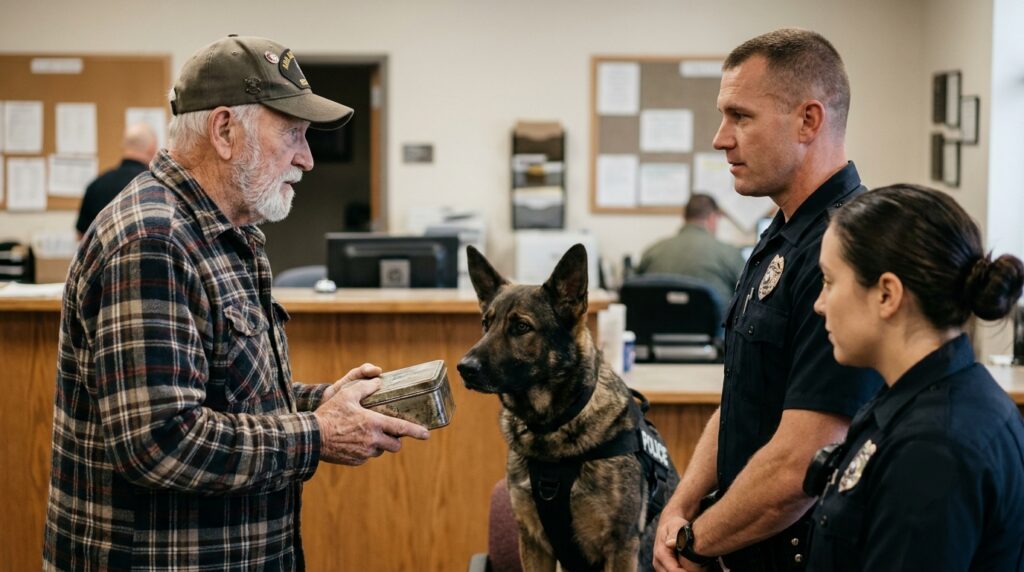
CHAPTER 4: THE PERMANENT ARRANGEMENT
The rear exit door clicked shut, the heavy pneumatic arm wheezing as it sealed the station’s recycled air inside. Outside, the gravel of the municipal yard was gray, wet, and desaturated under a sky the color of a bruised zinc plate.
Jesse didn’t wait for Sarah to finish filing the civilian non-compliance logs. He walked out into the cold air, his boots crunching heavily against the crushed limestone. Behind him, the old man moved with a fragile but unyielding persistence, his breathing heavy, his faded work shirt damp from the light mist hanging over the river boundary. Karl walked perfectly between them, the short lead slack, his thick head turned entirely toward the perimeter fence where Supervisor Vance’s vehicle was idling near the old equipment sheds.
“He’s going to burn it,” the old man said, his voice catching on the damp wind. “The ledger, the tag. Just like they buried the old tanks behind the foundry in ’84. If the soil maps get redrawn, the county loses the federal easement.”
“He won’t burn it,” Jesse said, though his hand rested on his service belt, his fingers tracing the cold leather casing of his flashlight. He knew Vance’s administrative logic; it wasn’t malice, it was the preservation of a system that couldn’t afford to look back. “He’s checking it into the secondary evidence locker by the old maintenance barn. That’s where the unverified files go to rot.”
They reached the rusted chain-link gate separating the precinct from the overgrown municipal flats. Twenty yards ahead, Vance was stepping out of his utility truck, the gray metal tin gripped in his gloved hand. He didn’t look back at them. He pushed open the creaking door of the corrugated iron shed—the original county kennel block, abandoned since the new digital facility was built on the south highway.
Suddenly, Karl stopped. The German shepherd didn’t bark, but a sharp, violent tremor ran through his entire frame. The animal’s nose lifted, catching a draft of air rolling off the river bank behind the sheds. It wasn’t the scent of an active human target; it was something buried deeper in the mud, a heavy, metallic tang that smelled exactly like the interior of the veteran’s keepsake tin.
“He knows it,” the old man whispered, his hand reaching out to steady himself against Jesse’s shoulder. His fingers were cold, stiff with arthritis, but his grip was surprisingly firm. “He isn’t tracking a scent, Jesse. He’s tracking an identity. The old dogs were trained on the industrial runoff because that’s what the draft evaders used to mask their boots in the marshes. Your father didn’t lose the line—he bred them to remember it.”
Vance froze in the doorway of the iron shed. The wind had shifted, throwing a thick plume of white steam from the municipal drainage pipe across the gravel. Karl broke. With a single, powerful surge that ripped the nylon lead directly out of Jesse’s hand, the dog sprinted toward the supervisor.
“Karl, abort!” Jesse shouted, his voice cracking against the iron buildings.
But the dog didn’t attack. He skidded to a halt three feet from Vance, his front paws digging into the wet river silt. He dropped his muzzle to the ground, his chest plowing into the weeds as he let out a long, mourning whine that echoed off the corrugated metal walls. He wasn’t acting as a weapon; he was acting as a witness.
Vance looked down at the dog, then up at Jesse and the elderly veteran who had managed to reach the edge of the enclosure. The supervisor’s hand remained inside his pocket, his fingers curled around the folded ledger sheet. The desaturated yellow light of the afternoon caught the rusted hinges of the iron shed behind him, revealing a row of old, hand-painted numbers on the concrete foundation—the remnants of the 1984 breeding pens.
“It doesn’t wash out,” Jesse said quietly, walking up to stand beside his partner. He reached down, his fingers burying into Karl’s wet fur, feeling the rapid, rhythmic thump of the animal’s heart. “You can delete the digital files, sir, and you can quarantine the physical tins. But the lineage carries the weight of what happened out here. My father knew it. That’s why he kept the tag.”
A long silence settled over the yard, broken only by the steady, low hum of the river water churning against the concrete pilings. Vance looked at the old man, whose thin shoulders were shaking under the damp plaid shirt, his eyes fixed on the metal box with a quiet, desperate reverence that no administrative protocol could ever codify.
Slowly, Vance withdrew his hand from his pocket. He didn’t hand the ledger back to Jesse. Instead, he dropped the zinc tin onto the hood of his utility truck, the metal giving a short, flat chime as it struck the steel.
“The asset stays on active rotation for the northern sector,” Vance said, his voice flat, drained of its bureaucratic edge. He turned back toward his vehicle, his boots scraping the gravel as he opened the driver-side door. “But he needs a certified civilian volunteer to maintain his tracking baseline near the flats. Someone who understands the historical markers. If the station log shows an unverified civilian on the floor again, I’ll pull the budget. Do you understand me, Deputy?”
“Clear, sir,” Jesse said.
The supervisor’s truck backed out of the yard, leaving a thin trail of blue exhaust that lingered in the damp air before dissolving into the mist. Jesse looked down at the old man, who had already crawled down onto the wet gravel beside the dog, his arms wrapped completely around Karl’s neck. The German shepherd pressed its heavy skull into the veteran’s shoulder, its eyes half-closed as it pulled in the familiar scent of whale oil, zinc, and a lifetime of quiet endurance that had finally found its way home.








