
CHAPTER 3: THE QUARANTINE ORDER
The brass latch clicked with the sharpness of a dry bone snapping.
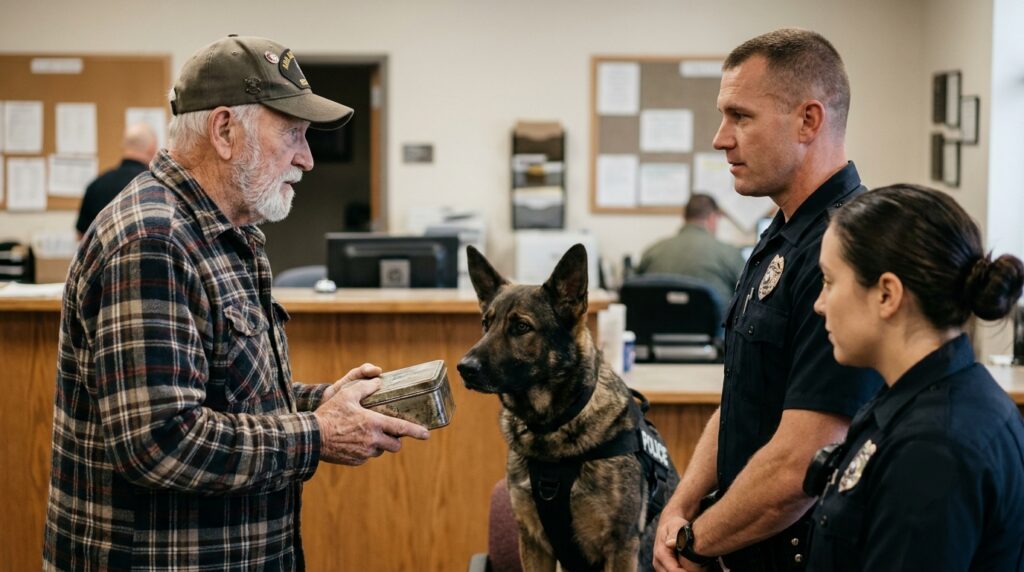
District Supervisor Vance stepped into the reception lobby, his heavy canvas field coat smelling of damp pine needles and vehicle exhaust. He didn’t drop his keys onto the counter. He held them tight in his fist, his gaze sweeping over the scene on the linoleum floor with a calculation that took less than a second to turn cold. His eyes slid from Jesse’s kneeling posture to the old man on the oaken chair, finally anchoring on Karl’s harness, which was still pressed firmly against the veteran’s plaid sleeve.
“Officer Vance,” Jesse said, rising slowly to his feet while keeping his hand flat over the yellowed ledger sheet. The movement was a shield, but it wasn’t fast enough.
“Why is the active tracking asset out of the secure lane, Deputy?” Vance’s voice didn’t rise, but it carried the flat weight of an administrative hammer. He walked past the high partition desk without offering a greeting, his boots leaving dark, wet half-moons of river mud on Sarah’s clean floor. “And who authorized a civilian contact during a scheduled maintenance block?”
“The gentleman brought in a historical programmatic artifact, sir,” Sarah said from behind the desk, her fingers tapping a rapid, nervous rhythm against her logbook. “We were verifying a chain of custody regarding the old county kennel records.”
“There are no historical artifacts in this precinct,” Vance said. He stopped two feet from the old man, looking down at the white beard, the faded auxiliary cap, and then at the weathered zinc tin sitting between Karl’s front paws. “There is state property, and there is unverified debris. Pick up the box, Jesse.”
Jesse didn’t move. His thumb remained pressed against the greasy paper, feeling the small ridges of his father’s wide, sweeping handwriting. “My father signed this ledger page, Supervisor. It outlines tracking refusals from the winter of 1984. He was logging anomalies in the old bloodlines near the flats.”
Vance’s face didn’t twitch, but his grip on the car keys tightened until the brass edges dug into his knuckles. He looked at the paper under Jesse’s thumb, his eyes narrowing just enough to expose the gray skin around his temples. “Your father was a fine sheriff, Jesse, but his late-career notes are not county policy. The ’84 line was retired due to behavioral degradation. It’s a closed administrative matter. The papers in that tin are unclassified personal waste.”
“It’s not waste,” the old man said softly. He didn’t rise from the chair, but his hand moved from Karl’s neck to the dog’s leather collar, his ancient knuckles gray against the dark hide. “Your father knew me, Vance. He knew what we pulled out of the river when the old zinc works went under. He knew why the dogs wouldn’t cross the marsh behind the municipal yard unless they were following a specific wash. You’re covering a dead line because the county doesn’t want the liability of a contaminated tracking grid.”
“Sarah,” Vance said, ignoring the old man entirely, his voice cutting through the damp air like a blade through tallow. “Log a civilian trespass and clear the lobby. Jesse, take the dog back to the transport kennel immediately. The asset is scheduled for an operational evaluation at the river boundary in ten minutes.”
“Sir, the dog is showing a profound physiological response to the artifact,” Jesse said, his voice dropping into a hardened register. He lifted the ledger sheet, holding it out between himself and the supervisor. “Look at the signal matches. If Karl is reacting to an old training footprint rather than a real scent path, every deployment we’ve done in the northern sector for the last six months is legally compromised. If a defense attorney gets hold of these refusal logs—”
“I said the matter is closed,” Vance interrupted, his hand moving with a sudden, violent efficiency to snatch the ledger sheet directly out of Jesse’s fingers. He didn’t crumple it. He folded it once, slide-tucking it into the deep breast pocket of his field coat before reaching down to scoop the zinc keepsake tin off the floor.
Karl let out a low, guttural rattle from the back of his throat—not a tactical bark, but a warning click that made the hair along his spine stand up in a rigid ridge.
“The dog is unstable,” Vance muttered, taking a step back as his boots clicked against the linoleum. “He’s identifying with non-standard stimuli. That box is being checked into evidence storage under an administrative quarantine order. Deputy, if that animal isn’t in the back of the cruiser before I finish filling out the non-compliance form, I’ll have the regional vet pull his field certification by sunset.”
The old man looked up at Jesse, his milky eyes reflecting the harsh yellow glare of the overhead lights. There was no anger in his face, only a heavy, ancient exhaustion that felt older than the building itself. “He’s going to take it to the yard, son,” the veteran whispered. “Just like they did with the others.”
Vance turned his back to them, his heavy canvas coat rustling as he walked toward the secure rear exit. The metal tin made a dull, hollow thud against his hip as he moved, a sound that made Karl’s head whip toward the door with an intense, unblinking focus.








