
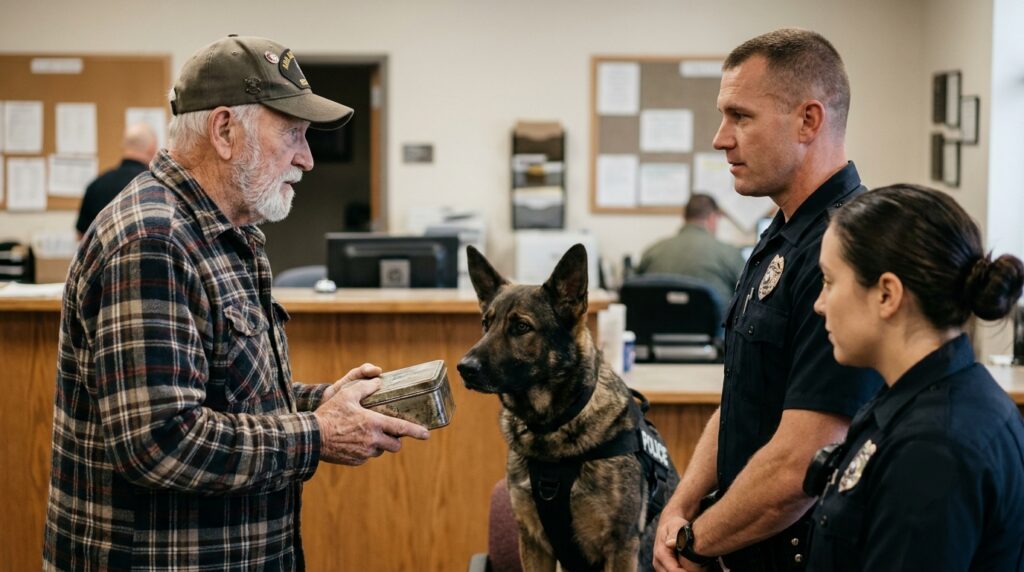
CHAPTER 2: THE ANOMALY LOG
The scrap of yellowed parchment drifted onto the gray linoleum, settling beside the zinc tin with a faint, brittle scrape.
Jesse did not breathe. His boots felt glued to the floorboards as he stared down at the handwriting. The loops of the letters were wide, aggressive, and instantly familiar—the exact shorthand his father had used on the margins of old training manuals stacked in their family garage. It was a signature that had been buried three years ago under six feet of damp creek-bed soil, yet here it was, resting against the paw of a county-owned asset that was currently defying every line of its tactical conditioning.
“Jesse,” Desk Officer Miller said again, her voice dropping into that low, dangerous register used when a domestic call turned sideways. She didn’t reach for her belt, but her hand stayed flat against the laminate counter, anchoring her. “The dog isn’t responding to the clicker. He’s fully anchored.”
The old man didn’t look up at them. His fingers were still buried in Karl’s thick ruff, his forehead pressed so tightly against the animal’s shoulder that the white hairs of his beard mingled with the dog’s black-and-tan coat. “He smells the grease,” the veteran murmured, his chest hitching against the dog’s ribs. “The whale oil and the zinc. We used it to seal the seals on the casing. Every time the pressure dropped in the hold, the grease would sweat. You don’t forget that smell. And neither do they.”
“Sir,” Jesse said, his throat dry as flannel. He knelt down, his uniform trousers tightening against his thighs as he reached for the paper. His fingers brushed the edge of the parchment—it felt thin, greasy to the touch, carrying the faint, sweet stench of rancid lard and old iron. “My father ran the K9 unit for twenty-five years before he retired. He didn’t work naval auxiliary. He was county sheriff. There’s no reason his name should be inside a private keepsake container.”
The old man let out a small, wet laugh that turned into a cough. He finally peeled his face away from Karl’s fur, though his left hand remained hooked into the dog’s harness, his thumb rhythmically smoothing down a frayed nylon seam near the buckle. “Your father didn’t build the program out of nothing, son. He took what was left of the border patrol tracking stock after the mid-seventies drawdown. He bought three barks from the federal surplus in Texas. He wanted dogs that could trail through swamp water without losing the line.”
Jesse turned the parchment over. The text on the reverse wasn’t an official document; it was a single leaf torn from a standard-issue ledger book, the blue lines faded to a ghostly gray. Written across the top in his father’s hand were three words: Subject Number Four. Below it, a list of dates spanning three months in the winter of 1984, each followed by a single metric note: Refusal. Refusal. Signal match only.
“Jesse,” Miller said, her voice closer now. She had moved around the counter, her eyes scanning the lobby glass to ensure no civilians were watching the precinct’s primary tracking dog lying on the floor like a family pet. “We have a transport arriving from the district court in twenty minutes. If the supervisor sees Karl out of his kennel with an unverified civilian, it’s an automatic infraction. For both of us.”
“Just give me a minute, Sarah,” Jesse said, his eyes scanning the ledger entries. The tracking logs didn’t make sense. His father’s reputation had been built on absolute procedural perfection; the dogs he trained were machines that followed skin rafts and crushed grass until the target was caught. But these entries described a dog that kept breaking the line, stopping at specific, unmarked coordinates in the pine woods to circle old foundations.
He looked at Karl. The German shepherd’s eyes were wide, dark, and focused entirely on the tin. A small bead of saliva hung from its jowl, dripping onto the zinc surface. The animal wasn’t acting aggressive; it was acting reverent, its entire body vibrating with a quiet, sub-vocal hum that Jesse had never heard in all their hours of active deployment.
“My father didn’t keep duplicates of these logs,” Jesse muttered, his thumb tracing the frayed edge of the paper. “The department records from ’84 were supposedly lost in the municipal yard fire.”
“They weren’t lost,” the old man said, his voice stabilizing as he gripped the edge of a heavy oak desk to pull his lean frame back into a seated position on the floor. His eyes were milky at the edges, filmed with cataracts, but they held Jesse’s gaze with an unsettling weight. “They were quarantined. Your father knew what happened to the handlers who used the old scent markers. He knew why the stock kept coming back to the same three miles of riverbank near the old zinc plant. He didn’t destroy the records, officer. He hid them because if the state found out the whole tracking line was compromised by an old industrial footprint, they’d have put the whole breed down.”
Before Jesse could reply, the heavy glass door at the front of the station rattled, the brass latch clicking open with a sharp, mechanical snap that made Karl’s ears instantly pop back into an alert vertical line.








