
CHAPTER 1: THE WEIGHT OF THE HINGE
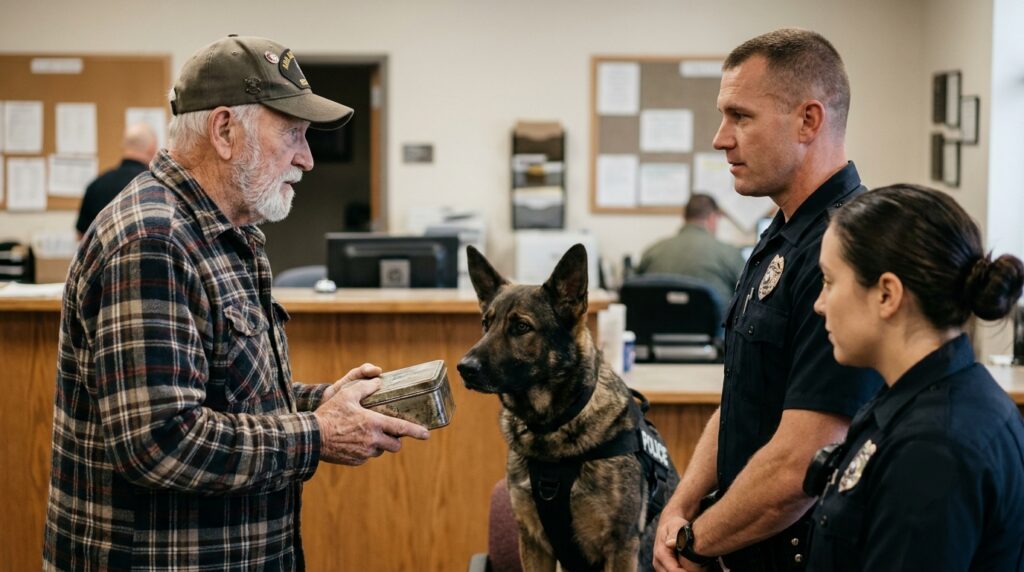
“I never thought I’d see something like this again,” the old man said, his voice scraping against the quiet of the linoleum floor like dry leaves.
The metal keepsake tin sat in his palms, its zinc edges grayed and dulled by decades of skin oil. It wasn’t large—no bigger than an old tobacco box—but his hands shook hard enough under its weight that the small hinges rattled.
Behind the high laminate counter of the reception desk, the young officer didn’t move toward his holster, but his shoulders went tight. He looked at the veteran’s cap, the faded embroidery of an auxiliary unit long since deactivated, and then down at the German shepherd sitting at his heel. The dog’s ears had gone entirely flat against its skull, its nostrils flaring as it pulled in the air coming off the opened box.
“Sir,” the lead officer said, taking a single half-step backward into the command lane. “You can’t just open unvetted containers in the lobby. We have a protocol for property drop-offs.”
“It’s not property,” the old man whispered. He didn’t look up. He didn’t look at the institutional blue walls, or the missing-persons flyers pinned to the corkboard, or the second deputy watching from the secure door. His eyes stayed on the dog. “It’s a signature.”
The German shepherd didn’t whine. It gave a short, rhythmic huff, its heavy leather harness creaking as it leaned its weight away from the officer’s leg. The handler pulled back slightly on the short lead, but the animal’s chest plowed forward, its front paws sliding an inch across the polished floor toward the old man’s work boots.
Then, the old man went down. It wasn’t a fall, but a slow, creaking collapse of his knees, his plaid shirt bunching around his belt as he lowered his torso to the level of the dog’s muzzle. The tin remained held out like an offering, the small square of metal bridging the space between them.
“Karl,” the officer commanded, his voice dropping into a sharp, low register. “Stay.”
The dog ignored him. The German shepherd pressed its thick, black-and-tan snout directly into the center of the old man’s chest, pushing past the metal box until its forehead rested beneath the veteran’s white beard. The old man’s arms closed around the dog’s neck, his fingers burying deep into the coarse winter coat. A wet, shuddering breath tore out of the old man’s throat, leaving a smear of dampness on the dog’s tactical harness.
The desk officer stepped out from behind the glass partition, her boots making no sound on the floor. She looked at the lead officer, her face settling into a hard, protective stillness that didn’t match the sudden twitch in her jaw. “Jesse,” she murmured. “Look at the dog’s tail.”
The animal wasn’t wagging. It was trembling, its rear legs locked in a rigid stance as if bracing the old man’s entire weight against the floorboards.
The lead officer looked down at the tin that had slipped from the veteran’s fingers. It lay open on the floor, its interior dark save for a single scrap of green webbing and a small, hand-stamped brass collar tag bearing a serial number that predated the county’s digital registry by forty years. But beneath the brass tag, wedged into the rusted corner of the box, was a folded piece of yellowed parchment with the lead officer’s own late father’s signature dried into the ink.








