Chapter 7: The Evidence Nobody Expected
By late afternoon, the weather had worsened.
A fine rain drifted across the terminal, darkening the asphalt and blurring the distant shoreline.
The next ferry was preparing to receive vehicles.
Passengers returned to their cars.
Rachel moved along the waiting lanes, answering questions and helping drivers understand the boarding sequence.
For the first time in nearly an hour, the terminal began to feel orderly again.
Patricia remained near the designated waiting area.
She had stopped shouting, but she continued watching Daniel.
Every time he moved toward the barricade, her eyes followed him.
Laura received confirmation that terminal security cameras had captured the earlier interference.
The cameras covered the boarding lanes and adjacent equipment areas.
Their purpose was operational safety, not public entertainment.
But the recordings could be reviewed when an incident required investigation.
Laura made sure the relevant footage would be preserved.
Michael’s dashboard recording provided another perspective.
Together, the two recordings showed a clear sequence.
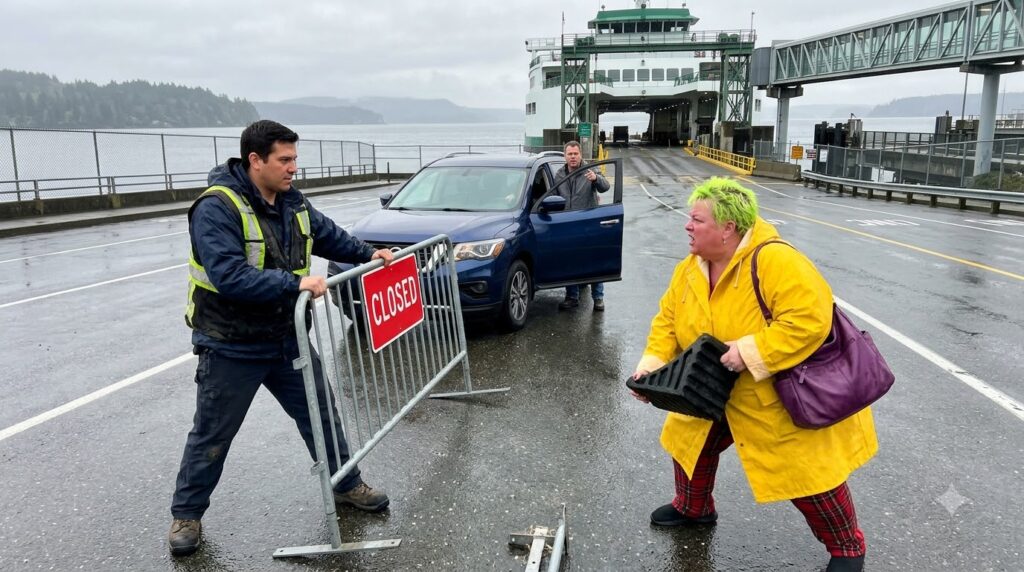
Patricia had deliberately placed the rubber chock beneath the barricade.
Daniel had attempted to restore the closure.
Patricia had physically resisted.
She had directed Michael to drive forward.
Michael had refused.
Daniel had removed the obstruction and secured the lane.
The recordings also showed that the ferry ramp had remained closed throughout.
No vehicle had approached the ramp during the confrontation.
That mattered.
The employees had prevented the situation from becoming more dangerous.
Laura completed her initial report.
She did not describe Patricia as evil or irrational.
She documented observable actions.
That was how her supervisors had trained her to handle incidents involving disruptive passengers.
Accurate records were more valuable than emotional descriptions.
Meanwhile, Margaret Ellis had begun reviewing the Harbor View Residents Alliance’s finances and correspondence.
She found no evidence that Patricia had been authorized to collect money for transportation privileges.
But she did discover that Patricia had distributed a flyer encouraging residents to contribute to a proposed ferry advocacy fund.
The flyer used the association’s name and logo.
Margaret had never approved it.
She contacted Patricia by phone.
Patricia answered while sitting in her car at the terminal.
The conversation was brief and unpleasant.
Margaret asked her to stop representing herself as an official transportation director.
Patricia insisted that she had created the position because nobody else was willing to fight for residents.
Margaret explained that organizational titles required board approval.
Patricia accused the board of being weak.
Then she ended the call.
Margaret sat at her kitchen table, staring at the disconnected phone.
She had known Patricia for several years.
Patricia could be energetic and persuasive when she cared about an issue.
She had helped organize neighborhood cleanup days and once spent an entire weekend arranging donated supplies after a winter storm.
Margaret did not deny those contributions.
But somewhere along the way, Patricia had begun treating volunteer involvement as personal authority.
And now that attitude had created consequences for people far beyond their neighborhood.
Margaret called an emergency board meeting for the following evening.
At the terminal, Laura approached Patricia with an update.
Because of the earlier interference, Patricia would not be permitted to enter the active loading area until staff determined it was safe for her to proceed and she agreed to follow all instructions.
She could remain in the public waiting area.
She could request assistance.
She could submit a complaint.
But she could not interfere with boarding equipment or direct vehicles.
Patricia demanded a refund and immediate passage.
Laura explained the available customer-service options and made no promises about special treatment.
Then Patricia asked a question that revealed how little she understood the situation.
“Do you know how many people are watching my video?”
Laura looked at her.
She knew the number of online viewers had nothing to do with the safety of a ferry ramp.
She answered calmly.
“The people I’m responsible for are the ones standing here.”
Patricia had no response.
For the first time that afternoon, she lowered her phone.