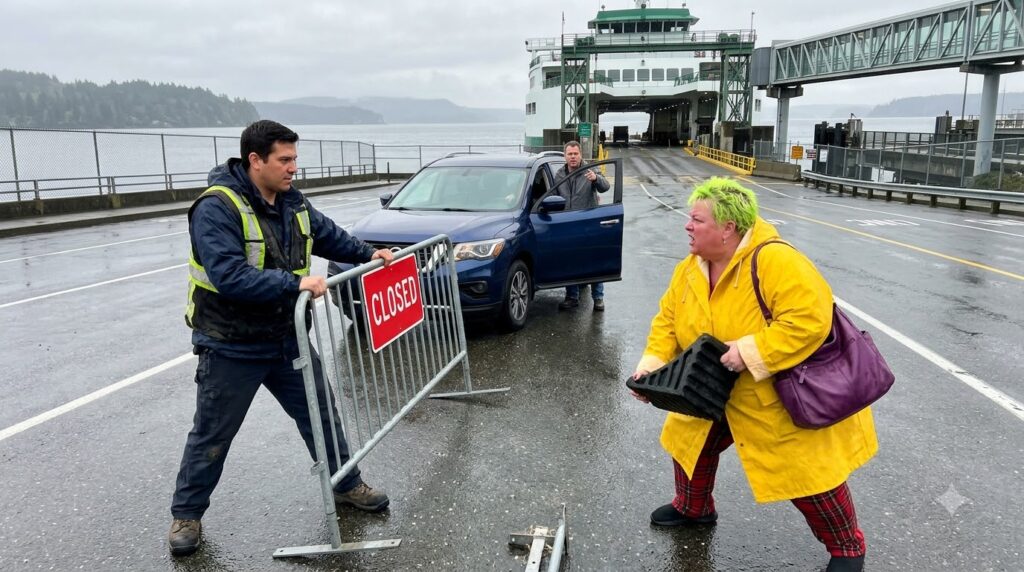
Chapter 4: A Title She Gave Herself
Laura asked Patricia whether she had contacted the terminal office earlier that day.
Patricia hesitated.
It was the first time anyone had seen her search for an answer.
Then she admitted that she had called.
She said she was organizing transportation for local residents and needed assurance that their vehicles would not be delayed.
Laura asked whether the group had an approved reservation or special transportation arrangement.
Patricia said no.
She argued that residents should not need special permission to receive fair treatment.
Laura agreed with the principle of fair treatment.
But fairness did not mean granting one passenger authority over everyone else.
It meant applying the same rules to all passengers.
That distinction seemed entirely lost on Patricia.
Michael returned to his SUV and leaned against the closed driver’s door.
He no longer wanted to participate in the argument.
He wanted the terminal staff to finish their work so the waiting vehicles could be organized for the next sailing.
Instead, the entire lane remained disrupted.
A second terminal employee, twenty-nine-year-old Rachel Foster, arrived to assist Laura.
Rachel carried a handheld operations tablet and had been reviewing the day’s passenger inquiries.
She quietly showed Laura the earlier call records.
The calls had been unusually persistent.
The person claiming to represent Harbor View Residents Alliance had asked for a private loading arrangement, requested the names of terminal supervisors, and warned that the organization would file complaints if its demands were ignored.
There was nothing inherently wrong with filing complaints.
Public transportation agencies were accountable to the people they served.
But Rachel had noticed something strange.
The caller had repeatedly referred to herself as the organization’s transportation director.
A quick review of the group’s public contact information showed no such position.
Laura asked Patricia to clarify her role.
Patricia held up the laminated badge again.
She insisted that she was responsible for transportation advocacy.
Laura asked whether the organization had formally appointed her.
Patricia became defensive.
She said she had founded the transportation committee herself.
That answer raised another question.
Had anyone else joined the committee?
Patricia did not respond directly.
She began talking about years of ignored complaints, rising fares, and the difficulty of traveling between island communities.
Some of her concerns were legitimate.
Ferry delays could affect work schedules, medical appointments, family obligations, and small businesses.
But legitimate frustration did not justify obstructing a safety barricade.
Laura explained that the terminal would document the incident and that Patricia could submit her concerns through established public channels.
Patricia demanded that the documentation describe her actions as a peaceful protest.
Daniel glanced at the barricade.
The metal frame bore a fresh scrape where the wheel chock had been forced against its foot.
The incident had involved more than peaceful speech.
It had involved deliberate interference with terminal equipment.
Meanwhile, Evelyn had called her daughter, Susan.
Susan was fifty-two and worked as a school administrator on Whidbey Island.
She listened as her mother described the delay.
When Evelyn mentioned Harbor View Residents Alliance, Susan interrupted.
She knew the organization.
In fact, she had attended one of its meetings the previous spring.
The group was a small neighborhood association that occasionally discussed transportation issues, but it had no official role in ferry operations.
Susan remembered Patricia.
She remembered her very well.
At the meeting, Patricia had proposed creating a special committee to negotiate priority access for residents who frequently used the ferry.
The proposal had received little support.
Several members had objected that it would be unfair to other travelers.
According to Susan, the committee had never been approved.
Evelyn looked toward Patricia, who was still arguing with Laura.
Something about the pink clipboard now seemed less impressive.
Evelyn did not want to become involved in neighborhood politics.
But she also disliked seeing ordinary workers intimidated by claims of authority that might not exist.
She told Susan what had happened.
Susan promised to contact the association’s current president and ask whether Patricia was authorized to represent the group.
Evelyn ended the call.
She had no idea that her daughter’s simple question would uncover a dispute extending far beyond the ferry terminal.