Chapter 10: The People Who Finally Got Home
Three weeks after the ferry incident, Michael drove along the familiar road toward his mother’s house.
The afternoon was clear.
Sunlight broke through the clouds, illuminating the trees and the quiet water beyond the shoreline.
He parked beside Helen’s porch and carried two grocery bags to the front door.
His mother was waiting.
She opened the door before he reached the steps.
Michael smiled and reminded her that she was supposed to let him carry the heavy things.
Helen laughed.
She had heard that warning from him for years.
Inside, the house smelled of fresh coffee and cinnamon.
A framed photograph of Michael’s father stood on the mantel.
The old man had been gone for six years, but his influence remained in countless small habits.
Michael still checked tire pressure before long trips.
He still kept an emergency blanket in his vehicle.
And he still believed that the people responsible for public safety deserved respect.
The ferry incident had become a local topic of conversation.
Michael’s dashboard recording had been provided to the terminal as evidence. He had not posted it publicly.
The transportation agency had reviewed the incident and confirmed that staff had followed the applicable loading and safety procedures.
Patricia had received formal notice concerning her conduct and restrictions on future terminal access unless she complied with operating rules.
The matter had also been referred for review by the appropriate authorities.
Michael did not know whether further legal action would result.
He did not need to.
The immediate issue had been resolved.
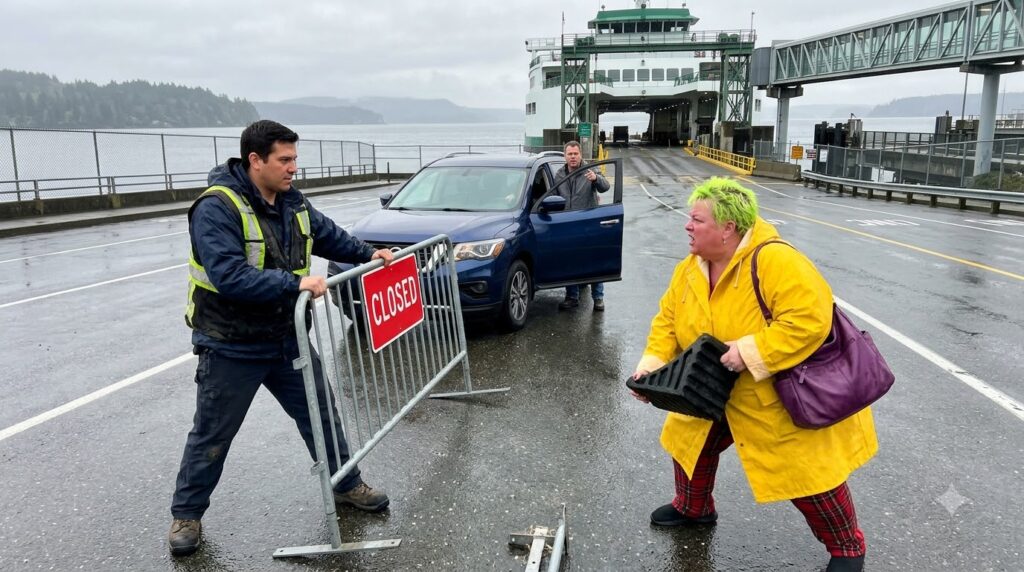
The barricade had remained closed.
The ferry had departed safely.
And the staff had been supported for following procedure.
Patricia’s original online video had also lost much of its influence.
After the association clarified her role and other witnesses described the missing context, viewers began questioning her account.
Patricia eventually removed the video.
She did not publish a public apology.
But she stopped claiming to be the association’s transportation director.
Margaret later confirmed that Patricia had provided additional receipts and returned the remaining unspent contributions to the residents who had made them.
The association closed its internal review after documenting the accounting and corrective actions.
For the neighborhood, that was enough.
There was no need to turn a dispute into a lifelong feud.
The community had established boundaries and moved forward.
At the ferry terminal, Daniel continued working.
Most passengers never knew his name.
They saw his reflective vest, his hand signals, and the way he directed cars toward the loading ramp.
They did not see the training behind those gestures or the responsibility that came with them.
One afternoon, Laura told him that several passengers had submitted positive comments about his handling of the confrontation.
Daniel seemed embarrassed by the attention.
He said he had only done what the job required.
Laura disagreed slightly.
Doing the right thing under pressure was precisely what made the job difficult.
Meanwhile, Evelyn joined the new neighborhood transportation advisory committee as an occasional volunteer.
She did not want a leadership position.
She wanted practical improvements.
The committee began gathering information about confusing terminal announcements, accessibility concerns, and ways to help passengers better understand delays.
Its first public letter did not demand special treatment.
It asked for clearer communication.
The response from transportation officials was constructive.
Staff agreed to review several suggestions and explain the process for submitting future concerns.
It was not a dramatic victory.
There were no viral videos.
Nobody waved a clipboard at a barricade.
But progress was being made.
Andrea and Lucas continued their regular medical trips.
On one later crossing, Lucas stood beside his mother in the passenger cabin and watched the shoreline disappear behind them.
He asked why the ferry sometimes had to wait.
Andrea explained that large boats carried many people and that everyone had to follow the rules to stay safe.
Lucas considered that for a moment.
Then he asked whether the people directing the cars were like crossing guards at school.
Andrea smiled.
She told him that was a pretty good way to think about it.
Back at Helen’s house, Michael finished repairing the loose handrail.
He tested it twice before putting away his tools.
Helen stood in the doorway, watching him.
She asked whether he still thought about the woman at the ferry terminal.
Michael admitted that he did, occasionally.
Not because he was angry anymore.
He had moved past that.
What stayed with him was the sight of the barricade and the worker standing beside it.
One man had been responsible for keeping a lane closed.
One woman had decided her personal wishes mattered more than everyone else’s safety.
And dozens of ordinary people had been caught between them.
Helen listened quietly.
Then she reminded him of something his father used to say.
Respect wasn’t measured by how much power a person could claim.
It was measured by how that person treated others when things didn’t go their way.
Michael looked toward the repaired handrail.
His father would have approved of that lesson.
Outside, the evening light settled across the yard.
The ferry would continue crossing the water, carrying workers, families, retirees, and travelers whose stories rarely made headlines.
There would be delays.
There would be disappointments.
And there would always be people who believed their urgency should outweigh everyone else’s needs.
But there would also be people like Daniel, Laura, Evelyn, Andrea, and Michael.
People willing to wait.
People willing to speak up.
People who understood that fairness was not the same as getting whatever they wanted.
At the terminal, the red CLOSED sign had never been a personal insult.
It had been a boundary.
And sometimes, the most important act of respect is recognizing a boundary even when it stands between you and the place you desperately want to go.
The End.