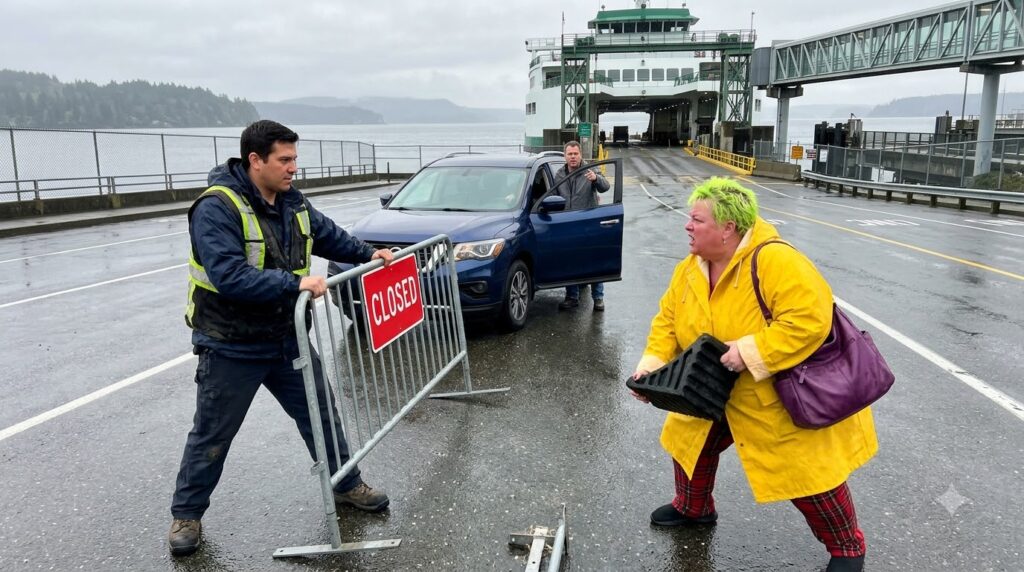
Chapter 5: The Passenger Who Had Everything to Lose
While Laura documented the incident, Michael sat inside his SUV and checked the time.
He had a reason for wanting to get home that went beyond ordinary inconvenience.
His mother, Helen Bennett, was eighty-one.
She lived alone in a modest house overlooking a quiet stretch of shoreline near Coupeville.
Three months earlier, she had undergone surgery after a fall. Her recovery was progressing, but she still needed help with groceries, medication, and household chores.
Michael visited every Wednesday.
That afternoon, he was bringing supplies and planning to repair a loose handrail on her back steps.
He had promised to arrive before dinner.
Now he would be late.
He called his mother.
Helen answered after several rings.
She sounded cheerful, as she usually did when she heard his voice.
Michael explained that he had missed the ferry.
He left out most of the confrontation.
There was no reason to worry her.
Helen told him not to hurry and reminded him that a late arrival was better than an unsafe trip.
Michael smiled.
His mother had always been practical.
After the call, he looked through the windshield.
Patricia was still standing near the barricade, gesturing toward the ferry.
He wondered what kind of person could turn a shared inconvenience into a personal battle for control.
Then he noticed something he had missed earlier.
A small silver sedan sat several vehicles behind him.
Inside was a woman holding a sleeping child against her shoulder.
The child appeared to be about six.
The woman looked exhausted.
Michael later learned that her name was Andrea Morales.
She was thirty-four and had spent the morning at a pediatric appointment in Seattle with her son, Lucas.
Lucas had a chronic respiratory condition requiring regular specialist visits.
The appointment had gone well, but the trip had been long.
Andrea had hoped to catch the earlier ferry and get Lucas home before his evening medication.
Now she faced another delay.
When Patricia first began arguing, Andrea had assumed it was a minor disagreement.
But as the confrontation continued, she grew worried that the disturbance might interfere with preparations for the next sailing.
She did not want special treatment.
She simply wanted the terminal to function.
Rachel approached the waiting vehicles to explain that staff were reorganizing the lanes.
She assured passengers that the next sailing would be handled according to normal procedures.
Andrea asked whether she could step out briefly to stretch her legs while Lucas slept.
Rachel directed her toward a safe pedestrian area.
Michael overheard the conversation.
He watched Andrea carefully lift Lucas from the car seat, supporting his head against her shoulder.
The boy stirred and coughed.
Andrea rubbed his back.
It was a small, ordinary gesture, but it reminded Michael how many different lives were gathered in those lanes.
Some people were commuting.
Some were traveling to appointments.
Some were returning from work.
Others were going home to people who depended on them.
Every delay affected someone.
And every safety decision protected more people than the loudest passenger could see.
Michael stepped out again, this time remaining beside his SUV.
He approached Andrea only after she had settled Lucas on a nearby bench.
He asked whether she needed help carrying anything.
She thanked him but declined.
They spoke briefly about the ferry schedule.
Andrea said she had been using the route for years and understood that delays happened.
What troubled her was watching someone interfere with the employees trying to manage them.
Michael agreed.
A few minutes later, Laura approached Patricia with a formal instruction.
The incident had been documented.
Patricia was required to remain clear of the boarding equipment and follow staff directions.
If she continued interfering, terminal personnel would request assistance from law enforcement.
Patricia laughed dismissively.
She said the police would support her because she was defending public access.
Laura did not argue.
She simply repeated the instruction.
Patricia took several steps backward.
Then she pulled out her phone.
She began recording Daniel, Laura, and the barricade.
Recording from an authorized public area was not itself the problem.
But Patricia accompanied the video with accusations that the terminal staff were illegally detaining passengers and refusing to allow elderly residents to travel.
She turned the camera toward Michael.
He immediately asked her not to film his vehicle’s license plate while making accusations about him.
Patricia ignored the request.
Then she pointed the phone toward Andrea and Lucas.
Andrea turned away, shielding her son’s face.
That was the moment Michael’s patience finally broke.
Not because Patricia was angry.
Not because she had delayed him.
But because she had begun dragging a tired mother and her sick child into a dispute they had never chosen.