Chapter 2: The Woman With the Clipboard
Patricia produced a laminated document from her handbag and held it above her head.
It was attached to a bright pink clipboard.
Across the top, in oversized letters, were the words:
COMMUNITY TRANSPORTATION ACCESS COORDINATOR
Below the title was a small photograph of Patricia and the name of a neighborhood organization called Harbor View Residents Alliance.
Daniel examined the document without touching it.
He had never heard of the organization.
Neither had Michael.
Patricia announced that she represented more than two hundred local residents who depended on the ferry system. According to her, the terminal had no right to close boarding while paying customers remained in line.
Her words sounded official.
The document looked official.
But something about the entire performance made Michael uneasy.
He had spent twenty-two years working as a maintenance supervisor for a regional utility company. He understood the difference between public complaints and operational authority.
A laminated badge from a neighborhood group did not give someone control over a ferry loading ramp.
Daniel understood that too.
He explained that the loading decision belonged to the vessel crew and terminal operations staff. Once boarding closed, reopening the lane required proper authorization and a new safety assessment.
Patricia dismissed his explanation.
She insisted that she had attended transportation meetings, written letters to state officials, and personally confronted managers at other terminals.
Those experiences, she claimed, gave her the right to intervene.
Then she made a demand that surprised everyone.
She wanted Daniel to record her name in the terminal log as the person responsible for reopening boarding.
Not merely as a complainant.
As the person who had corrected what she called an improper closure.
Michael stared at her.
She wasn’t simply trying to catch the ferry.
She wanted official recognition for forcing the lane open.
A few cars farther back, seventy-one-year-old Evelyn Carter lowered her window.
Evelyn had lived on Whidbey Island for nearly four decades. Her late husband had worked in marine transportation, and she knew that loading procedures existed for reasons passengers rarely saw.
She was traveling home after a medical appointment in Seattle.
Her knees ached, and the long drive had exhausted her. Missing the ferry would mean another wait, but she had no desire to see anyone pressure a worker into an unsafe decision.
Evelyn watched Patricia wave the clipboard toward Daniel’s face.
She recognized the behavior immediately.
For years, she had served as secretary of her neighborhood association. She had encountered people who mistook being the loudest person in a meeting for being the person in charge.
Patricia seemed to belong to that category.
A white terminal operations pickup approached along the service lane.
It stopped well away from the barricade.
A woman in a dark waterproof jacket stepped out.
Her name was Laura Chen, and she was the afternoon terminal supervisor.
At forty-nine, Laura had spent most of her career working around commercial transportation operations. She had handled delayed sailings, mechanical problems, difficult passengers, and emergency medical situations.
She approached without rushing.
Daniel gave her a brief account of what had happened.
Patricia interrupted repeatedly, insisting that the employee had deliberately prevented paying passengers from boarding.
Laura listened until both had finished.
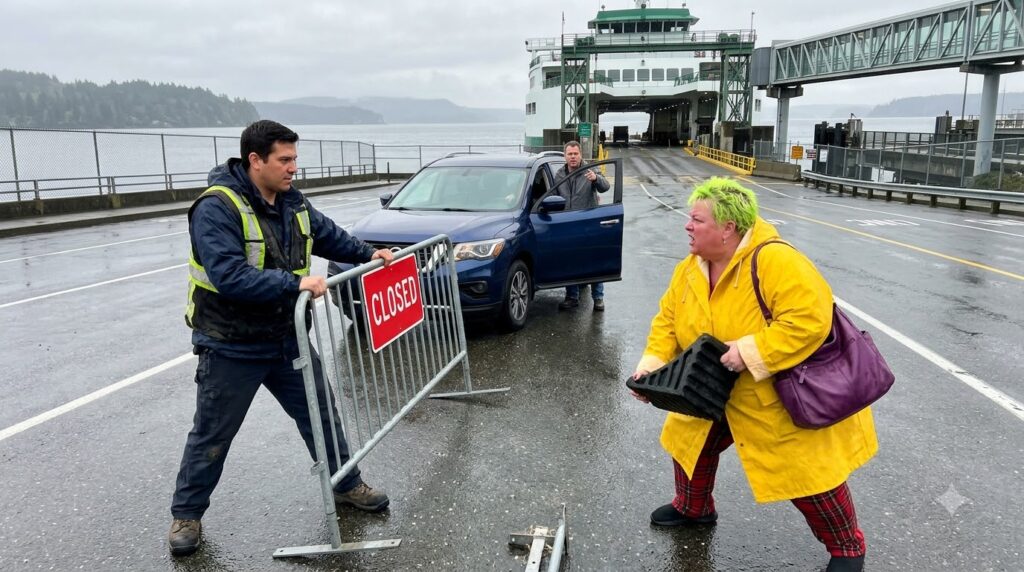
Then she examined the barricade and the wheel chock in Patricia’s hand.
Her expression changed.
The rubber wedge was not a passenger’s personal property. It belonged to the terminal and had been placed beside the barricade for authorized equipment use.
Laura asked Patricia to return it.
Patricia refused.
She demanded Laura’s full name and employee identification number.
Laura provided her name and explained that passenger complaints could be submitted through the proper channels.
Then she made the situation clear.
The ferry had completed its loading process. The vehicle deck was full, the ramp was closed, and no additional vehicles would board that sailing.
Patricia’s clipboard did not change any of those facts.
Michael expected the confrontation to end there.
Instead, Patricia pointed toward the ferry and accused the terminal staff of deliberately leaving available vehicle space unused.
Laura asked what evidence she had.
Patricia claimed she had seen an empty section of deck through the ferry’s side opening.
Laura looked toward the vessel.
Then she turned back.
There was something Patricia didn’t know about the ferry’s loading plan.
And it was important enough that Laura decided to explain it in front of everyone.