
CHAPTER 4: THE DELAYED HANDOFF
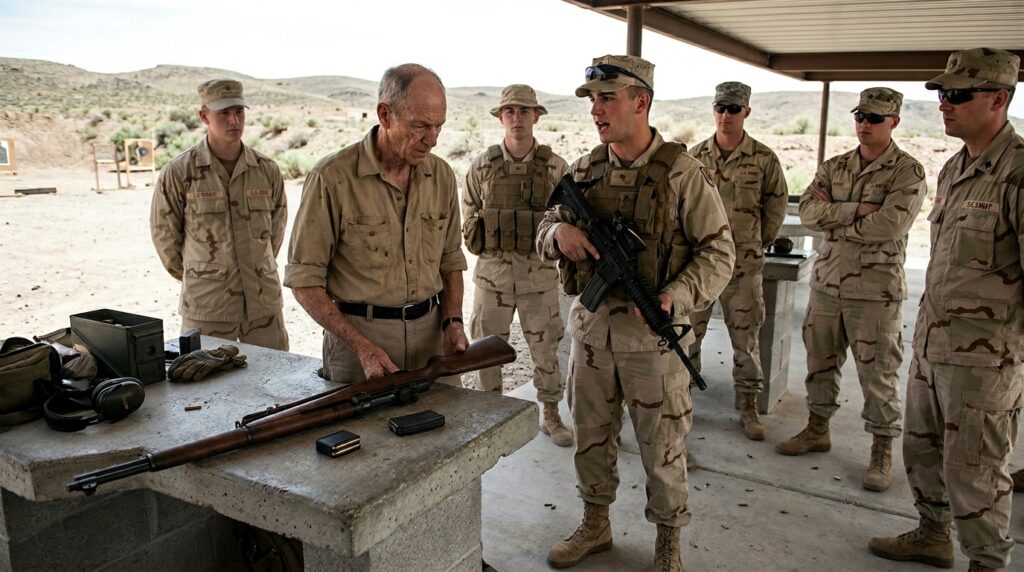
The heat coming off the concrete shooting bench felt like an iron weight pressing against the space between them. Specialist Miller didn’t look back down the scope. His eyes remained fixed on the tarnished silver disc resting in Thomas’s palm, his breathing flattening until the tactical vest across his chest stopped its rhythmic squeaking entirely. The silver chain dangled down, its links darkened by decades of sweat and oil, swinging with a micro-movement that seemed to match the low, steady vibration of the desert wind.
“Where did you get that?” Miller’s voice lost its modern, sharp edge. It was thin, bare, stripped of the institutional veneer he had worn like armor since the morning began.
“Your grandfather didn’t drop it,” Thomas said softly, his fingers shifting to turn the case over. The worn metal gave off a faint, dull reflection of the noon sun. “He gave it to me when the third line broke. He told me the main springs were broken anyway, but the glass was still clear enough to see the face. He wanted someone to carry it out who had a chance of seeing the valley again.”
The surrounding soldiers in the lane didn’t move. The silence stretched out, fragile and heavy, breaking only when Thomas reached out and placed the silver watch directly onto the green canvas mat, right next to the empty brass cartridge casing that was still ticking as it cooled.
Miller looked at the watch, then down at the crossed rifles tattooed into his own flesh. The ink on his arm was dark, sharp, and new—a tribute to a man he had only known through framed photographs and stories told in quiet living rooms. To see the actual silver, scratched and dented by the frozen gravel of a ridge line he’d only read about in tactical manuals, seemed to dissolve the distance between the pristine range and the old world.
“He told us he lost it in the withdrawal,” Miller muttered, his fingers twitching toward the chain but hesitating, as if touching it would validate the reality of the failure the records had tried to hide. “He always said he left everything behind in the mud except his boots.”
“He left his boots too,” Thomas replied, his voice dropping into a gentle, unhurried rhythm. He reached down and smoothed the frayed canvas strap of the M1 Garand, his thumb lingering over a small patch where the fabric had been stitched back together with heavy fishing line. “But he gave me this because he knew my memory would hold onto the serial numbers long after the logistics offices cleared the ledger. He didn’t want you growing up thinking he ran.”
The young specialist slowly lowered his hands to his sides, his rigid, athletic posture collapsing into something softer, older. The small gallery of witnesses behind them began to stir, their eyes dropping to the concrete floor as the true weight of the confrontation settled into the lane. It wasn’t a challenge about marksmanship anymore; it was an inheritance.
Thomas smoothly picked up the rifle from the bench. He didn’t offer a dramatic farewell or wait for range control to log the weapon’s non-standard receiver. He moved with the quiet, practiced economy of a man who spent his life carrying things that didn’t belong in inventories. The heavy timber settled against his side, the iron buttplate clicking softly against his belt buckle.
“The sight doesn’t need glass, son,” Thomas said, looking back at Miller one last time. “It just needs you to remember the drift.”
He turned and walked down the shaded concrete lane, his boots kicking up small puffs of dry desert dust as he moved toward the sun-baked parking lot where his old civilian truck was waiting. The young soldiers parted for him without a word, their caps tipping slightly in the glare, their modern rifles held loosely against their chests like toys that hadn’t yet been paid for.
Miller remained at the bench, his hand finally closing around the tarnished silver casing of the watch. The metal was still warm from Thomas’s pocket, retaining the heat of a body that had survived the frost. Behind him, the targets at three hundred yards remained still in the shimmer, the black circles untouched by lead but completely altered by the truth that had just cleared the line.








