
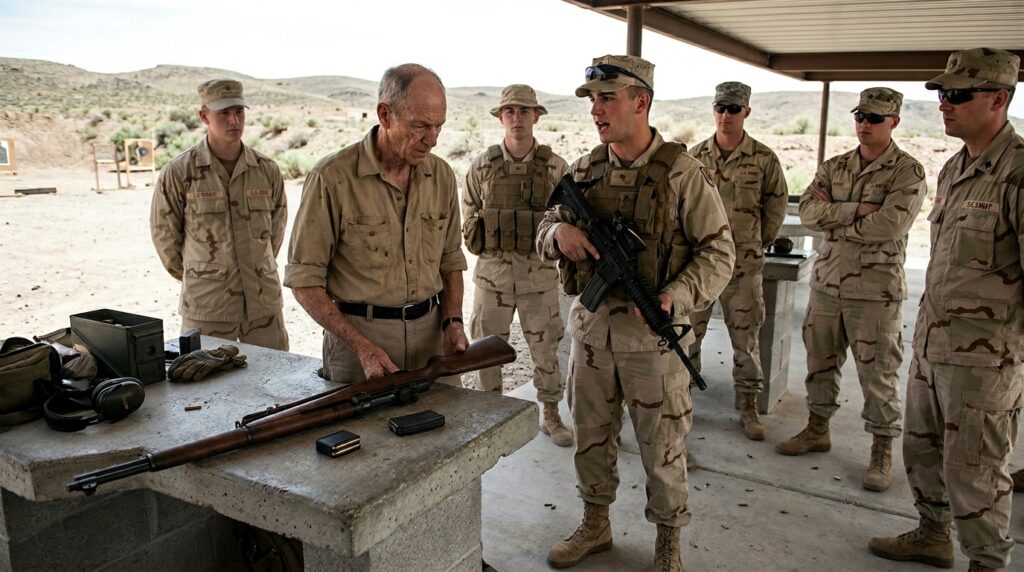
CHAPTER 1: THE GRAIN OF THE WALNUT
“Show us what that old rifle can still do, sir.”
The words didn’t bounce off the concrete overhead shield; they sort of died in the heavy, grease-thick air of Lane Four. Specialist Miller didn’t lower his M4. He kept it slung across his crisp, digital-pattern chest like a badge of ownership. His boots were clean. The polymer on his weapon didn’t have a single scratch to show for three tours of base security.
Thomas didn’t look up immediately. He kept his thumbs pressed against the walnut stock of the M1 Garand, feeling the microscopic ridges where some long-dead armorer had scraped the wood smooth sixty years ago. The heat off the tarmac was rising, making the targets at three hundred yards look like small, black beetles drowning in oil.
“I carried one like this long before you learned to stand,” Thomas said. His voice wasn’t loud. It had the dry, raspy scrape of sand moving across a porch.
A couple of the guys behind Miller shifted their weight, their nylon gear squeaking like a nest of mice. Someone cleared their throat. The casual, noon-hour smugness that had hung over the firing line since the old civilian truck pulled up was beginning to sour.
Thomas unhurriedly reached down. His knuckles were large, distorted by time, resembling the knots in the oak trees outside his kitchen window. He unlatched the internal clip mechanism. The metal didn’t click; it slid with a heavy, oiled thud that sounded entirely different from the light, tinny snap of the aluminum magazines the boys were swapping at the cleaning benches. He laid his modern, black-bodied magazine down on the green canvas mat.
Miller took half a step back. His chin went up, just an inch, his eyes narrowing as he tried to find the joke again. “Sights are probably drifted, old-timer. The wind out past the berm is pulling five knots from the east. You want me to get you a spotter with some glass?”
“I have eyes,” Thomas murmured.
He lifted the nine-pound rifle. To the young men watching, the movement should have looked clumsy—the man was thin enough that the desert wind seemed to blow through his tan work shirt—but the rifle didn’t shake. The iron buttplate settled into the hollow of his shoulder with the familiar, magnetic thud of a key turning in a lock he’d owned for fifty years.
The world narrowed to the small, dark circle of the rear aperture.
The front sight blade came up, cutting through the heat shimmer. Thomas didn’t squeeze. He didn’t look at Miller. He smelled the old Cosmoline grease cooking out of the handguards under the noon sun, a smell that instantly dissolved the concrete lane and the clean uniforms behind him, replacing them with the memory of frozen mud and the wet wool of trousers that hadn’t been dry for three months.
His finger found the wide, cold curve of the trigger. His left hand, liver-spotted and scarred near the thumb, clamped onto the forearm. The slight tremor that had plagued him while driving the truck out here disappeared. His heart slowed, dropping into the gap between breaths.
Then he noticed the small notch carved into the steel of the receiver right below the bolt—a mark that shouldn’t have been on an ordinary state-issued rifle. It was three small, hand-filed lines.
Thomas’s chest tightened, his breath catching in his throat before the shot could break. He knew those lines. He had carved them himself in the winter of 1951, on a mountain that didn’t have a name.








