
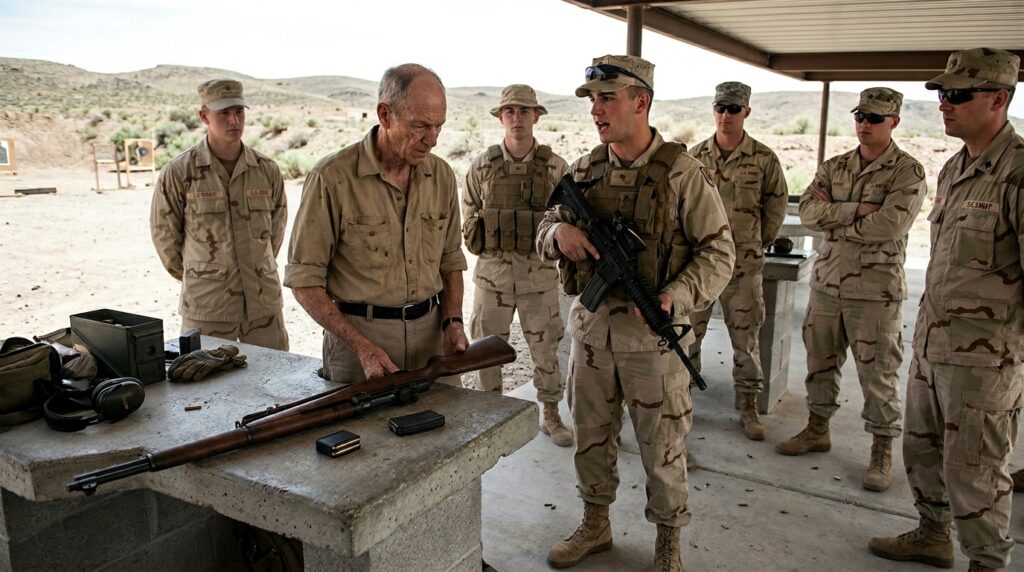
CHAPTER 2: THE THREE NOTCHES
The finger didn’t pull.
Thomas froze, his knuckle locked around the curve of the steel trigger, holding the nine-pound weapon perfectly steady against his shoulder while his mind spun backward into a vortex of cold grease and gray snow. The three hand-filed lines on the receiver burned against the periphery of his vision. They weren’t an armorer’s mark. They were crude, uneven, scratched into the parkerized finish with the edge of a broken bayonet on a ridge line where the air smelled like cordite and frozen blood.
Behind him, the silence of the firing lane grew heavy, weighted by the collective expectation of the young soldiers waiting for the report. The desert wind rattled the edge of the corrugated roofing overhead, a dry, rhythmic sound that felt entirely distinct from the sudden stillness holding Thomas in its grip.
“Problem, sir?” Specialist Miller’s voice cut through the heat shimmer. The smirk hadn’t entirely left his face, but the casual edge had turned into something sharper, a little more probing. He stepped a fraction closer, the nylon of his tactical vest scraping against the concrete lane separator. “Sights went blurry on you? We can get you some reader glasses from the range box if the iron’s too small.”
Thomas didn’t lower the rifle. He kept his cheek welded to the faded, oil-darkened walnut of the stock, but his lungs refused to expand. He knew every grain of this wood, not because he had bought it at an estate sale or found it surplus, but because his fingers had bled into these exact grooves when the temperature dropped below zero and the grease turned to ice.
“The wind,” Thomas lied softly, his voice a dry rasp that barely cleared his teeth. “The wind is shifting at the hundred-yard berm.”
“Ain’t no wind down there that’ll stop a thirty-niner bullet from hitting paper, sir,” Miller said, taking another half-step forward. He leaned down slightly, his young, unblemished face coming into Thomas’s peripheral view. He was trying to see what the old man was looking at. His eyes scanned the concrete bench, then the rifle, his gaze lingering on the worn canvas sling that hung slack beneath the barrel. “If the weapon’s unsafe, you shouldn’t be firing it. Institutional safety regulations are pretty clear about vintage hardware on an active line.”
Thomas slowly let his breath out, a long, controlled exhalation that tasted of the range’s dust and the faint bitter tang of sulfur. He didn’t drop the weapon from his shoulder; instead, he smoothly rotated the receiver toward himself, just enough to bring the hand-carved notches into the direct light of the midday sun.
Miller’s eyes dropped to the steel. The young soldier frowned, his eyebrows knitting together as he noticed the deliberate, crude disfigurement of the military finish. “What is that? A tracking mark?”
“An accounting,” Thomas murmured. He finally lowered the rifle, resting the buttplate on the concrete bench but keeping his left hand firmly wrapped around the forearm, shielding the wood as if it were fragile. His skin looked like old parchment against the dark grain, thin and spotted with age, yet his grip didn’t waiver. “This wasn’t bought out of a crate, son. This was left in the tree line near Chosin. I didn’t think there were any left in the state inventory.”
The witnesses behind them stopped shifting. The small group of active-duty men leaned forward, their attention entirely pulled from their own high-tech gear toward the scratched piece of metal on the bench. The arrogance in the lane was beginning to fray, replaced by the uncomfortable curiosity of men who realized they were standing in front of a ghost.
Miller looked from the three notches up to Thomas’s weathered face, his confident posture losing a fraction of its rigidity. “Chosin? That’s… that’s a long time to keep a rifle clean.”
“I didn’t keep it,” Thomas said, his voice dropping into a register that made the young specialist look down at his own polished boots. “It was taken from a boy who didn’t need it anymore. A boy who was waiting for an artillery support order that never came because some colonel in an office three hundred miles away thought the ridge was already lost.”
Thomas reached into his tan work shirt pocket, his fingers searching for the small, hard shape he had carried all morning, but he stopped himself before drawing it out. The time wasn’t right. Not yet. He looked back at Miller, noticing for the first time the small, faded tattoo on the young man’s forearm—a stylized set of crossed rifles over an old division patch that matched the engraving on the back of the pocket watch hidden against Thomas’s ribs.
“Let me see the bolt,” Miller said suddenly, his tone shifting from a challenge to an unbidden professional interest. He reached out a hand, his fingers hovering just an inch above the walnut stock before he caught himself and waited for permission. “The serial number on the receiver looks like a non-standard run. If this came out of a depot supply line, it shouldn’t have these markings. Government property doesn’t get reissued with personal modifications unless it was salvaged through a dynamic recovery unit.”
“It was salvaged,” Thomas said, his hand remaining stationary over the forearm. “But not by the government.”
He slid the bolt back with a smooth, heavy pull of his palm, the brass cartridge within the chamber glinting briefly in the harsh sunlight before settling into the feeding tray. As the mechanism opened, a tiny piece of folded, yellowed paper that had been wedged into the recess behind the follower clip dislodged, tumbling silently onto the green canvas mat between them. It was frayed at the edges, dark with old oil, and bore a faded stamp that Miller recognized instantly as an old field-casualty tag.
Miller reached down and picked up the paper before Thomas could move his swollen fingers. The young specialist’s face drained of its color as his eyes scanned the blurred typewriter ink on the fragment.








