
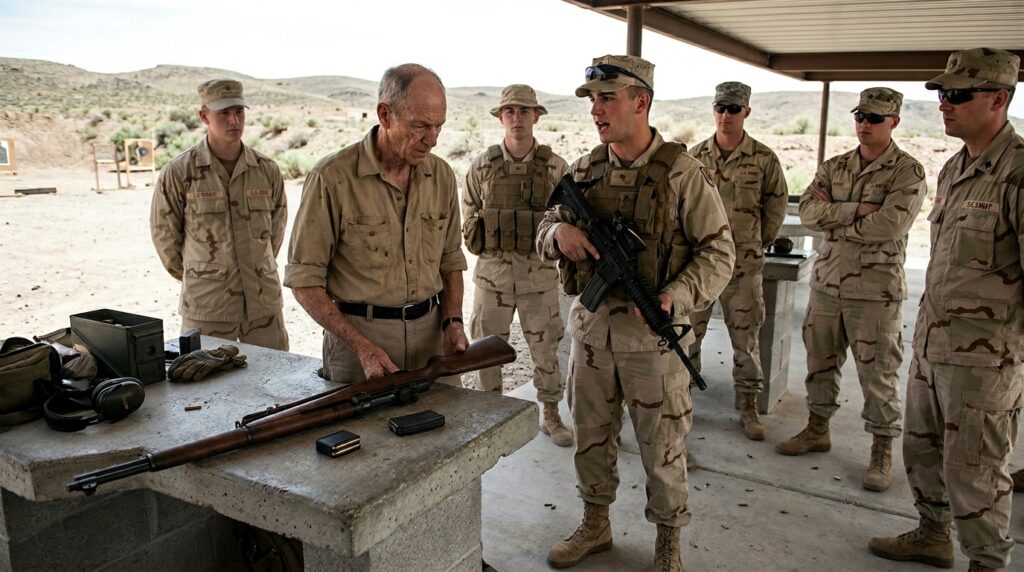
CHAPTER 3: THE DECOY REVEAL
Miller didn’t read the paper out loud. His thumb merely pressed against the soft, disintegrating fiber of the casualty tag, flattening the crease against his palm. The ink was faded to the color of dried veins, but the stamped heading was unmistakable: 8th Joint Logistics Depot – Tactical Asset Quarantine. Beneath it, a single line of purple ink cataloged the wood-stock rifle not as surplus, but as a weapon recovered from a dark sector where an entire defensive perimeter had ceased to broadcast.
“This serial number,” Miller said, his tone dropping an octave, his gaze locked onto the blurred characters. “It isn’t in the active database. It was flagged as destroyed during an evacuation protocol in the mountain passes. My grandfather used to talk about these logistics logs. The brass wiped them from the master records to cover up an ammunition delivery failure that left an entire sector dry.”
He looked up at Thomas, his chest rising and falling beneath his pristine nylon vest. The small group of active-duty soldiers behind him had completely stopped talking. The distant sound of another lane firing—a dull, rhythmic pop-pop-pop—felt miles away from the small bubble of absolute silence that had settled over Lane Four.
“You didn’t buy this,” Miller whispered, his fingers tightening slightly on the edge of the yellowed paper. “This is a ghost gun. A battlefield recovery that shouldn’t exist. If range control looks too closely at this receiver, they’ll confiscate the whole platform. It’s technically stolen federal property from a sealed investigation.”
Thomas reached out and gently took the paper back from the young specialist’s fingers. The touch was soft, almost reverent, the frayed edge of the tag disappearing into his rough, liver-spotted palm. “The boy who held it didn’t steal it, son. He died holding it. The system wanted the failure forgotten, so they buried the paper. I just unburied the iron.”
“Why bring it here?” Miller’s gaze was sharp now, the professional arrogance returning but completely transformed into a defensive wall. His brow furrowed as he stared at the old marksman’s work shirt. “You brought an unrecorded, classified piece of failure onto a modern range to make a point? To prove our optics don’t matter compared to a dead squad’s weapon?”
“No,” Thomas said, his voice entirely devoid of anger. He turned back toward the shooting bench, his eyes following the grain of the walnut stock down to the iron buttplate. “I brought it because a rifle isn’t the only thing that gets left behind when a logistics report is rewritten. People get left behind, too. Their names get smudged out by the same ink.”
He lifted the weapon once more. This time, the physical weight of the timber seemed to pull at his thin shoulders, but he adjusted his stance, his worn khaki trousers catching the dry breeze. The target three hundred yards away was still shivering in the desert heat, a tiny black speck that seemed entirely unreachable without a modern ballistic calculator or a red-dot sight.
Miller stepped back, but his hand stayed near his own slung weapon, his eyes tracking every movement of the old man’s frame. “If you drop that hammer, sir, the firing pin might fracture. The metal fatigue on an unverified salvage receiver is unpredictable. The internal pressure could shatter the receiver face.”
“It won’t shatter,” Thomas said. His finger settled onto the cold curve of the trigger again. “The boy who cleaned this weapon before the cold took him knew how to dress the sear. He spent three hours in the dark with a piece of oil-cloth making sure it would break clean when the line was crossed. He wasn’t thinking about safety regulations. He was thinking about the man next to him.”
He didn’t wait for Miller to reply. He didn’t check the five-knot wind from the east. He allowed his eyes to find the tiny aperture, the front blade rising up to bisect the black target sticker through the haze of the range. The three lines carved into the steel were right beneath his nose, a crude physical reminder of an old promise that had outlived the records, the colonels, and the war itself.
The hammer fell.
The report wasn’t a sharp crack like the modern rifles; it was a deep, resonant boom that vibrated through the concrete floor of the lane, hitting Thomas’s chest with a familiar, heavy punch. A single, hot brass casing flew upward, spinning into the bright noon light before bouncing off the lane separator with a clear, metallic ring.
Miller immediately raised his spotting scope to his eye, his posture turning rigid as he focused on the paper three hundred yards downrange. The target was clean. There was no hole in the black center circle. There was no white mark on the outer rings.
“Miss,” Miller said, a strange mix of relief and lingering tension in his voice. “The round didn’t even register on the backing board, sir. The sights must be completely drifted out of alignment, just like I said.”
Thomas slowly cycled the bolt, catching the next round before it chambered, his face remaining entirely expressionless. He didn’t look at the target. He looked down at the empty brass casing resting on the mat, then reached into his shirt pocket again, his hand wrapping around the heavy, silver pocket watch that had been ticking against his chest all morning.
“I wasn’t aiming at the center,” Thomas said quietly, his eyes meeting Miller’s. “I was checking the drift. The front sight blade isn’t original to the weapon. It was taken from a spotter’s kit.”
He pulled the watch from his pocket, the silver chain clinking against the brass casing on the table. The back of the watch case was engraved with the exact same stylized crossed rifles and division patch that was tattooed on Miller’s young arm, but beneath the emblem, a name was scratched into the metal—a name that matched the signature on the casualty tag Miller had just held.
Miller’s breath caught in his throat, his hand dropping away from the spotting scope as his eyes locked onto the tarnished silver disc in the old man’s hand.








