
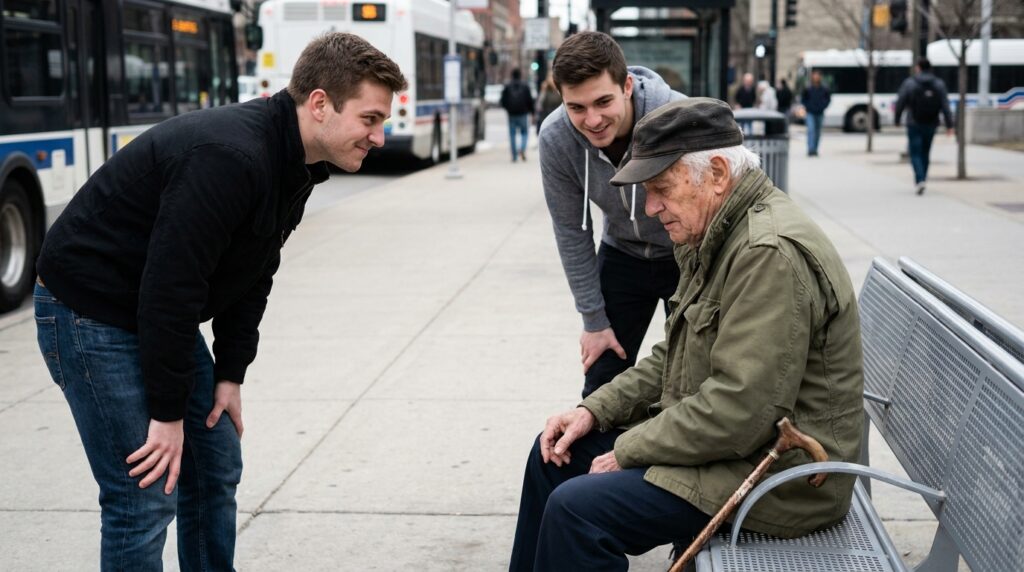
CHAPTER 5: THE SUBDUED HORIZON
The visitor’s fingers didn’t stay near his pocket. They moved back to his side, sliding an inch down his thigh to clear the lower edge of his nylon windbreaker, his hand flattening against his denim trousers. The pale wire in his ear gave another sharp, metallic click—a dry, double-pulse transmission that sounded like a remote relay station confirming an unlisted data point.
He looked down at the mud-stained leather of his boots, then back at the silver ridge of tissue trailing into the veteran’s collar. The identification was complete. In the logic of the registry he served, a man with that specific surgical marker didn’t possess an address, a financial routing number, or a active file in the national census. He was a historic variable—a ghost left behind in the rust belt because the state had run out of black ink to finish the ledger.
“The sixty-eight line was logged as non-recoverable,” the visitor said. His voice had returned to its flat, monotone baseline, but the horizontal orientation of his shoulders had shifted. He was no longer crowding the center depth of the awning. He was leaning back into his heels, his weight redistributing to allow for an immediate lateral exit if the space became hostile. “The archive division in Arlington cleared the terminal logs two cycles ago. You shouldn’t be standing on a municipal transit route.”
“I have a monthly voucher,” the veteran said. His hand went back to his head, his fingers smoothing the dark cotton of his cap back over the scar until the silver tissue was entirely blotted out by the shadow of the brim. He didn’t lock the cane back into his palm; he let the rubber tip rest light against his sneaker, using it to monitor the low-frequency vibrations humming through the wet concrete. “The county transit board doesn’t check the Arlington registry before they clear the forty-two line.”
On the bench, Marcus let out a slow, trembling breath that formed a gray cloud against the glass of the vending machine. He was still looking at the visitor’s boot, which remained parked squarely on the edge of his folded rejection letter. The blue watermark was crushed, the fibers of the paper pulp absorbing the dark, grease-heavy moisture of the curb until the crimson PSYCHOLOGICAL DISCONFORMANCE stamp began to smear into a dull violet stain.
“Get up, Marcus,” the boy in the gray hoodie—Caleb—said from the edge of the shelter. His voice was raw, thin as a shaved wire. He hadn’t stopped looking at the black transport van idling at the curb. The exhaust pipe was spitting a thick, blue plume of diesel smoke into the drizzle, the smell of burnt petroleum completely drowning out the scent of the convenience store trash. “Marcus, move your legs. Now.”
The primary mocker didn’t look at his friend. He gripped the edge of the bench, his knuckles turning a dry, bloodless white against the damp wood grain. He didn’t use the cocky, expansive posture that had defined his entrance. His shoulders were drawn inward, his chest hollowed as if he were trying to reduce his physical volume under the steady, vertical gaze of the old man.
“I didn’t know,” Marcus whispered. He wasn’t looking at the visitor; he was looking directly at the frayed stitching on the veteran’s right shoulder where the unit patch had been cut away. His voice lacked its previous resonance, dropping into the submissive cadence of an enlistee addressing an inspector at a high-intensity intake point. “They just gave me the packet at the regional courthouse. They told me to wait here for the commercial shuttle to the depot.”
The visitor looked down at the paper beneath his heel, then slowly dragged his boot backward, releasing the sheet. The white stock was torn along the upper corner, the alphanumeric sequence MD-OBL-79 nearly obliterated by the tread mark.
“The shuttle isn’t coming, kid,” the visitor said, his eyes returning to the veteran’s face, tracing the unblinking, mechanical stillness of the older man’s pupils. “The intake sequence for station seven-nine was closed out forty-eight minutes ago. The ledger is clean. If you’re still on this pad when the city bus pulls in, you belong to the county.”
He turned on his heel. The movement was a perfect ninety-degree pivot, clean of the amateur hip-sway that Marcus had used to crowd the shelter. He didn’t look back at the old man or the two boys. He stepped into the open doorway of the black transport van, his tactical boots clicking twice against the up-armored threshold before the pneumatic system slammed the panel shut with a heavy, metallic clack.
The air brakes released with a loud, high-pressure screech that rattled the rusted tin roof of the shelter. The low projector lenses swept away from the concrete pad, their needles of white light pivoting into the rain as the vehicle swung back onto the industrial park access road, its heavy tires throw up a high fan of yellow water as it accelerated into the dark.
Marcus reached down, his fingers shaking as he picked up the damp, torn sheet of paper from the wet gravel. He didn’t look at the text. He folded it twice more, reducing it to a small, tight square that he shoved deep into the interior lining of his jacket, pulling the zipper all the way to his throat.
The true forty-two line was visible now at the far end of the avenue—a large, lumbering white box with a high-mounted halogen array that washed over the entire street with a flat, predictable glare. It wasn’t fast; it rolled forward with the slow, hydraulic indifference of a public service machine, its windshield wipers rhythmic and loud against the glass.
The veteran turned back toward the road, his spine locking into the same rigid alignment he had held since his feet left the bench. He adjusted his cane, the rubber tip finding its regular anchor point on the concrete seam.
“Keep the change on the lesson, son,” the old man said, his low voice completely flat as the municipal bus pulled to the curb, its brakes groaning in the wet dark.








