
CHAPTER 3: THE LEVER OF PRECISION
“The forty-two line doesn’t detour for mistakes,” the veteran said.
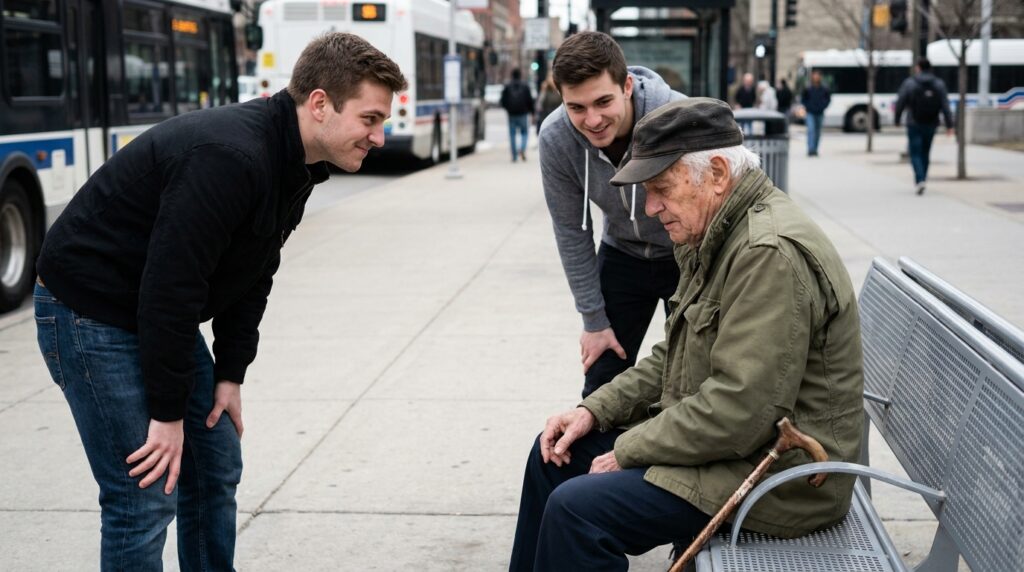
His hand went down. It wasn’t a reaching motion; it was a deliberate drop, his long, dry fingers closing not around the handle of the ash-wood cane, but across the top edge of the official white stock paper protruding from the kid’s jacket pocket. The movement was so exact, so clean of telegraphing tension, that the primary mocker didn’t react until the crisp grain of the paper was already sliding against his inner lining.
The kid’s hand twitched downward, his fingers spreading like a fan across his knee, but his knuckles struck the hard edge of the veteran’s wrist block. There was no impact sound, just the dull friction of sleeve fabric against sleeve fabric. The veteran didn’t shove. He simply anchored his forearm at a forty-five-degree angle, locking the kid’s shoulder against the back slats of the bench through basic skeletal leverage.
“Give that back,” the kid whispered. The aggressive drawl from three minutes ago was entirely gone, replaced by a flat, unvarnished urgency. His eyes shifted down to the paper, then back up to the shadow beneath the veteran’s cap. “That ain’t yours. You don’t know what that is.”
The veteran pulled the document completely free. The white stock was stiff, damp along the upper corner where the Ohio mist had begun to pool. In the harsh, yellow illumination of the vending machine, the blue watermark wasn’t a standard selective service seal. It was an enlistment rejection matrix from the Department of Defense, stamped with a heavy, crimson overlay: UNFIT FOR SERVICE – PSYCHOLOGICAL DISCONFORMANCE.
Beneath that primary stamp, running along the very margin of the page where the paper met the veteran’s thumb, was a secondary alphanumeric sequence. It was small, rendered in a faded, non-standard violet ink that had bled slightly into the wood pulp: MD-OBL-79.
The old man’s thumb didn’t move over the sequence. His skin remained perfectly still against the ink, but his internal calculation shifted instantly. He knew that sequence. It wasn’t an administrative error; it was an obsolete procurement code used exclusively by the third-tier logistics wing during the late Cold War border reorganizations—the same division that had cleared his own records from the national archives forty years ago.
“MD-OBL,” the veteran murmured. He didn’t say it loud enough for the kid in the gray hoodie to hear, but the primary mocker’s posture froze entirely at the sound of the syllables. The kid’s chest stopped its rapid rising and falling. His fingers dipped back toward the wooden bench, his nails digging into the damp grain.
“You can read it,” the kid said. It wasn’t a question anymore. His voice was thin, sharp as a wire drawn taut between two points. “They told me nobody on the civilian side could read that string. They said if anyone asked, it was a clerical error from the regional intake branch.”
“They lied to you,” the veteran said. His arm didn’t lose its rigidity. He held the paper flat against the yellow light, his eyes moving across the text with a mechanical sweep that left no room for emotional variance. “They always use that specific ink when they want a file to dissolve under standard sorting lights. It keeps the intake clerk from flagging the source station.”
A half-step behind the bench, the boy in the gray hoodie finally moved. He didn’t advance toward the older man; instead, his boots scraped backward over the gravel at the edge of the concrete transit pad. He was looking at his companion’s face, tracing the sudden, bloodless pallor that had spread from the kid’s jawline down into his collar.
“Marcus,” the gray hoodie said, his voice cracking slightly against the distant roar of the interstate. “Marcus, let’s just go. The bus is coming around the curve by the warehouse. We can take the walk down to the avenue.”
The kid on the bench—Marcus—didn’t move a muscle. He remained pinned under the heavy, vertical shadow of the old man, his eyes fixed on the pale rectangle of paper that carried his life’s sharpest failure. His mouth opened slightly, his teeth catching the raw glare of the neon signage.
“He knows,” Marcus said, his voice dropping into a flat, monotone register. “He knows what the station code means, Caleb. He’s not a local.”
The veteran folded the white stock once, the crease snapping like a dry twig in the quiet of the shelter. He didn’t put it in his own pocket. He held it out, his fingers resting on the very edge of the paper, offering it back to the kid with the same calculated indifference he had used to take it.
“A rejection from a ghost station isn’t a draft notice, son,” the veteran said, his gravelly voice dropping an octave until it cut cleanly beneath the sound of the approaching bus engines. “It means they looked at your lineage and decided you were too loud to keep a secret. You want to prove you’re worth the ink they used on you? Learn to sit still when the room gets dark.”
Marcus reached out, his hand shaking with a fine, high-frequency tremor as his fingers took the folded document. He didn’t slide it back into his pocket; he held it tightly against his ribs, his shoulders hunching forward until his chin nearly touched the black nylon of his jacket.
The headlights of the forty-two line swept across the wet asphalt of the intersection, turning the yellow puddles into blinding, silver mirrors. The reflection struck the shelter’s rusted awning, casting a lattice of sharp, dark bars across the veteran’s face. Beneath the cap, his jaw remained set, his eyes already shifting away from the two young men to analyze the hydraulic entry system of the approaching vehicle.








