
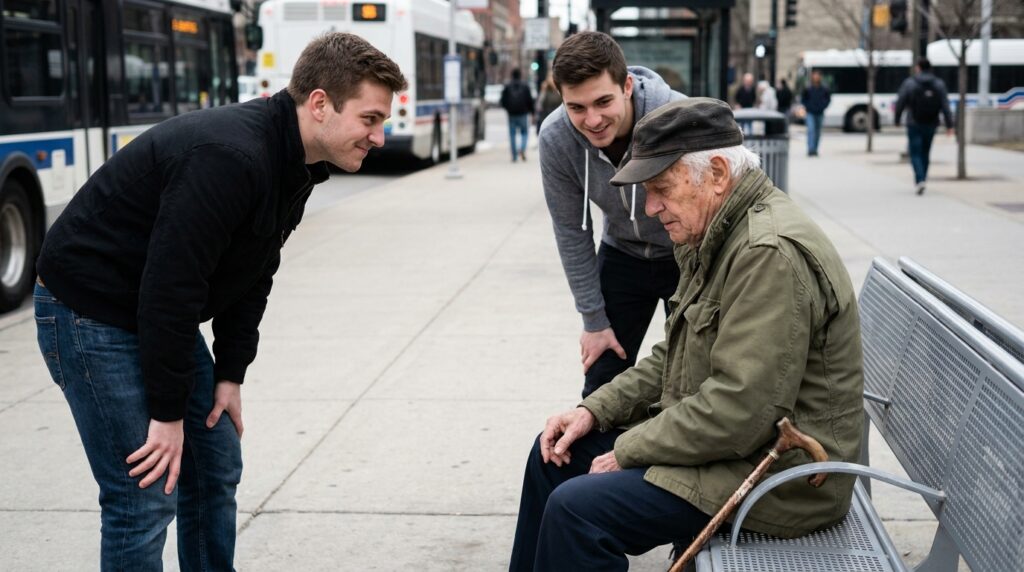
CHAPTER 4: THE SHATTERED MASK
The blinding reflection of the headlights didn’t hit the bus shelter like a public transit vehicle should.
A municipal forty-two bus carried a broad, high-mounted halogen array that washed over the entire concrete pad uniformly. This light was different. It came from dual, tightly focused projector lenses mounted low to the bumper, slicing through the gray Ohio mist in two parallel, razor-sharp needles. They didn’t slow at the designated transit line forty feet out. They surged forward, the massive chrome grille of an unbadged black transport van swelling into the frame with the heavy, hydraulic momentum of a machine built for kinetic interception.
The veteran’s eyes didn’t widen. They narrowed, his pupils instantly tracking the deceleration rate through the rhythmic slap of the heavy wipers against the windshield. It wasn’t the municipal line.
“Get behind the bench,” the veteran said. The command didn’t carry the previous instructional gravel; it was a flat, low-frequency clip that left no room for hesitation. His hand went down to the ash-wood cane, his fingers sliding into the notched grip with absolute mechanical precision.
Marcus didn’t move fast enough. He was still staring at the folded document in his fist, his brain locked in the shock of the station code reveal. The black van’s tires struck the curb with a sharp, heavy thud, the wet rubber spitting a fan of dark, oily puddle water directly across the concrete pad. The pneumatic hiss of the front doors releasing wasn’t the standard two-stage hiss of a city transit carrier—it was a rapid, high-pressure decompression that signaled an up-armored air brake layout.
Before the door had fully clearing the latch, a man stepped onto the asphalt. He didn’t wear a uniform, but his posture was identical to the line work the old man had left behind forty years ago—shoulders pinned back, weight centered low over heavy leather tactical boots, a dark nylon windbreaker concealing his right hip. His face was completely smooth, devoid of distinguishing features except for a thin, pale communications wire coiling into his right ear canal.
The visitor’s gaze didn’t linger on Marcus or Caleb. It locked directly onto the frayed stitching on the veteran’s right shoulder, his eyes identifying the specific dimension of the missing patch frame within a fraction of a second.
“Station code seven-nine is inactive, old man,” the visitor said. His voice was entirely neutral, carrying the flat, monotone drone of someone reading coordinates off a terminal display. He didn’t draw a weapon, but his right hand remained anchored near his lower pocket lane, his fingers curved into an open ready position. “The regional branch noted a signal trip on the administrative subnet three minutes ago. You’re holding paper that belongs to a locked ledger.”
Marcus finally collapsed backward, his spine hitting the wooden slats of the bench with a dull impact as his boots slipped on the wet concrete. His fingers let go of the folded sheet; the white stock fluttered once in the draft before the visitor’s heavy boot came down flat across the paper, pinning it to the stained concrete pad with a heavy crunch of gravel.
The veteran stood his ground, his spine forming a vertical line that cut the yellow light of the vending machine cleanly in two. He didn’t raise the cane. He didn’t drop into a defensive crouch. He shifted his grip down the ash-wood shaft by exactly three inches, utilizing the lower third of the wood as a counterweight against his forearm.
“The boy was rejected at an intake portal,” the veteran said, his low voice cutting beneath the idle of the van’s heavy diesel engine. “That makes him a civilian asset under the seventy-two agreement. You have no operational logic to cross the transit lane.”
The visitor took a half-step forward, his weight pressing down on Marcus’s pinned file until the crisp white paper began to tear along the margin ink. “The seventy-two agreement was dissolved before these kids were born, counselor. The ledger is entirely open. You’re standing in an unmapped grid with a dead man’s cap.”
With his left hand, the visitor reached out—not toward the veteran, but toward Marcus’s collar, his fingers ready to grab the black nylon fabric to pull the boy toward the open door of the van.
The veteran’s response was a single, measured micro-movement. He didn’t swing the wood; he stepped into the visitor’s approach lane, his left shoulder blocking the man’s reach while his hand pulled the cap from his own head.
As the cap came free, the yellow neon light from the convenience store caught the side of the older man’s skull. Running from the crown down to the very base of his left ear was a thick, silver ridge of fibrous tissue—a precise, surgical track that could only have been left by a high-velocity bone saw during a military medical intervention. It wasn’t an ordinary scar from a field injury; it was the distinct hallmark of an unauthorized cranial clearing, the kind administered to personnel before their names were scrubbed from the national service registry to prevent any recovery of operational memory.
The visitor’s fingers froze an inch from Marcus’s jacket. His eyes dropped to the silver ridge of tissue, his jaw tightening as his head tilted slightly to process the structural geometry of the scar. His communication wire gave a small, distinct electronic beep that echoed in the quiet of the shelter.
“The tribunal,” the visitor said, his flat tone breaking for the first time, a sharp note of institutional recognition surfacing in his throat. “The sixty-eight line. You’re the asset from the valley.”
“There are no assets left in this valley,” the veteran said. He didn’t look down at the man’s hand. He kept his eyes locked on the visitor’s pupils, his gaze completely steady under the driving rain. “Just two kids who need to get on the forty-two line, and an old man who knows exactly how much noise a diesel engine makes when it’s idling in a restricted zone.”
The visitor didn’t retreat, but his hand slowly lowered away from Marcus’s collar. His fingers returned to his side, his posture stiffening as the communication wire in his ear clicked twice in rapid succession. The heavy door of the black transport van remained open, its low-frequency engine vibration rattling the rusted metal frame of the shelter.








