
CHAPTER 2: THE CONSTRICTION ZONE
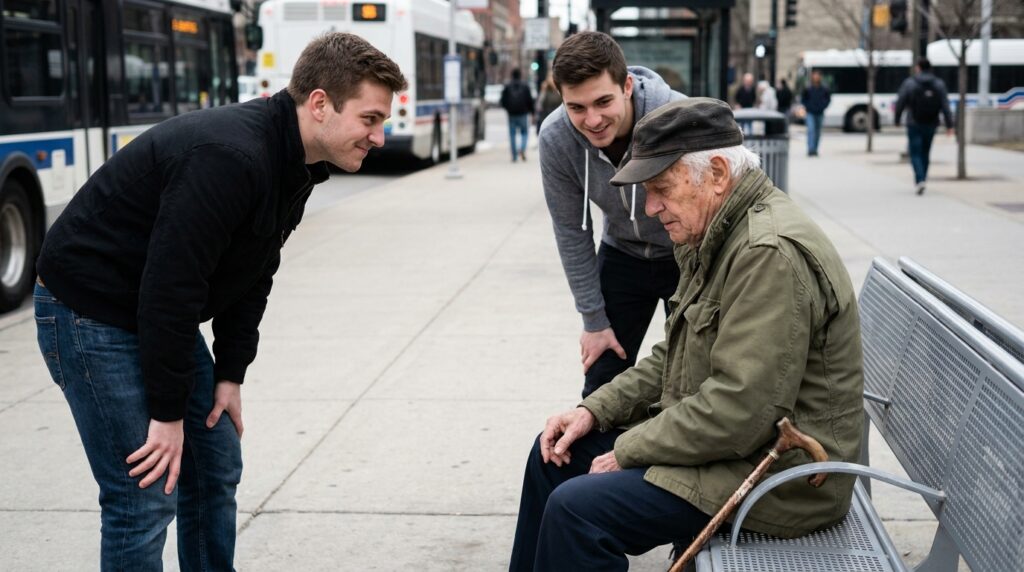
The white sneakers didn’t just slide; they hitched on a seam in the wet concrete.
The kid in the black jacket didn’t understand the physics of it yet, but his body did. His eyes, wide and suddenly white-rimmed under the yellow glare of the bus shelter, tracked the movement of the old man’s hands. The wood hadn’t swung. It hadn’t clattered. The ash-wood cane had simply cleared the ground by an inch, its shadow stretching long and sharp toward the curb as the veteran’s center of mass shifted forward.
To the kid, it must have looked like a structural collapse—an old wall suddenly tipping into the street—but it was too quiet for a fall. There was no lunging. There was no amateur gathering of muscle. The veteran’s shoulders remained perfectly horizontal, a rigid axis cutting through the driving mist.
The younger one in the gray hoodie ceased his grinning. The sound didn’t fade; it clipped off cleanly, a small, wet intake of breath that signaled the exact moment his hindbrain recognized a predator. He didn’t step forward to assist his friend. His heels hit the rusted structural pillar of the transit awning, the cold metal catching him between the shoulder blades with a hollow thunk.
“Back up,” the kid in the black jacket muttered. His voice had lost its edge, the cocky Ohio drawl replaced by a high, defensive rasp. He didn’t take his hands out of his pockets. That was his second mistake. By keeping his fingers jammed deep into the nylon lining, he had pinned his own elbows against his ribs, destroying his lateral balance. “I said back up, old man.”
The veteran didn’t grant him the distance. He occupied the space the kid vacated, his boots stepping precisely into the dry square of concrete beneath the awning. Up close, the lines on the older man’s face weren’t signs of fragility; they were deep, calculated fissures that didn’t twitch under the pressure. The yellow light from the vending machine caught the silver edge of his jaw, sharp as a shaved coin.
In the kid’s open pocket, a small object glinted against the dark fabric—a brass key-ring, its edge notched with three deep, uniform filing marks. It was a non-standard modification, the kind of alteration made by someone who spent too much time trying to bypass cheap padlocks on commercial storage units. The veteran’s eyes logged it, stored it, and dismissed it within the space of a single heartbeat. A thief’s tool. A marker of small-time desperation.
“You’re crowding the lane, son,” the veteran said. The voice didn’t come from his throat; it came from deep within his chest, a low, gravelly vibration that carried the structural resonance of an iron grate sliding over granite. It wasn’t loud, but it had the distinct quality of a command that had once traveled across open tarmac through the roar of twin-turbine engines. “The city gives you eight feet of sidewalk. You’re using nine.”
The primary mocker tried to twist his torso, a frantic attempt to re-establish his stance, but his scuffed white sneakers found the slick, oily film of the roadside puddle. His right heel slipped an inch. His weight dropped heavily onto his left hip, his shoulder clipping the wooden slats of the transit bench with a sharp, splintering crack.
The gray hoodie watched the descent, his face pale within the shadow of his cotton fleece. He looked down at his companion, then up at the old man’s olive field jacket. His gaze lingered on the frayed stitching on the right shoulder—the pale, faded rectangle where a velcro unit identifier had been stripped away with enough force to scar the fabric permanently. The boy’s fingers twitched against his thighs, but he remained anchored to the metal pillar, a historical witness to a total systemic failure.
The black jacket didn’t get back up. He sat heavily on the damp wood of the bench, his breath coming in short, ragged puffs that turned to white vapor in the cold air. His hands finally slipped free of his pockets, but they didn’t form fists. They spread flat against the wet slats, his fingers gripping the grain as if the earth itself had begun to tilt beneath his boots.
A square white corner of paper showed at the lip of his jacket’s internal pocket—heavy stock, official, bearing a faint blue watermarked seal that looked remarkably like a selective service heading. It was crisp, uncreased by travel, the kind of document that arrived via certified mail and remained unread on a kitchen table for weeks until the pressure forced it into the street.
The veteran stood over him, his shadow completely enveloping the bench. He didn’t lean down. He didn’t offer the kid the satisfaction of a threat. He simply adjusted his cap, his long, scarred fingers pulling the brim down until his eyes were completely swallowed by the darkness of the shelter’s awning.
“You’ve got five minutes before the forty-two line pulls up,” the old man said, his eyes shifting back to the road where the yellow headlights were just beginning to cut through the fog at the edge of the industrial park. “I suggest you find another place to wait.”
The kid didn’t answer. His mouth stayed slightly open, a small drop of rain catching the light on his chin as he looked up at the straight, unyielding line of the veteran’s spine. The silence returned to the shelter, but it was different now—it wasn’t the silence of an empty street, but the heavy, vibrating stillness that follows a sudden explosion.








