CHAPTER 7: THE CLOSING PLATS
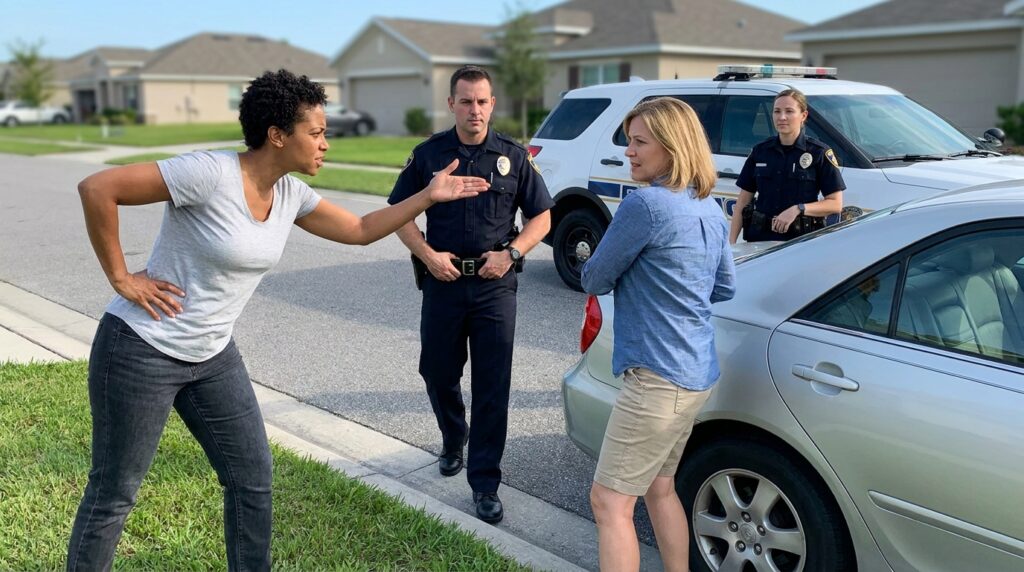
“Sign the lower field,” the primary officer said. His words were flat, hard blocks dropping into the stifling heat between the neighbor’s concrete porch steps and the edge of the parched lawn. He held out the steel clipboard, its lower edge pitted with gray zinc oxidation, his thumb holding down a carbon-layered pink triplicate form that rustled and snapped in the hot draft coming off the street.
The neighbor didn’t reach for the pen. Her fingers remained bunched into the loose fabric of her gray t-shirt, her knuckles white and covered in a fine skin of gray clay from where she had been clawing at the sod hours earlier. Her gaze remained pinned to the red steel seizure notice resting face-up on the wooden pallet. “The assessment is out of order,” she whispered, her chest hitching with a short, shallow rhythm that didn’t match the aggressive cadence she had used at the curb. “The district surveyor didn’t file the final plat adjustment. If the citation goes into the public record before the mortgage company closes their audit, the title lock is permanent. I won’t have a legal entrance left to list.”
The homeowner stood five feet back on the dividing seam of the two lawns. The coarse grass beneath her sandals felt dry, brittle like dried straw, snapping under her weight with a small, sharp crunch that sounded loud in the heavy silence of the block. She watched the neighbor’s face—the complete deflation of her manufactured authority, the lines around her mouth tightening as the weight of the civil citation began to settle over her property.
“The title lock was already permanent,” the homeowner said, her voice low and even, matching the steady thrum of the idling patrol unit behind them. “The mortgage firm didn’t pull their audit because of my sedan. They pulled it because they found the duplicate application you filed with the county clerk using a falsified lot registration number from 1982. You were trying to override the state’s lien data with an obsolete description.”
The neighbor’s eyes flicked to the homeowner, a sudden, sharp needle of desperation surfacing through her exhaustion. “The lot was sub-divided incorrectly thirty years ago,” she said, her voice rising into a thin, raw register that cracked in the dry air. “Your garage sits six inches into the original common-use lane. If the county executed the tax seizure on the true plat line, they would have taken my western fence with it. I had to create an active litigation dispute to freeze the asset release.”
The primary officer didn’t look up from the form. He tapped the steel clip of the board with his pen tip, the metallic click clean and decisive. “The county doesn’t freeze asset releases for residential parking complaints, ma’am,” he said, his tone remaining empty of sympathy, a purely bureaucratic instrument tracking the physical realities of the scene. “Moving a municipal boundary pin to manufacture an adverse possession claim against your neighbor is a third-class records violation. The state surveyor’s office has already logged the coordinate drift from your porch camera feed.”
The neighbor slowly reached out her hand, her arm stiff, her fingers shaking as they closed over the cheap black plastic barrel of the officer’s pen. She didn’t read the lines. She dragged the point across the pink carbon paper, leaving a short, jagged signature that tore through the top layer of the form, exposing the oily black ink beneath.
Behind them, the secondary officer stepped down from the driveway curb, her tablet screen darkening as she slid it into her nylon belt pouch. “The supervisor unit is clearing the dispatch line now, sir,” she reported to the primary officer. “The county code team has been notified to set the orange boundary flags along the true plat marker first thing tomorrow morning. The vehicle at forty-one is cleared of all obstruction reports.”
The neighbor dropped the pen. It dangled from its small silver chain, clicking against the metal frame of the clipboard as she turned away without another word. Her flats dragged across the pitted concrete of her porch step, her body leaning heavily against the rusted iron screen door handle as she pulled herself inside the dark, unlit interior of her kitchen, leaving the screen door to slam shut with a dull, hollow rattle.
The homeowner walked back toward the silver sedan, her fingers loosening their grip on the brass key ring in her pocket. The heat coming off the car’s hood was beginning to drop as the sun dipped behind the uniform rooflines of the subdivision, leaving the metal looking dark, desaturated under the graying sky. The curb line was exactly where it had been four hours ago—pitted, cracked, lined with loose gravel and parched weeds—but the invisible lines governing the asphalt had settled back into their stone-cold beds, unyielding and permanent.