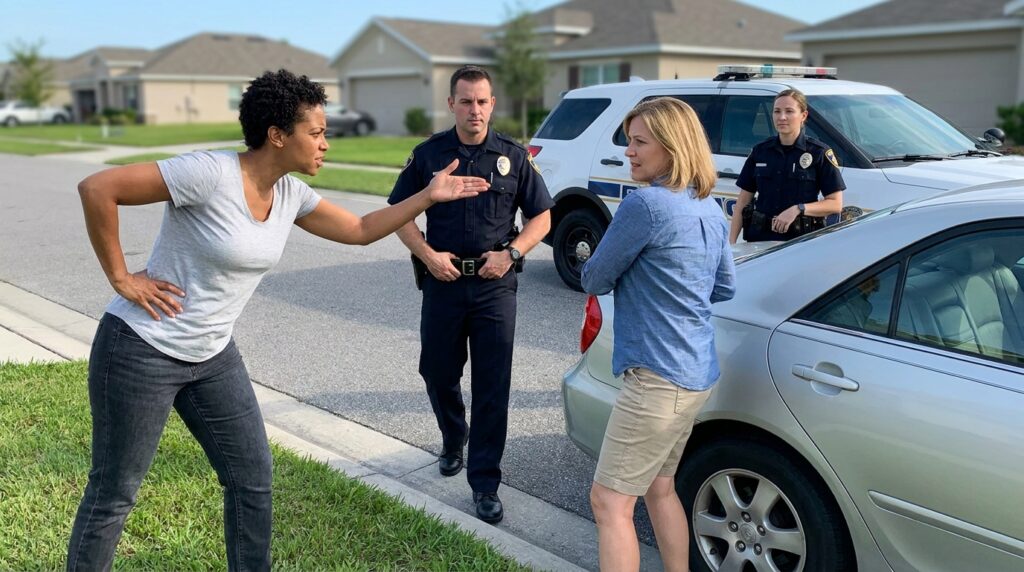
CHAPTER 3: THE PARCHMENT BLOCKADE
The neighbor didn’t wait for the secondary officer to finish her report. She snapped the black vinyl binder open, the plastic rings popping with a sharp, metallic sound that mimicked a small branch breaking underfoot. Her fingers, covered in a fine layer of gray limestone dust from the disturbed sod, pulled out a thick, multi-page document printed on heavy-grain, cream-colored legal paper. The margins were clean, almost too clean, but the text was a dense thicket of old-fashioned, serif fonts.
“This is the 1982 charter,” the neighbor said, thrusting the pages toward the primary officer’s chest line. Her voice had regained a brittle momentum, the flat, dry tone of a person trying to force a physical obstacle between herself and an incoming truth. “Look at section four, paragraph B. The curbside setbacks are absolute. Any non-registered domestic transport left stationary for more than forty-eight hours forfeits its spatial clearance. I am well within my rights to demand removal.”
The primary officer took the document by the top edge, his leather glove leaving a dull grease mark against the crisp paper. He didn’t read it immediately. Instead, his thumb rubbed the surface of the sheet, testing its thickness, feeling the unusual weight of a stock that didn’t match the cheap, lightweight wood-pulp paper standard for local county clerk printouts. He tilted it toward the light, squinting at the faint watermark running vertically through the fiber—an intricate insignia of a defunct title company that had folded during the housing crash two decades ago.
The homeowner didn’t lean in to look. She stayed anchored against the silver sedan, her fingers brushing the rusted handle of the rear door, where the metal felt cold and pitted under her skin. She had spent hours digging through the public county registries on her tablet, tracing the legal history of this entire block back to the original land grants. She knew every true line, every true variance. This piece of paper the neighbor was brandishing was a phantom, an obsolete artifact or a direct fabrication designed to simulate the heavy gravity of institutional law.
“That charter was superseded during the 1996 township reorganization,” the homeowner said, her tone steady, holding its ground like the iron pin buried near her front tire. “The current codes are digital. They’re hosted on the municipal server, and they don’t include spatial forfeitures for vehicles with active residential decals.”
The neighbor’s arm remained extended, her elbow locked, her knuckles tight. “The digital transition was never fully ratified by the district board. This paper holds the foundational easement lock. If you park here, you are trespassing on a common-area buffer zone that feeds directly into my parcel’s layout.”
The primary officer finally lowered the pages, his face remaining a blank mask of bureaucratic endurance. He looked from the heavy paper back down to the orange hand trowel sitting by the neighbor’s trash bins. The orange paint on the small tool was flaking off in distinct, bright curls, identical to the microscopic orange flakes scattered in the dry clay around the freshly exposed iron surveyor stake.
“Ma’am,” the officer said, his attention turning entirely to the neighbor, his voice dropping into that low, flat register used to de-escalate territorial disputes before they turned into physical incidents. “This document doesn’t have a valid county recorder stamp for this decade. It looks like an old title policy layout from an inactive file.”
“It’s the original deed logic,” the neighbor insisted, her forward lean increasing by a fraction of an inch, her flats grinding into the loose asphalt grit at the curb’s edge. Her face was flushed now, a dark crimson patch rising from the collar of her t-shirt up into her cheeks. “The entire drainage system relies on this specific line remaining clear of non-municipal weight. If her car sits here, the subsoil compacts. It compromises my foundation.”
The homeowner took a step forward, breaking her contact with the sedan. The movement was deliberate, her sandals coming down firmly on the dry grass of her lawn. “The drainage culvert runs eight feet beneath the opposite side of the asphalt lane,” she said, looking directly at the neighbor’s locked binder. “Your foundation isn’t being compromised by a parked sedan. But that yellow grid sheet in your pouch says your porch is sitting right inside the city’s pending six-foot expansion zone.”
The neighbor froze, the document trembling slightly in the officer’s hand. Her eyes darted from the homeowner’s face down to the clear plastic sleeve of her binder, where the corner of the water-damaged yellow layout was still visible. For the first time since the patrol unit had stopped, her aggressive posture showed a structural crack—a quick, involuntary swallow that tightened the tendons in her throat.
Behind them, the secondary officer tapped her earpiece, the small blue light flashing against the dark hair tied behind her head. “Sir,” she called out to the primary officer, her gaze fixed on the digital screen of her handheld tablet. “The dispatch link is confirmed. We just got the direct video feed from the doorbell across the yard. It’s not just a parking dispute anymore. We have visual confirmation of active line tampering from three o’clock this morning.”
The primary officer didn’t return the heavy paper to the neighbor. He folded it once, slowly, the thick grain resisting the pressure of his palm, and tucked it into his side pocket. He looked at the neighbor, then at the orange trowel behind her. “Let’s take a walk over to your porch, ma’am,” he said, stepping into her exit path. “We need to look at what you’ve been pulling out of that dirt.”