CHAPTER 4: THE DIGITAL EYE
The coarse glass grain of the phone screen was cold under the homeowner’s thumb. She swiped twice, her skin catching slightly on a hairline fracture running across the display, before tapping the encrypted icon for her porch security rig. The screen pulsed, casting a pale gray reflection against the blue cotton sleeve of her shirt as the local storage drive sorted through eight hours of raw, uncompressed nighttime data.
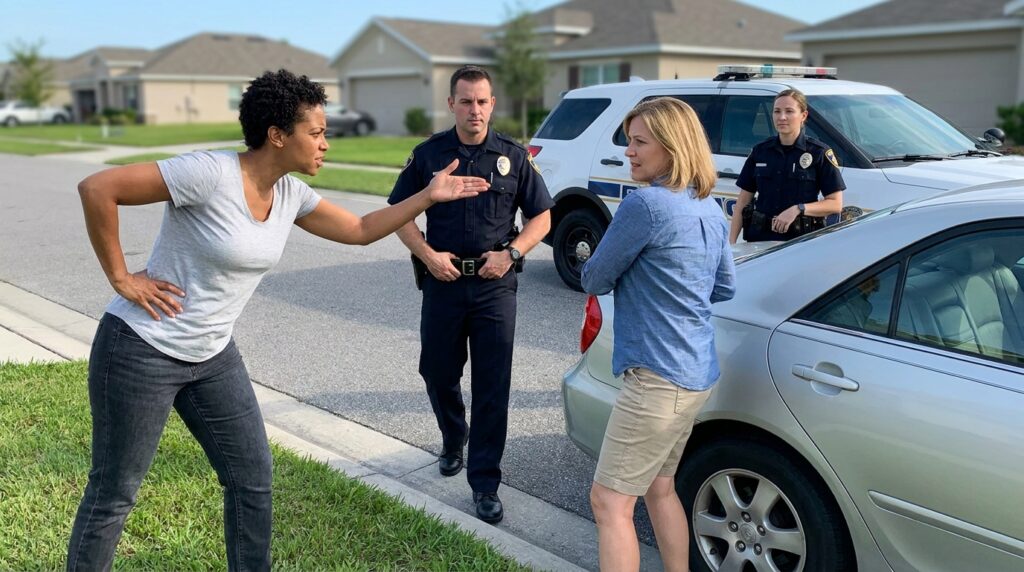
“Right here, Officer,” the homeowner said. Her voice remained clipped, steady, stripped of the fatigue that had spent weeks burrowing into her posture. She held the device flat, resting it near the edge of the silver sedan’s roof so the primary officer could see the unedited frame.
The neighbor made a sudden, frantic movement to her left, her flats slipping on a patch of loose limestone gravel. She reached out, her fingers catching the black vinyl binder tightly against her ribs as if trying to shield the water-damaged yellow layout from view. Her arm shook, the muscles in her jaw tightening until the skin over her cheekbones looked thin and brittle. “That footage is unverified,” she snapped, her voice rising into an unnatural, defensive pitch. “It’s a private recording covering a public right-of-way. It’s entirely inadmissible under township privacy ordinances.”
The primary officer didn’t answer her. He leaned his torso over the hot silver roof of the car, his heavy utility belt clattering softly against the metal trim as he focused on the moving pixels. His breathing was slow, deep, smelling faintly of black coffee and stale car interior. Behind them, the secondary officer moved into a hard blocking position at the foot of the neighbor’s driveway, her hand resting flat on her duty belt, her shadow anchoring the physical lane between the property lines.
On the small screen, the desaturated infrared timeline jumped to 03:14 AM. The wide-angle lens captured the street in shades of metallic gray and chalky white. The stillness of the suburban block was broken by a single, solid silhouette emerging from the shadow of the neighbor’s hedge line. The figure was short, wide-shouldered, carrying a long-handled tool that glinted under the distant streetlamp.
The homeowner watched the primary officer’s eyes track the digital movement. The video showed the figure kneeling directly at the edge of the concrete curb, using an orange hand trowel to systematically scrape away the topsoil, digging down six inches until the flat head of the iron surveyor pin emerged from the red clay. The figure then produced a small, laminated card—the exact yellow grid sheet currently tucked inside the neighbor’s plastic pouch—and held it against the stake, checking a series of measurements with a metal rule.
“That’s a civil surveyor layout,” the homeowner muttered, her voice remaining low, tracking the tremor in the neighbor’s hands. “She wasn’t checking for standard parking violations. She was matching the physical iron pins against the district’s expansion template.”
The neighbor’s flats ground into the pavement as she tried to shift her stance, but the secondary officer’s presence at her flank remained unyielding. “The city plans to take six feet of this block,” the neighbor whispered, the aggressive mask finally fracturing into something raw and desperate. “The public utility easement is expanding. If they verify the pins at their current marker, my porch is gone. The structural setback becomes non-compliant. I had to establish the adverse line before the official county crew logs the final data next week.”
The primary officer stood up straight, his face an unreadable block of administrative stone. He reached into his pocket and pulled out the thick, cream-colored document he had confiscated a moment before, turning the pages over to reveal a hidden, unstamped addendum tucked into the back flap. It was a private structural report, printed on heavy grain but completely devoid of any official municipal registration numbers.
“This layout doesn’t belong to the city,” the officer said, his thumb tapping the edge of the hidden addendum. “This is a private filing from a commercial mortgage firm. Ma’am, you aren’t trying to stop a city easement. You’re trying to move the physical boundary line to clear a private refinancing audit.”
The homeowner took a slow, deep breath, her palm tightening over the keys in her hand. The real-time cause-and-effect was locking into place behind her eyes. The anonymous notes, the constant harassment about her car, the deliberate digging at midnight—it wasn’t a standard neighborhood grievance about parking. It was a calculated, frantic attempt to seize six inches of the legal lot line before an outside bank discovered that the neighbor’s property was structurally out of bounds.
The neighbor didn’t run. She stood frozen on the concrete, her flats buried in the weeds, her eyes fixed on the primary officer’s hand as he pulled a black ink pen from his breast pocket. The secondary officer stepped down from the driveway line, her boots crunching rhythmically against the grit as she prepared to open the official state incident file.