CHAPTER 2: THE SURVEYORS SHADOW
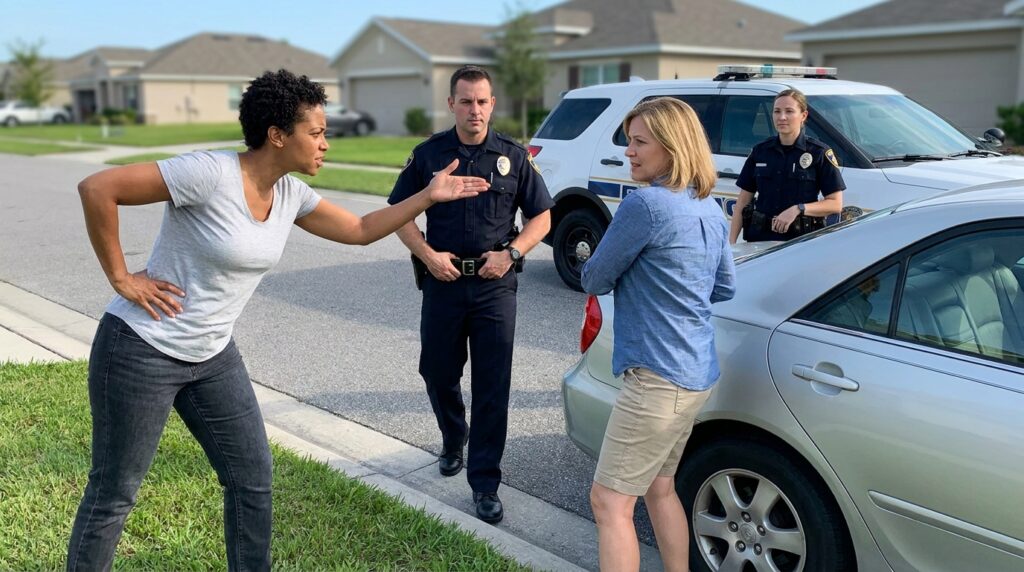
“Driver’s license and registration,” the primary officer said. His voice had the dry, abrasive quality of ungreased machinery, cutting clean through the neighbor’s rising intake of breath. He didn’t look at the neighbor; his eyes remained fixed on the homeowner, watching the precise movement of her fingers as they uncurled from the brass key ring.
The neighborhood felt compressed, the air between the houses thickening under the weight of the afternoon sun. Across the black asphalt lane, the vertical vinyl blinds of number forty-two twitched, a three-inch gap revealing the pale silhouette of a forehead pressed against the glass. The secondary officer noticed it instantly. She shifted her boots, the stiff leather of her holster squeaking against the fabric of her trousers, her shadow stretching long and dark across the sun-baked weeds at the pavement’s edge.
The homeowner reached through the open driver-side window of the silver sedan. The interior of the car was an oven, releasing a draft of trapped heat that smelled of old upholstery and parched foam. Her fingertips brushed the glove box latch—pitted plastic, rough against her skin. She pulled the vehicle registration from the visor, the paper stiff and yellowed at the margins by years of southern exposure. When she pulled her arm back out, her knuckles scraped the oxidized chrome trim of the door frame, leaving a faint gray smudge of zinc oxide across her skin.
“She’s over the line, Officer,” the neighbor broke in, her flats scraping against the gravel as she tried to re-anchor her posture. Her hands were still clamped onto her hips, her light gray t-shirt bunching at the shoulders. “The subdivision covenant is explicit about curbside obstruction. I have the standard county variance paperwork right here.”
She held a black vinyl binder tight against her ribs. Tucked into the clear plastic front sleeve was a folded document, its edges softened and grayed by moisture. Through the crinkled plastic, the homeowner caught the edge of something unexpected—not a standard photocopy of a neighborhood association charter, but a dense, technical grid sheet lined with faded yellow highlighter marks. The lines didn’t look like property lots; they were wide, parallel corridors that sliced through the existing boundaries of the block like a highway template.
The primary officer took the homeowner’s paper without looking at it, his thumb catching the edge as he tilted his head toward the neighbor. “Ma’am, I told you to step back. I’m not asking you again.”
The neighbor’s mouth snapped shut, the dark curls around her temples damp with sweat. She didn’t retreat more than three inches, her heels sinking slightly into the soft, unwatered dirt where she had recently kicked topsoil over the rusted iron surveyor stake.
The homeowner stood her ground by the sedan’s front fender, her palm resting on the hood. The silver metal was hot enough to sting, the vibration of the idling patrol unit thirty feet behind them humming through the chassis. “The car hasn’t moved since Thursday,” the homeowner said, her tone flat, drained of the anxiety that had kept her awake through the previous three nights of anonymous notes. “The parking permit is logged with the township. It’s taped to the lower left corner of the windshield.”
The primary officer took two steps toward the front of the sedan. His heavy utility belt clicked and clattered with every stride, the handcuffs in their case thumping against his hip. He leaned over the hood, his boots straddling the very line where the grass met the asphalt. His eyes moved from the white parking decal behind the glass down to the small patch of disturbed earth near the tire.
“This stake,” the officer said, pointing a finger toward the rusted iron rod protruding from the dirt. “Who uncovered this?”
A sudden silence settled over the curb. The neighbor’s fingers tightened against the vinyl binder, the plastic crackling sharply in the quiet. “The county came out three weeks ago,” she said quickly, her voice rising an octave, the words tumbling out with an artificial precision that sounded like a read script. “They were verifying the stormwater easement. It’s a matter of public record. The whole grid is out of compliance.”
The homeowner watched the neighbor’s knuckles. They were white against the black cover of the binder. Underneath the neighbor’s frantic certainty, there was something else—a slight, rhythmic tremor in her forearm, the physical strain of someone holding a heavy weight with brittle bones. The homeowner looked down at the yellowed grid sheet through the plastic sleeve again. One of those highlighted corridors didn’t just cross her yard; it ran directly through the neighbor’s front porch, a thick marker indicating a complete structural deletion.
“The county didn’t send anyone,” the homeowner said softly, her eyes tracking the tremor up to the neighbor’s tense jaw. “I checked the municipal portal last night. There hasn’t been a variance request filed on this block since 2018.”
The primary officer didn’t look up from the stake. He reached down, his leather-gloved hand brushing aside a clod of dry clay to expose the square, stamped head of the iron pin. The metal was heavily pitted, flaking off in dark red scales onto the green grass. He pulled a small steel scribe from his shirt pocket and scraped the top of the metal, revealing a clean, bright glint of underlying steel beneath thirty years of rust.
“This wasn’t uncovered by an engine or a rainstorm,” the officer muttered, his gaze tracking a straight line from the iron pin back toward the neighbor’s driveway, where a small, orange hand trowel sat half-hidden behind a plastic trash bin. “Someone’s been digging here within the last twenty-four hours.”
The secondary officer stepped forward from the cruiser, her hand leaving her belt as she closed the distance to the lawn edge. “Sir,” she said, her voice dropping into a low, professional murmur. “We have a secondary unit checking the digital log now. The resident at forty-one just uploaded a video clip to the county dispatch queue.”
The neighbor didn’t move, but her posture seemed to shrink, the rigid lines of her shoulders rounding as the shadow of the secondary officer fell over her binder.