CHAPTER 6: THE PAPER RAILS
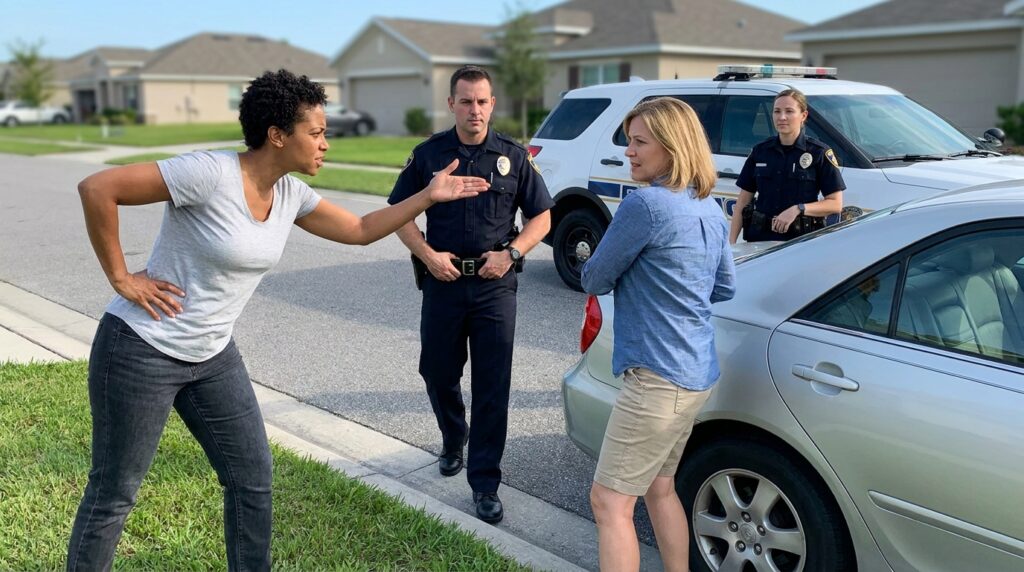
“Check the tax ID on that 1982 addendum,” the secondary officer said. Her finger tapped the screen of her portable tablet, the blue luminescence casting a pale sheen over her dark hair. Her voice had the mechanical rhythm of a court reporter, flat and cold in the dry afternoon heat. “The county registrar didn’t just log a lien, sir. The judicial certificate was detached three weeks ago. The parcel under forty-four isn’t an active residential deed anymore—it’s listed as a seized asset under structural quarantine.”
The primary officer didn’t return the heavy, cream-colored document to the neighbor’s hands. He let his thumb slide over the bottom edge of the sheet, where a jagged, perforated margin indicated that a smaller piece of paper—likely a formal state notice—had been torn away with systematic haste. He looked down at the neighbor’s driveway edge, where three bundles of dry, parched turf grass sat on a wooden pallet near the trash receptacles. Beneath the corner of the lowest bundle, the tip of a bright red, stamped steel placard was visible, buried face-down in the loose red clay.
The homeowner took two steps closer to the fence line, her sandals grinding into the limestone grit that had settled along the concrete seam. The hot metallic breeze coming off the asphalt lane smelled of sun-baked zinc primer and the stagnant, iron-rich water pooling inside the street drain. “She wasn’t trying to save her porch from a city expansion,” the homeowner said, her eyes tracking the precise line of the neighbor’s trembling arm. “She was trying to merge the curbside lot numbers before the county surveyor mapped the block for the liquidation auction. If she could prove an active, multi-year encroachment onto my parcel, the title company would have to hold the foreclosure execution under a boundary dispute clause.”
The neighbor didn’t move. Her flats remained sunk into the loose topsoil, her fingers locked around the empty black binder as if its plastic spine were the only rigid thing left on the street. Her face had drained of its aggressive color, leaving a mottled, gray complexion that made her look years older under the harsh glare of the southern sun. “The notice was filed without a physical audit,” she whispered, her words dropping with a brittle, dry cadence. “The board didn’t calculate the common-area buffer. They just looked at the old plat maps from the eighties. If I could get the surveyor to log the silver sedan as an permanent obstruction on the easement, the whole file would drop back into the litigation queue.”
The primary officer leaned down, his heavy leather utility belt creaking as he used his gloved hand to slide the bundles of dead turf off the pallet. He pulled the red steel placard out from the dirt, his fingers scraping away a thick crust of dried mud to reveal the bold, black lettering of a municipal sheriff’s seizure order. The metal was stamped with yesterday’s date, the edges still sharp enough to cut through the thin layer of topsoil clinging to its face.
“This was posted on your front door at eight-fifteen yesterday morning,” the officer said, his gaze fixed entirely on the neighbor’s face. He didn’t drop his arm; he held the heavy steel notice between them like a barrier. “You didn’t call us out here because of a parking violation, ma’am. You called us because you needed an official police report documenting an unyielding civil dispute at the exact hour the county inspector arrived to verify the lot clearance.”
The neighbor’s posture folded inward, her shoulders rounding as she let the empty binder slip from her fingers. It hit the concrete driveway with a flat, hollow slap, the clear plastic sleeves crinkling under the weight of the fall. She didn’t look down at it. Her eyes stayed locked on the primary officer’s ink pen, which was now moving rapidly across the grid sheet of his pocket notebook, tracking the specific codes for public records obstruction and state marker destruction.
The homeowner stepped back toward the passenger side of her silver sedan, her fingers closing tightly around the cold brass key ring in her pocket. The entire infrastructure of the block felt different now—no longer a simple collection of tidy lawns and uniform siding, but a fragile system of legal boundaries and hidden financial fractures that could be unraveled by six inches of shifted dirt. Her vehicle wasn’t an obstacle; it had been used as a pawn in a frantic, subterranean gamble to stall an institutional machine that had already closed its gates.
Behind them, the secondary officer moved toward the patrol SUV, her boots crunching a steady, rhythmic pattern against the parched pavement as she picked up the radio mic to summon the district supervisor. The house at number forty-two remained completely silent, the three-inch gap in the vinyl blinds now dark and empty, its audience withdrawn as the real authority on the block finalized its records.