CHAPTER 5: THE UNCOVERED PIN
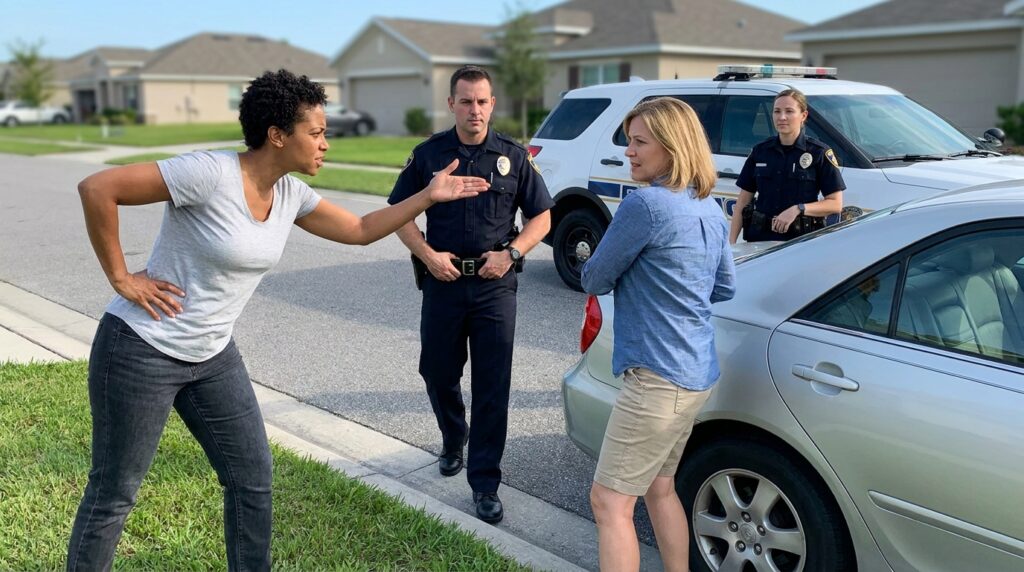
“Let’s look at the dirt,” the primary officer said. His tone remained clinically detached, a cold weight dropping into the space between them. He turned on his heel, his heavy black leather boots grinding a trail of white limestone grit against the sun-baked asphalt as he walked toward the neighbor’s driveway entrance.
The neighbor moved with him, her flats slapping unevenly against the pavement. The rigid posture she had maintained throughout the afternoon had developed a heavy lean, her shoulders rounding as she clutched the black vinyl binder to her chest. “There’s no cause to examine my private storage area, Officer,” she said, her voice hitching, losing its sharp, institutional rhythm. “The property issue is entirely out here at the curb. Whatever my private contractor left by the trash receptacles is irrelevant to this resident’s parking violation.”
The homeowner didn’t stay behind by the silver sedan. Her hand left the warm door handle, her keys making a soft metallic click as she slipped the ring over her index finger. She walked a parallel line along her own grass edge, her sandals pressing into the dry Bermuda turf. The heat coming off the lawns felt thicker here, smelling of scorched thatch and the metallic tang of old water pipes buried shallowly beneath the topsoil.
At the side of the neighbor’s driveway, three large plastic trash bins sat clustered against a weathered wooden fence line. Behind the center container, partially hidden by a pile of loose yard clippings, the orange hand trowel lay flat. The flaking orange paint on its handle caught the direct glare of the sun. Beside it, a shallow patch of red clay had been freshly scooped out, exposing not a standard county pipe, but a square, industrial-grade iron pin that had been entirely severed from its underground anchor.
The primary officer stopped, his shadow falling over the hole. He knelt down, the leather of his duty belt grooving into his hip as he leaned forward to inspect the damage. He reached out with his gloved right hand and lifted a heavy, solid object that had been stowed beneath the lip of the plastic bin—a six-inch block of concrete with an old steel rod rusted into its center core.
“This is an official benchmark marker,” the officer muttered, his voice dropping into a harsh, pragmatic register. He turned the block over, scraping a layer of dried mud with his thumb to reveal a stamped brass cap with a district serial number. “You didn’t just dig around the stake at the curb, ma’am. You physically pulled the primary subdivision anchor out of the ground.”
The homeowner stood at the lawn boundary, her arms crossed against her blue shirt. The weight of the deception was unraveling with every clod of earth the officer turned over. “She needed the physical line to look malleable,” the homeowner said, her gaze fixed on the neighbor’s pale face. “If the primary benchmark marker is missing, the surveyor crew coming next week has to reconstruct the entire lot line from old deed data—the exact 1982 documents she’s been holding in that binder.”
The neighbor’s hand dropped from her binder, the plastic cover crackling as her grip failed. She looked at the severed concrete block in the officer’s hand, her lips tightening into a thin line that began to twitch at the corners. “The bank wouldn’t clear the bridge loan without a certified title clearance,” she whispered, her eyes darting toward the curtained windows of the houses across the street. “They said my driveway footprint encroached on the township common space by four inches. If the loan didn’t process by Friday, the listing went into automatic default. I just needed to buy thirty days to adjust the layout.”
The primary officer stood up slowly, the iron-and-concrete marker remaining balanced in his palm like a piece of structural evidence. He didn’t look at her with anger; his face held only the cold, unyielding calculation of a state official documenter. “Moving or damaging an official district survey marker isn’t an association variance issue, ma’am,” he said, shifting his weight onto both heels. “It’s a state-level property alteration violation.”
Behind them, the secondary officer’s tablet chimed twice—a short, high-frequency alert that cut through the stagnant afternoon air. She looked up from the screen, her expression hardening as she caught the primary officer’s eye. “Sir,” she said, her voice dropping into a flat, professional warning. “The county registrar just pushed the full file through. The loan default notice isn’t pending. The municipal tax lien was finalized at noon yesterday. This property isn’t under review for a refinance—it’s already under an active county seizure warrant.”
The neighbor didn’t answer. She took a single step backward, her flats catching on the edge of her own concrete driveway as the decoy explanation she had built around the city’s expansion completely shattered, leaving her standing exposed against the rusted surfaces of her own home.