CHAPTER 7: THE TRUE TRANSIT
“The truck stays right where it is, Brenda. Step off the asphalt.”
The voice didn’t belong to Miller. It belonged to the county surveyor, a thick-set man whose neon orange vest was stiff with dried silt and grease from a dozen different municipal jobs. He stood on the curb apron of Brenda’s driveway, his boots planted in the very weeds she had spent eighteen months trying to classify as an illegal municipal hazard. Behind him, a heavy yellow county flatbed hummed, its diesel exhaust smelling of sulphur and wet clay, its rear steel ramps lowered directly onto the shoulder.
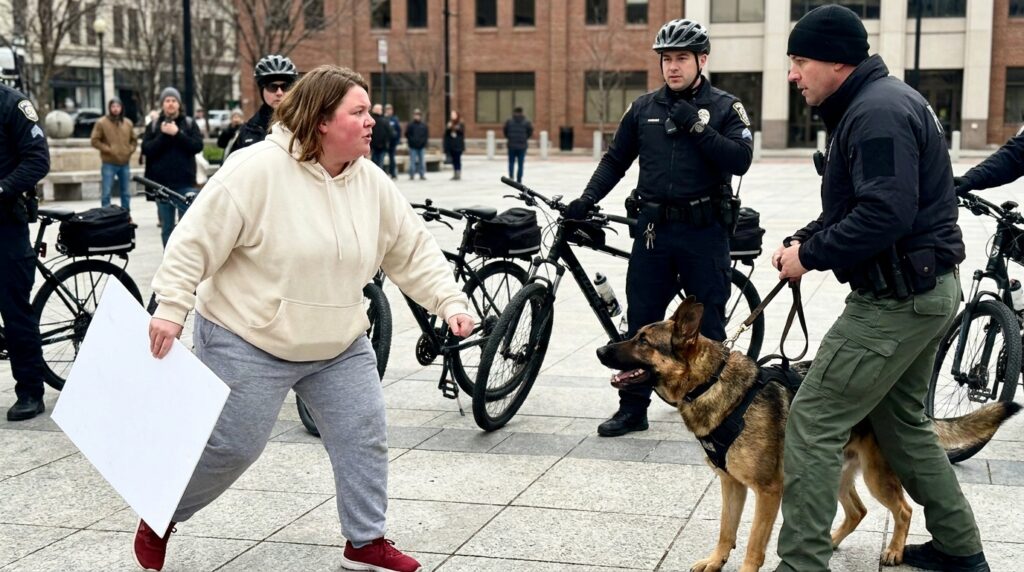
Brenda didn’t drop the blue folder. Her red sneakers were caked in dry plaza dust, the color faded to a dull pink under the glare of the late afternoon sun. Her cream hoodie was damp with sweat, the heavy fabric pinning the old 1994 blueprints against her ribs like a collection of dead laws.
“The easement draft gives the residents oversight,” Brenda said, her voice cracked, the tone thin and gritty as she extended the watermarked manila envelope toward him. “The fifteen-foot fire lane runs right through this driveway line. You can’t park the transit gear here.”
The surveyor didn’t look at the paper. He didn’t check the red wax seal she had broken in her basement. He simply reached down and adjusted the brass dial on the heavy steel tripod positioned over the rusted iron pin at the curb edge. “I don’t care about a thirty-year-old council draft, lady. I have a court-ordered infrastructure correction warrant for Block Four, Lot Twelve.”
From the open driver’s side window of his cruiser parked forty feet down the cul-de-sac, Miller watched the exchange in absolute silence. He didn’t clear his belt; he didn’t issue another micro-harassment warning. He just leaned his elbow against the door panel, his sunglasses reflecting the yellow strobe light of the county truck as it rotated across the white garage doors of Oakridge Estates.
“The landscaper’s trailer is the violation,” Brenda muttered, her throat tightening as she saw the young family from the end of the block standing on their porch. They weren’t holding phones. They weren’t recording her for a forum post. They were just watching the heavy iron transit rods get hammered into the sod with a rhythmic, metallic thud that shook the ground beneath her heels.
The surveyor stepped back from his lens, his face completely flat as he pulled a long steel tape measure from his utility belt. The metal snap of the tape retraction was loud, like a pistol shot in the quiet afternoon. “The landscaper’s trailer is within the three-foot variance allowed for residential curbs. Your front porch foundation isn’t.”
Brenda froze. The blue plastic folder slipped an inch down her ribs, the friction of the rough plastic scraping against her hoodie. “What?”
“The original probate transaction ten years ago missed the municipal parkland allocation,” the surveyor said, his finger pointing toward the concrete base of her front steps, where the stone met the manicured edge of her grass. “The builder poured this entire block’s foundation three feet past the county boundary line. Your living room sits on municipal parkland, Brenda. The town doesn’t need an easement to clear this driveway—the town owns the dirt under your stairs.”
The world seemed to slow down, the passage of time dilating into a series of disconnected sensory impacts. Brenda looked down at her sneakers. The red rubber soles were resting exactly on the green lawn edge she had defended like a fortress for over a year. Beneath the grass, hidden under decades of roots and unapproved soil, was the true line. Not the line she had manufactured to control the cul-de-sac, not the viral shot she had tried to stage at the K9 perimeter, but a cold, heavy piece of county iron that legally unauthorized her own home.
The landscape family didn’t laugh. The neighbors didn’t point or shout about the digital video that was already circulating through the local subdivision network. The silence that settled over Oakridge Estates was worse than the plaza freeze—it was the flat, transactional silence of a closed ledger.
She turned her head slowly toward her front door. The white paint on the trim looked flaked and old in the setting sun, the corners showing the rusted heads of the nails the builder had driven into the framing before the county transit board had even signed the plat maps. She had spent eighteen months looking out her window to find an intrusion, completely blind to the fact that her entire life was an encroachment.
Brenda didn’t yell. She didn’t invoke Section Four or demand a tow truck. She simply turned her red sneakers toward the steps, her weight shifting heavily onto the concrete that didn’t legally belong to her, leaving the surveyor and his iron rods to map out the true boundaries of the block.