CHAPTER 4: THE INTRUSION COGNITION
The phone screen went dark as Brenda slipped it into the front pocket of her cream hoodie. Her fingers immediately dropped back to the raw, un-sanded pine stake of the placard, her knuckles locking tight against the grain. Her red sneakers gripped the stone expansion joint for one final micro-second before she drove half a step forward, crossing the invisible vector she had calculated between the courthouse fountain and the security line.
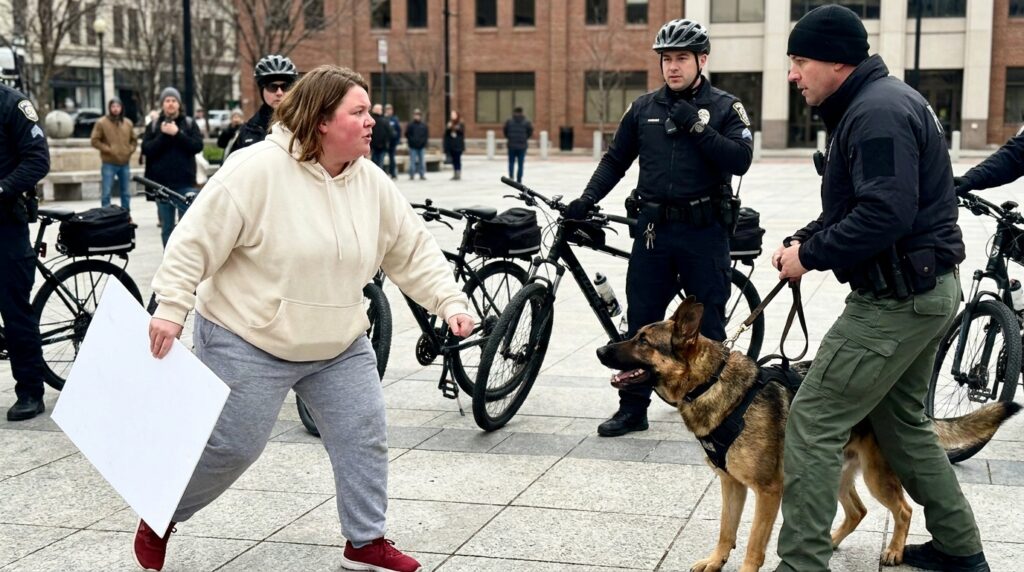
She entered the K9 lane with her body crouched in a stocky forward lean, her shoulders drawn high and tense to absorb the public exposure. Her round face flushed hot, a dark crimson rash creeping up from the collar of her hoodie as her breathing turned thin and jagged. She held the heavy, blank white cardboard placard low, letting it swing near her thigh like an un-slung tool, its white surface completely clear of text—a pristine visual vacuum waiting to be filled by the lens of anyone recording the square.
“Keep that dog back, you don’t get to threaten us!”
Her voice erupted into the midday room tone of the plaza, a strained, echoing yell that carried the gritty rasp of dry basement dust. The sound hit the vertical limestone columns of the precinct portico and bounced back, sharp and thin.
The K9 Handler didn’t advance. His tactical boots remained perfectly flat against the concrete tiles, his tall, solid frame anchoring the corner of the municipal step line. But his gloved right hand moved with deliberate, mechanical precision, gathering a single loop of the heavy nylon leash and pulling it taut against his hip. The movement shortened the line by six inches, locking the German Shepherd strictly to his heel. The dog remained in an upright, attentive stance, its tan-and-black head level, its ears pointing forward like small steel wedges. Its mouth stayed open in a relaxed pant, completely unresponsive to the high-frequency vibration of her shout.
Brenda didn’t stop her forward momentum. She felt the heavy envelope in her crossbody bag press hard against her ribs—the 1994 unfiled draft serving as her internal justification for the intrusion. To her, this six-foot corridor wasn’t law enforcement territory; it was an obstruction of a public right-of-way, an unratified restriction identical to the landscaping trailer back in the cul-de-sac.
“Everyone sees it!” she screamed, snapping her face sideways toward a pair of office workers who had stopped near a concrete planter, their forks hovering mid-air above their plastic salad containers. She thrust her left hand toward the sky, her index finger pointing directly at the lintel of the precinct door as if indexing a formal violation for an online audience. “You’re using that dog to scare us!”
The handler remained entirely silent. His bearded jaw didn’t shift, and his eyes, shadowed beneath the brim of his black knit cap, stayed fixed on the upper edge of her blank cardboard sign. He didn’t offer a counter-argument; he didn’t give her a monologue to record. The only sound between them was the dry rustle of Brenda’s sweatpants and the faint, metallic click of the leash swivel rotating against the dog’s black harness as the animal adjusted its weight by a fraction of an inch.
Out of the corner of her eye, Brenda saw the midground shift. The static line of dark utility bicycles wasn’t vacant anymore. A seasoned officer, his grey hair visible beneath the rim of his white helmet, had stepped away from the handlebars. His glasses caught the full glare of the midday sun, turning his eyes into two blank discs of light as he began a steady, unhurried advance toward her left flank.
She tightened her grip on the pine stake, preparing to swing the placard up into the center of the frame to lock in the shot. The unfiled draft in her bag felt heavier now, a physical anchor that she believed gave her the right to stand on this stone, regardless of the uniform in front of her. But the officer wasn’t looking at her folder. He was tracking the position of her red sneakers as they drifted another inch into the restricted lane.