CHAPTER 6: THE RETREAT STANDOFF
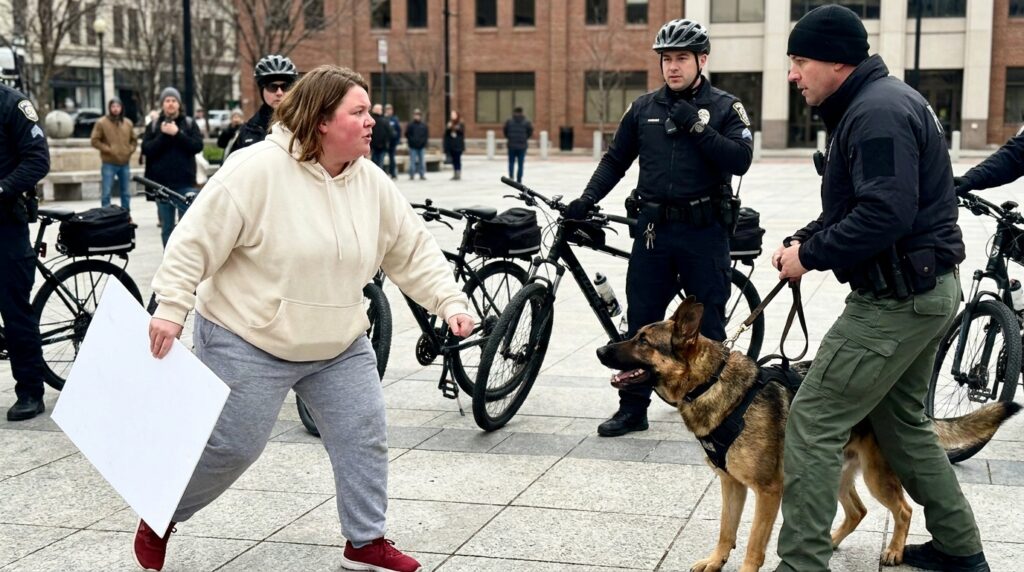
The weight of the unyielding arm remained an iron fixture in Brenda’s field of vision. She took another step backward, her red sneakers scraping a dull, dusty line across the sun-bleached concrete tiles. The hard leather of the officer’s utility gear gave a low creak as he adjusted his stance, his boots remaining anchored precisely on the seam of the expansion joint. He didn’t chase her retreat; he simply occupied the vacancy she left behind, filtering the hot air of the plaza with absolute institutional indifference.
Her fingers dropped away from the blue plastic folder inside her crossbody bag. The 1994 unfiled draft—the blueprint she had pulled from the damp dark of her basement, the sheet she believed would rewrite the boundaries of the Oakridge Estates cul-de-sac—hung limply inside the nylon pocket. It felt like dead weight now. The town square wasn’t an arena waiting to be governed by old watermarks and unexecuted intentions; it was a machine operating on active perimeters, and she had just been excluded from the gear works.
She glanced past the officer’s shoulder. The K9 handler had not broken his fixed line. His dark beard remained tucked into the collar of his windbreaker, his boots still, his gloved hand resting with unmoving pressure against the heavy nylon leash loop. At his side, the German Shepherd let out a quiet huff, its ribs expanding against the black harness before it sat back on its haunches, its dark eyes tracking Brenda with the same mechanical vigilance as the lenses of the municipal building cameras above.
Brenda turned her face toward the granite benches, her mouth opening to salvage the narrative, to throw one last high-frequency grievance into the public air. “The subdivision records are clear,” she said, her voice dropping into that thin, frantic register that had failed to stir the cul-de-sac. “The public safety easement dictates—”
The words didn’t land. A few paces away, sitting on the low stone edge of a dry fountain basin, a teenager in a gray graphic tee didn’t look up from his screen. He held his phone flat between his palms, his index finger resting near the record toggle. The dark, circular lens of the device was pointed directly at the front of her cream hoodie, catching the exact moment her posture shrank back, the precise second her stocky forward lean broke into an awkward, unbalanced shuffle. He wasn’t recording a citizen exposing corruption; he was logging a standard municipal disruption for a neighborhood thread that had already grown tired of her memos.
The silence that followed was heavy and dry, smelling of exhaust fumes and hot stone. Nobody argued with her. Nobody stepped off the benches to read the blank cardboard placard she held low against her leg. The public pressure she had spent eighteen months cultivating through code-enforcement hotlines and midnight forum posts had vanished into the concrete grit under her feet. She was entirely alone within the grid.
Her hand dropped deep into the pocket of her sweatpants, her knuckles knocking against the small, folded slip of surveyor’s notes she had discovered in the basement files. The rough edge of the paper felt like a splinter. Discrepancy noted at eastern boundary pin. Variance unapproved. The words seemed to sharpen against her skin. She had come here to force the department to draw a line around her neighbors, but the system had simply turned the transit back toward her own coordinates.
She turned left, her red sneakers dragging through the dust as she began her exit across the wide tiles toward the parking lot line. Behind her, the row of dark utility bicycles remained a neat, static wall. The officer did not lower his arm until her shadow had completely cleared the stone boundary of the plaza corridor, leaving her to carry her blank sign and her unfiled truths back to a subdivision that had already learned to look past her window.