
CHAPTER 5: THE INTERVENTION BARRIER
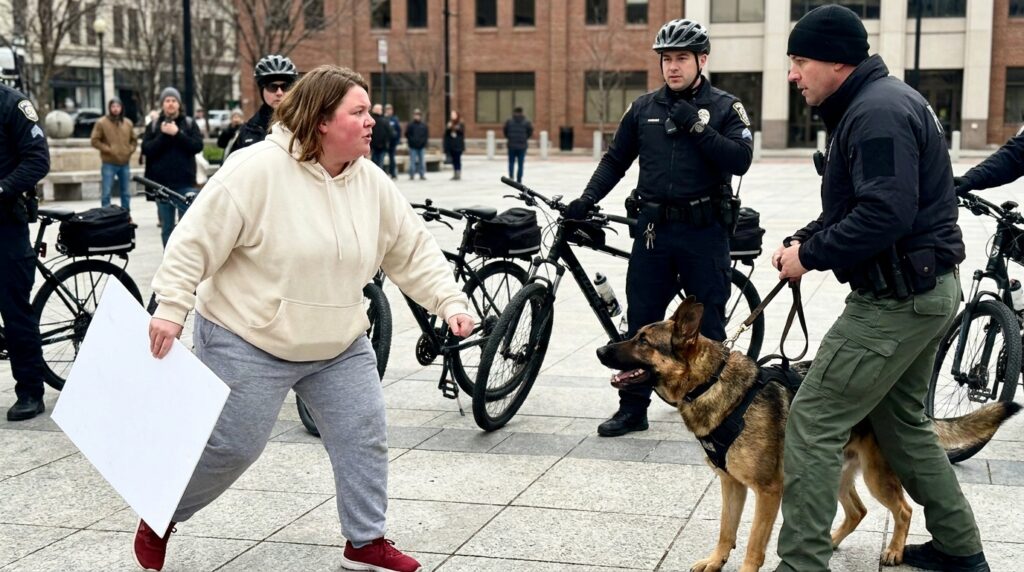
The sun-bleached concrete tiles beneath Brenda’s red sneakers felt utterly unyielding as the shadow of the bicycle officer dropped across her left flank. Her arm was already tightening to lift the pine stake, her shoulder drawing back to angle the blank white placard directly into the camera vector she had mapped out. But the frame didn’t lock. The visual path she was trying to force into existence was instantly severed by a thick sleeve of heavy black utility fabric.
The Bicycle Officer stepped into the midground with a flat, unhurried precision that completely ignored the high-frequency register of her screaming. He didn’t reach for his belt. He didn’t offer a dramatic display of force for the nearby phones. With the slow, deliberate momentum of a heavy weight shifting into place, he extended one long, rigid arm straight out between Brenda’s chest and the designated K9 lane.
His hand was flat, his fingers locked together, creating a hard physical barrier just four inches from the thick cream cotton of her hoodie. His face remained entirely composed behind his glasses, the glare from the open plaza sky turning the lenses into cold silver discs that gave Brenda nothing to read—no irritation, no professional hesitation, no opening for an argument.
“Keep moving back, ma’am, behind the line.”
The command was clipped, delivered in a low, flat frequency that carried the absolute, unyielding density of municipal law. It wasn’t an explanation; it wasn’t a debate about Section Four or zoning codes. The words hit Brenda mid-breath, their mechanical weight cutting off her public pressure shout before she could project the second half of her phrase toward the plaza benches.
Brenda’s red sneakers hitched on the concrete expansion joint. Her stocky forward lean collapsed back into her heels, the sudden loss of momentum sending a jarring shock through her knees. She stared at the officer’s extended arm, the heavy black nylon fabric of his sleeve showing tiny, ground-in specks of gray road grit along the seam. Beyond his shoulder, the K9 handler stood like a column of dark stone, his gloved hand still holding the single loop of the leash, his German Shepherd remaining perfectly quiet and alert at his heel, its tongue lolling out in a slow pant that seemed to mock the performative urgency of her stunt.
“This is an unratified restriction,” Brenda muttered, her throat dry, the words scraping against the silence that had suddenly dropped over the immediate circle of the square. She reached into her crossbody bag, her fingers frantically clawing at the thick corners of the manila envelope, desperate to pull out the indigo lines of the 1994 easement draft to prove the public nature of the lane. “The town council files from ninety-four state—”
“Behind the line, ma’am,” the officer repeated. His voice didn’t rise an octave. He didn’t lower his arm by a single millimeter. The flat barrier of his hand remained exactly where it was, an immutable physical boundary that completely invalidated the watermarked paper she was clutching against her ribs.
Out of the corner of her eye, Brenda saw the office workers near the concrete planter lower their forks. They weren’t watching an explosive exposure of police intimidation. They were watching a middle-aged woman in a bunching hoodie get systematically and quietly pushed out of a standard safety perimeter. One of them turned away, sliding their phone back into a pocket with a brief, dismissive shake of the head. The internet vacuum she had meticulously prepared was collapsing into a mundane public nuisance detail.
She took one step back, her shoe rubber scraping loudly against the stone, but as her hand moved inside her sweatpants pocket to brace her balance, her fingers brushed the sharp, cold edge of the secondary surveyor’s slip. The word unapproved seemed to pulse through the fabric against her thigh, a silent, secondary trap that she had forgotten in her rush to conquer the plaza. She had come here to demand an enforcement of boundaries, but the rigid arm in front of her was proving that the system only recognized the lines it drew itself, not the ones she unearthed in the dark.








