CHAPTER 3: THE PLAZA GRID
Three hundred and forty-two paces from the gravel perimeter of the municipal parking lot to the bottom tier of the city hall steps. Brenda did not drop her gaze as her red sneakers scuffed the transition line between asphalt and the smooth, sun-bleached concrete tiles of the civic plaza. Her fingers pressed through the thick pocket of her gray sweatpants, pinning the folded surveyor’s note against her thigh. The scratch of the old paper felt hot, an uncorrected weight that she had quarantined beneath the urgent business of the afternoon.
The heat in the open square didn’t behave like the heat in the cul-de-sac. Here, it radiated from the vertical faces of limestone columns and government glass, dry and metallic, carrying the distant drone of commercial truck traffic from the regional bypass. Brenda held the manila envelope flat against her chest with both hands, the heavy weight of the 1994 easement blueprint serving as a rigid shield between her oversized hoodie and the few pedestrians eating lunch on the concrete benches.
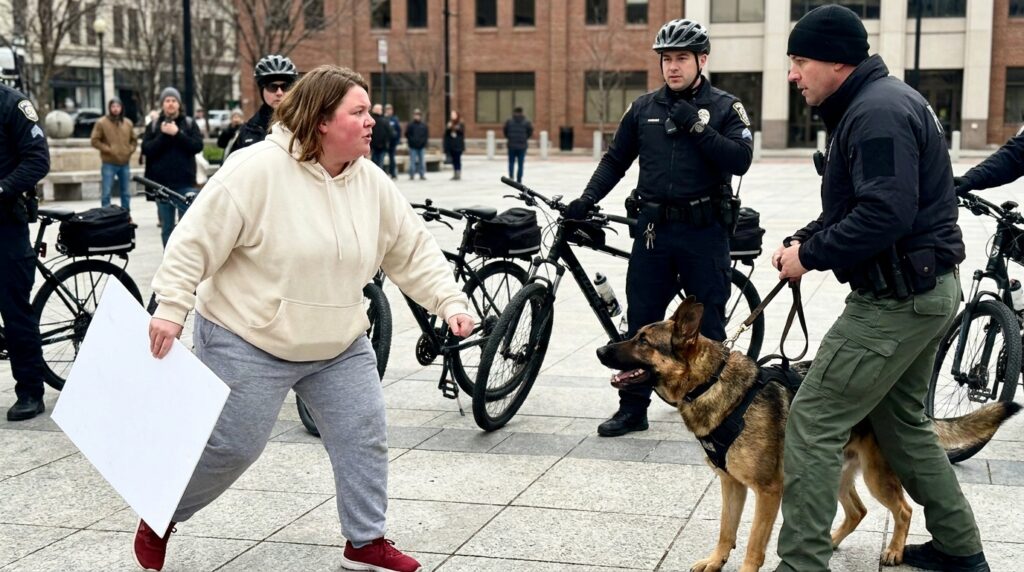
She stopped at the intersection of two expansion joints. To her left sat the municipal court building; to her right, the low, brick bunker of the precinct precinct headquarters. In the center depth, positioned near the broad granite steps where the city hall flags hung limp in the high July air, a row of dark utility bicycles formed a neat, static line.
Brenda raised her phone. Her thumb tapped the screen, opening the local neighborhood network app. The interface remained cold—no fresh alerts, no responses to her warnings about the turf trailer. Her fingers split the camera frame, zooming in until the grid lines on her screen aligned perfectly with the stone columns of the precinct portico. She wasn’t looking at the architecture. She was looking at the security perimeter.
Beneath the shade of the portico roof stood the K9 handler. Even from forty yards away, his silhouette read with a distinct, institutional weight: the black knit cap pulled tight above a short, dark beard; the matte black tactical vest over a dark windbreaker; the dull sheen of brass clips on the single nylon leash trailing down to his heel. Beside him, the German Shepherd sat upright, its tan-and-black head perfectly steady, its jaw slightly open in a relaxed pant that showed the pink line of its tongue.
They were the absolute anchor of the plaza’s public space. They were what the town used to define the boundary between general access and restricted municipal operations.
Brenda lowered the phone, her thumb sliding down to the plastic edge of her blue folder. She didn’t see a security detail; she saw a visual coordinate. If she stood exactly twelve feet from the bicycle line, right where the expansion joint cut toward the courthouse fountain, the camera lens would capture the dog’s head, the handler’s vest, and the unyielding brick facade of the precinct in a single vertical frame.
She walked toward the spot, her sneakers clicking in a slow, metered rhythm against the stone. She stopped. She turned the blank side of her protest placard toward her chest, the raw cardboard texture catching the rough fabric of her cream hoodie.
A young clerk in a short-sleeved blue shirt walked past her, his leather shoes making a light, hollow sound on the concrete tiles. He glanced at the blank sign, then at Brenda’s flushed face, his pace hitching for a fraction of a second before he looked down at his watch and accelerated toward the municipal court doors. The silence of the plaza closed in behind him, heavy and unmoving.
Brenda adjusted her grip on the wooden stake of the placard. The wood was rough, un-sanded pine that left tiny, dry splinters in the palm of her hand. She didn’t look down to pick them out. Her eyes were fixed on the K9 handler’s hands. He hadn’t shifted his posture. His fingers remained looped through the nylon handle of the leash, his knuckles still and grey in the shade.
She checked the digital grid on her screen one more time. The spacing was exact. The K9 lane—the open six-foot corridor between the bicycle line and the granite steps—was clear. The public was entirely absent from that narrow strip of stone. It was an artificial boundary, an unfiled restriction maintained by nothing but habit and the presence of the dog.
She tucked the folder tighter under her arm, her shoulder blades locking as she took a deep breath of the hot, exhaust-tainted air. The surveyor’s note in her pocket felt like a cold stone against her leg, but the paper in her hands—the watermarked 1994 draft—was what she needed right now. She would bring the cul-de-sac to the plaza. She would make them draw the line where everyone could see it.