
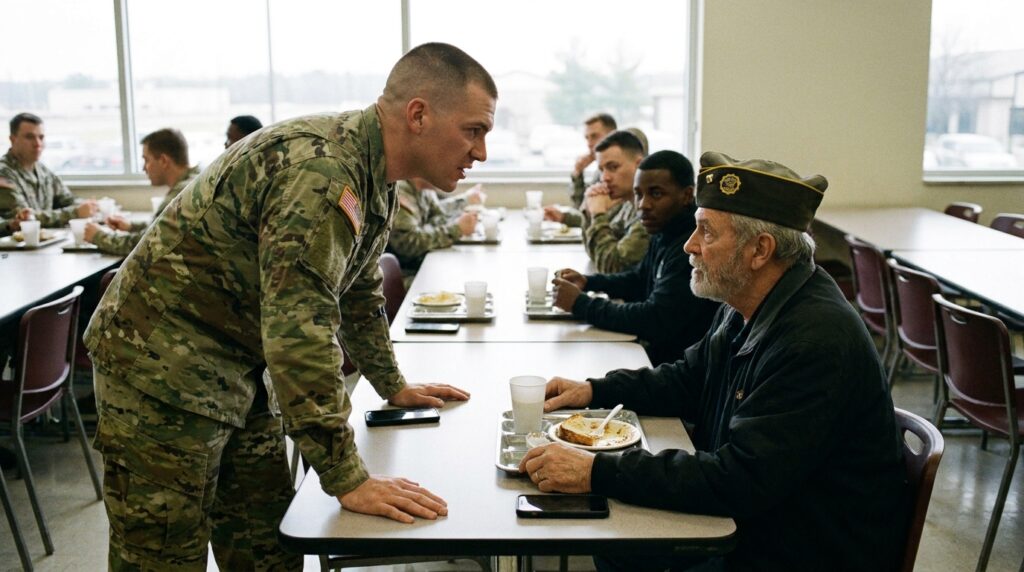
CHAPTER 5: THE PRIVATE RECKONING
“Throw your papers on the steel, old man. Let’s see what kind of ghost we let through the gate.”
The colonel didn’t drop his leather briefcase onto the desk; he placed it precisely parallel to the modular gray partitioning. The back office of the logistics center smelled of fifty years of carbon copies, dead air, and the specific bitter tang of a heating unit that hadn’t been cleaned since the Panama mobilization. A single industrial desk, fabricated from olive-drab sheet metal with zinc-plated corners, occupied the dead center of the room beneath a caged inspection lamp.
I didn’t reach for my pocket immediately. I stood by the doorframe, my boots planted on the exposed concrete where the green floor enamel had long since flaked away into fine dust. “The gate guards check what they’re paid to check, Colonel. A blue card doesn’t expire in the system just because the names on the list get short.”
“Your card didn’t just flag a gate log,” the colonel said, his fingers working the brass tumblers of his briefcase locks with three sharp, rhythmic clicks. He swung the lid up, revealing the manila folder with the red security tape resting alongside a stack of modern digital manifests. “It triggered a silent alert in the command network. The Seventh Supply Depot hasn’t had an authorized signature in the active routing registry since the winter of nineteen eighty-six. Every logistics lane we’re currently spooling up for the Ninth Battalion’s transit is pulling structural data from a ledger that shouldn’t exist.”
The older master sergeant stayed by the door, his shoulder pressed against the painted cinder block wall. His arms were crossed, his broad chest tightening the fabric of his service shirt until the silver thread on his long-service stripes gleamed under the zinc lamp. His gray eyes stayed locked on my right pocket. He knew what the weight of three brass keys sounded like when they hit an iron desk.
I pulled my hand from the canvas pocket, the key ring clicking against the zinc surface as I let it slide across the green lacquer. The small brass P-38 can opener spun once, its dull edge catching the light before pointing like a compass needle toward the colonel’s briefcase. Beside it lay my old service identification—the laminated paper brittle, the edges yellowed and frayed, bearing the stamp of the long-deactivated Seventh Supply Depot.
The colonel didn’t touch the keys. He picked up the faded identification card by its plastic corner, squinting through his low-profile reading glasses at the ink signature across the bottom.
“Forty years,” the colonel muttered, his voice dropping into a flat, transactional drone. “According to the archival purge, the subterranean vaults under the maintenance bays were cleared and backfilled with gravel when the old regiment dissolved. But the current electrical draw on the lower sub-station says otherwise. Someone is maintaining the terminal links down there. The logs are still updating.”
“Gravel doesn’t stop a data line if the conduit was wrapped in lead,” I said. My voice was low, carrying the hard edge of a man who had personally poured the concrete over the main junction boxes in seventy-six. “Your modern engineers think everything runs on a glass wire through the air. They don’t know how to look for a three-inch iron pipe buried twelve feet deep under the motor pool.”
The master sergeant shifted his weight, his leather shoes scraping the flaked floor enamel. “I told you, sir. The old guard didn’t use electronic clearance codes. If you wanted into the storage grid, you needed the physical registry. The specialist thought he was dealing with a civilian loiterer because he doesn’t understand that the infrastructure under his boots is older than the division.”
“The specialist is currently being written out of the deployment manifest,” the colonel said, his jaw tightening as he slid the manila folder across the zinc desk toward me. The red security tape had been sliced clean with a desk knife, its edges curling like dead skin. “Look at the coordinate grid on page three. That’s the target zone for the Ninth’s vehicle staging next week. The staging area is designated as Area K-Fourteen.”
I didn’t open the folder. I didn’t need to. The designation K-Fourteen hit my ears with the physical weight of a closing steel bulkhead. It was the exact coordinate of the remote valley where my old recovery team had been deployed during the final month of the eighty-six drawdown—the location where four hundred tons of unclassified equipment had vanished from the system during a forty-eight-hour communications blackout.
“Area K-Fourteen isn’t a staging zone, Colonel,” I said, my palms settling onto the cold edge of the zinc desk, feeling the faint, deep vibration of the sub-floor transformers humming beneath the building’s foundation. “It’s a burial ground. If you send the Ninth’s heavy armor into that valley, the ground isn’t going to hold the weight.”
The colonel leaned over the desk, his eyes narrowing into two sharp points of gray light behind his lenses. “The modern geological scans say the bedrock is stable, sir. The engineers cleared it last Tuesday.”
“The modern scans are reading the top sixty feet of shale,” I countered, my thumb tapping the brass ring of my keychain. “They aren’t reading the three tiers of reinforced storage vaults we built out of surplus steel plating after the treaty was signed. Layer One is the decoy—your people think it’s an old cold-war fuel bunker. But if you break that seal to set up your radar arrays, you’re going to drop twenty-four active-duty vehicles straight into the true baseline.”
The room went completely silent again, the air thickening with the sudden realization that the conflict in the cafeteria wasn’t a random dispute over a seat. The young specialist’s movement orders were a direct line into an ancient, structural trap—and the only man who held the physical index to the baseline was currently sitting under their inspection lamp.
The master sergeant stepped away from the door, his hand rising toward the small, triple-notched silver rivet that held the backing of the office security safe against the wall. His fingers didn’t touch the metal; they hovered there, his face turning pale as he noticed a faint, fresh scratch across the lacquer of the vault door—the signature mark of an unredacted logbook that had been moved within the last twenty-four hours.








