
CHAPTER 4: THE INSTITUTIONAL SHIFT
“The Ninth Battalion doesn’t move without a clear manifest, Colonel.”
I didn’t reach for the manila folder. My left hand remained draped over the edge of the adjacent bench, one finger pinned to the cold, wet rim of the milk carton. The red security tape across the folder’s flap was thick, the kind that left a structural diamond pattern behind if someone tried to dissolve the adhesive with a heated razor.
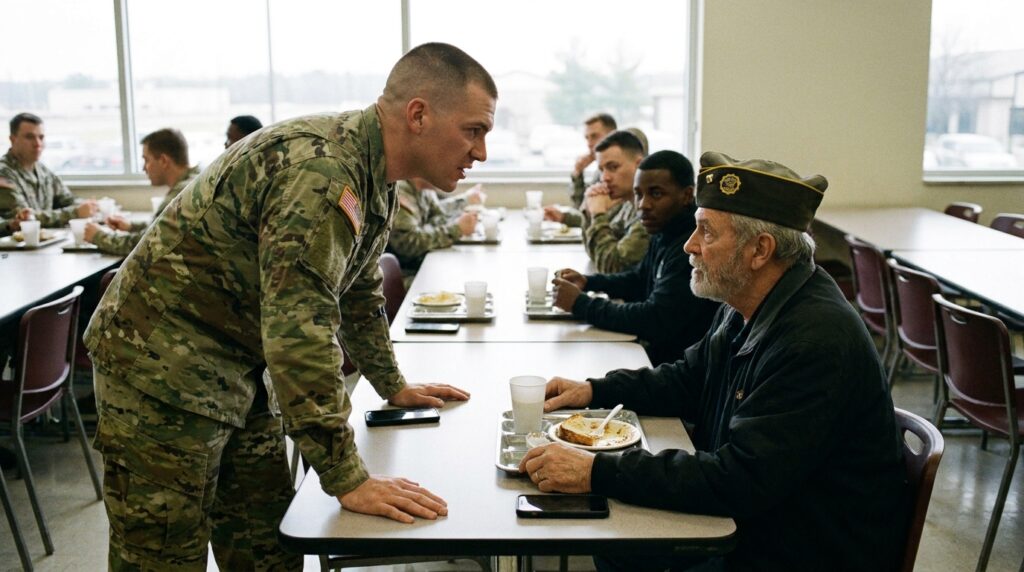
The colonel didn’t lower his arm. His silver eagles remained perfectly level, catching the blue reflection of the cafeteria window like two small, cold eyes. Behind his shoulder, the elder of the two master sergeants shifted his boots, the leather creaking against the unwashed linoleum. The sergeant wasn’t looking at the folder or at his superior officer. His gaze was fixed on the peak of my cap, tracing the tarnished silver thread with the narrow, calculating focus of a man who spent his life measuring the distance between an order and an execution.
“The Ninth isn’t moving under standard logistics anymore,” the colonel said. His tone was clipped, the syllables dry and short. He took one step closer, his thigh pressing against the edge of the upended pedestal, his pristine trousers instantly catching a smear of red chili grease. He didn’t blink. He didn’t look down at the stain. “We have forty-eight hours before the tracking network goes active at the perimeter gate. If the transit vaults aren’t verified by an officer with prior clearance, the entire manifest drops into the gray lane.”
“Then let it drop,” I said. My thumb slid down the side of the cardboard milk carton, leaving a clean trail through the condensation. “The gray lane is where the old regiment kept its errors anyway. Your people shouldn’t be digging around the foundation.”
A sharp intake of breath came from one of the junior lieutenants near the beverage bar. To a three-month officer, speaking to a colonel without a formal preface was a court-martial offense; to me, it was simply an exchange between two men who knew exactly how many tons of concrete it took to hide a bad logistics report.
The older master sergeant finally broke his stance. He took a single, heavy stride forward, his hand rising to touch the colonel’s elbow—a gesture that broke every rule in the manual, yet went completely unpunished. He leaned into the narrow space between the staff officer and my bench, his shoulder blocking the view of the remaining trainees who were still watching from the middle rows.
“Sir,” the sergeant said. He wasn’t addressing the colonel. He was looking at the small brass key ring protruding from my canvas jacket pocket. “He isn’t from the transit pool. Look at the patch on the collar line, Colonel. That’s the old Seventh Supply Depot. The ones who ran the logistics for the classified storage before the eighty-six drawdown.”
The colonel’s arm went rigid. His eyes flicked from my face down to the faded olive-drab canvas beneath my chin, where the small, blackened brass pins of a long-deactivated supply command were tucked into the wool lining. The metal was pitted, ruined by decades of damp air and basement storage, but the outline—the crossed keys beneath an anvil—was still readable to anyone who had studied the institutional history of the base.
“The Seventh was erased from the ledger forty years ago,” the colonel whispered.
“The paper was erased,” I corrected him. My voice remained low, a dead level that stayed below the hum of the fluorescent lights. “The concrete didn’t go anywhere. You built the modern cafeteria right over the top of the old ventilation shafts. I can hear the air hum under my boots every time the motor pool starts their trucks.”
The master sergeant didn’t answer. He slowly brought his right hand up to his brow, his fingers locking into a rigid, textbook salute that had nothing to do with the current base administration. It was a salute for the dead unit—the one that had held the line when the supply chain failed during the winter of seventy-four.
The three junior lieutenants near the beverage dispenser went pale. The spectacle of a master sergeant with thirty years of service stripes saluting an old man in a stained canvas jacket was a complete inversion of everything the base manual taught them about the nature of authority.
“Drop your hand, Sergeant,” I said, my thumb still tracing the cold cardboard of the milk carton. “I don’t have a ledger for you to sign.”
The sergeant lowered his arm, his fingers curling into a tight fist against his seam. “The specialist didn’t know who he was crowding, Colonel. He’s with the new rotation. They think anything without an electronic bar code doesn’t exist.”
“The specialist is an idiot,” the colonel said, his voice sharpening as he finally withdrew the manila folder and tucked it back beneath his arm. He looked at the three junior officers, his expression turning cold. “Clear this room. Every trainee on this shift is to be logged at their barracks within ten minutes. If I see a single phone out of a pocket, the entire company stays on the wash rack until the deployment order expires.”
The room moved instantly. The silence broke into a frantic, mechanical scuffle as the trainees gathered their gear bags and backed toward the exits, their eyes darting back toward my seat as if trying to memorize the silhouette of an unclassified weapon. Within ninety seconds, the only sounds left in the cavernous hall were the low, rhythmic clank of the tray return line and the slow, wet dripping of the milk from the upended table onto the floor cleaner below.
The colonel turned back to me, his pale face tight under the glare. “We’re going to the back office, sir. And you’re bringing those keys.”








