
CHAPTER 2: THE UPENDED AXIS
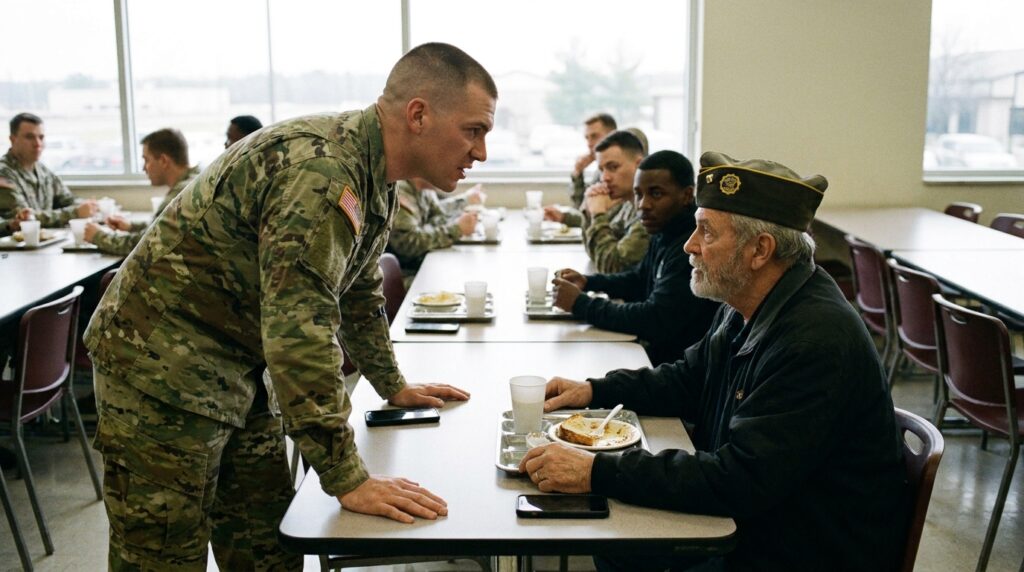
The iron welds underneath the laminate didn’t give way; they became a lever. I didn’t pull back—I drove my hips forward, using the rigid frame of the plastic chair as a brace, and slammed the palms of my hands upward into the steel ribs of the pedestal.
Physics is a clean, unblinking ledger. When a hundred and eighty pounds of modern muscle leans sixty percent of its mass over a counterweight, it doesn’t take a miracle to tip the scale. It takes four inches of pure vertical torque.
The heavy composite top exploded upward.
Miller’s smirk wasn’t even gone before the front edge of the table caught him beneath the low curve of his breastplate. The sound was a dull, hollow thud—the impact of wood-grain laminate meeting a tactical vest filled with synthetic fiber and small ceramic inserts. His white knuckles lost their grip on the rim, his fingers slipping across the polished surface as his center of gravity was violently deleted.
The single meal tray pinned near my left forearm went airborne first. The small carton of milk burst against the metal zipper of his uniform, a white streak cutting through the digital camouflage pattern before the heavy ceramic bowl of chili followed it, splashing dark, thick grease across his throat and the sharp line of his collar.
But the table didn’t stop at his chest. I kept my weight behind the lift, my boots digging into the salt-stained linoleum floor until the pedestal cleared its vertical axis. The entire structure went over like a collapsing bulkheads. Trays, plastic cups, and cheap metal forks cascaded outward, clattering against the concrete floor like a handful of gravel thrown into a turbine.
Miller didn’t fall clean. His athletic frame tried to compensate—his boots skittered back, his heels catching the edge of a plastic gear bag left by one of the trainees behind him. He went down hard, his spine hitting the lower crossbar of an adjacent row of seats before his shoulders met the floor. The sound of his descent was loud, wet, and thoroughly public.
The cafeteria stopped breathing.
The drone of three hundred voices—the arguments about physical training scores, the logistics of the third-shift motor pool, the casual laughter of people who thought they were safe behind military wire—shattered into absolute, vacuum-sealed silence. Somewhere near the tray return line, a plastic cup rolled across the floor, its rhythmic clack-clack-clack the only clock left running in the room.
I didn’t stand up. I remained right where I was, my spine settled into the contours of the plastic seat, my hands returning to my thighs. My right hand slid back into the canvas pocket of my jacket, my thumb finding the notched edge of the brass P-38 can opener on my keychain. My breath was slow, a single, deliberate draw through my nose that didn’t rattle.
Miller lay in the center of the debris field. The modern digital pattern of his uniform was ruined—soaked through with lukewarm brown grease and the dripping white film of the base-commissary dairy. His buzz cut was dusted with crumbs from the white bread. For three seconds, his eyes were wide, staring up at the white-hot glare of the fluorescent tubes overhead as if trying to locate the mortar tube that had just registered his coordinates.
Then the shock turned into something narrow and dark. His jaw tightened, the veins in his thick neck bulging against the wet collar of his jacket as his palms flat-lined against the floor to push his weight back up. He was a specialist. He had two years in the division and a physical fitness badge on his chest, and he had just been put on his back by a man whose retirement papers were older than his enlistment contract.
“You old son of a—”
“You should have left well enough alone, son,” I said.
The words didn’t carry the weight of a shout. They didn’t need to. In that specific kind of quiet—the kind that settles over a platoon when the first trip-flare goes off in the wire—a whisper carries better than a command. My voice was a dead level, stripped of any anger, stripped of any defensive heat. It was the tone of an inspector marking an unserviceable vehicle for the scrap heap.
Miller froze, his elbows locked half-way through his rise. His eyes met mine across the ruined space where the table had been. He was looking for the senile confusion he’d tried to exploit two minutes ago. He was looking for the trembling fingers of an old-timer who had wandered off the civilian bus line.
He didn’t find them. He found thirty years of concrete. He found the unblinking, gray focus of a man who had cleared supply lines through Hue when the current active-duty command was still in elementary school.
Beneath the wet camouflage fabric of his right shoulder, a small, dark red stain was beginning to spread—not from the chili, but from a sharp, metallic edge beneath the table’s edge that had caught his sleeve during the flip. A tiny, square piece of paper had dislodged from the interior pocket of his tactical vest during the tumble, its white corner sticking out from beneath a crushed plastic cup near his left boot. It was an official printout, bearing the gray watermarked seal of the Department of the Army, and the top line of the text contained a single word in bold stenciled print: MOVEMENT.
Miller’s eyes flicked down to the paper, then back up to my face. The unearned arrogance in his expression was completely gone, replaced by the sudden, sickening realization that every single person in the room—including three junior lieutenants from his own battalion—was currently recording the exact measurement of his failure.
His mouth moved, but the volume was gone. His boots scraped against the linoleum as he gathered his legs under him, his hands rising slightly in a short, defensive gesture that didn’t look like a soldier preparing for a fight. It looked like an apology.








