
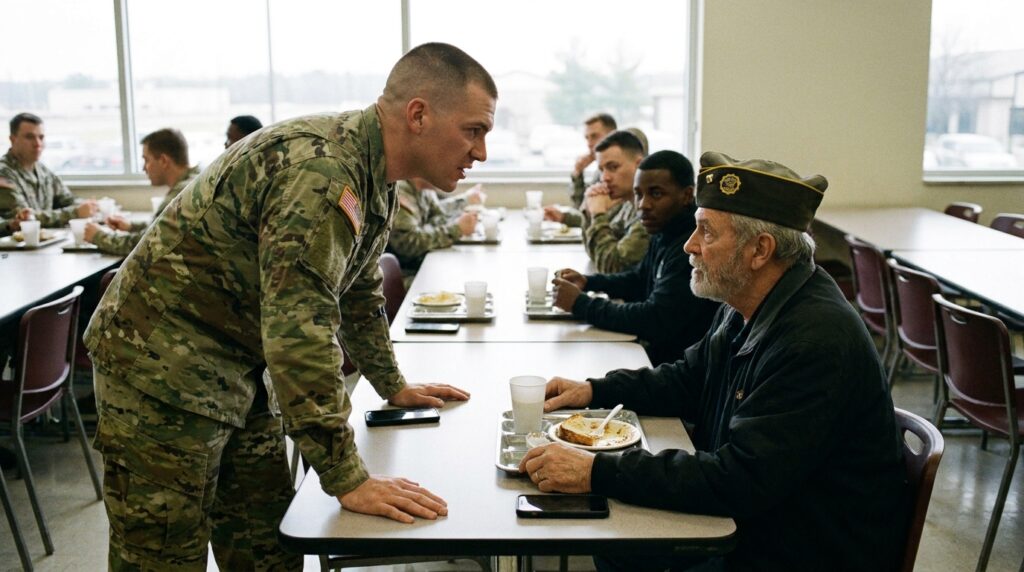
CHAPTER 3: THE YIELDED LANE
The tactical vest did not possess an defense against gravity. Specialist Miller remained frozen on his side for three full beats of the wall clock, his breathing rattling against the floorboards like a loose belt in an engine block. The pool of spilled commissary milk was already graying as it drew the fine dust of the linoleum into its margins, creating an oil-slick halo around his modern boots.
“All right,” he muttered. The unearned brass in his voice had vanished, replaced by the thin, flat tone of a man who had suddenly found the edge of a cliff in the dark. “All right, I get it.”
He didn’t look at the junior lieutenants from his battalion who were backed against the beverage dispensers. He didn’t look at the thirty trainees whose plastic forks were suspended mid-air like rows of small teeth. His focus was locked entirely on my right sleeve, tracking the slow, unhurried rhythm of my arm as it settled back onto my knee. He was looking for the twitch—the residual vibration that remains in a muscle after an amateur throws an unauthorized strike.
He didn’t see one. A proper lever doesn’t shake after the weight is moved; it simply returns to the shelf.
I leaned slightly forward, the stiff canvas of my jacket creaking in the silence. The scent of the spilled chili was sharp, heavy with iron and old salt, rising from the broken composite board between us. “Pick up your trash, Specialist.”
My delivery didn’t rise to meet the cavernous ceiling of the hall. It stayed down in the grease with him, cold and level.
Miller’s left palm skidded once on the wet floor before he found his purchase against the leg of an adjacent bench. He dragged his athletic frame upward, his boots making a soft, sucking sound as he cleared the mess. The arrogance had been thoroughly scraped from his posture, replaced by a rigid, mechanical haste. He didn’t look me in the eye as he bent down, his fingers catching the corner of the watermarked stenciled paper—the movement tracking order—that had slipped from his protective vest. His thumb deliberately covered the bold stenciled word at the top, folding the sheet twice into a tight, hard square before stuffing it deep into his lower cargo pocket.
The room didn’t thaw. The three hundred men and women in the facility remained pinned to their positions, their attention focused on the slow, heavy cadence of Miller’s retreat. He didn’t salvage his gear bag; he left the olive-drab nylon strap tangled under the frame of the neighboring table, stepping backward into the blue-tinted shadows near the exit doors with his chin tucked into his collar. He was a small man now, regardless of the athletic build or the modern digital pattern on his chest. He had been measured against an older scale, and the deficit was visible to every private in the room.
My fingers remained inside my pocket, resting against the key ring. The small brass P-38 was warm from my body heat, the notch of its tiny blade smooth under my index finger.
The immediate threat had vanished through the double doors, but the air in the cafeteria remained heavy, charged with the subtext of an unresolved intrusion. I could feel the eyes of the civilian contractors at the far counter—men who wore the gray utility uniforms of the base maintenance crew—shifting from the overturned pedestal to the old unit patch sewn onto the right shoulder of my canvas jacket. They knew the three rows of silver thread on my cap weren’t surplus store acquisitions. They knew what kind of outfit used that specific weight of iron for its field equipment forty years ago.
A door behind the serving line clicked open, the sound of an iron latch dropping into place. The smell of floor cleaner and institutional bleach began to slide across the room, cutting through the heavy grease of the chili.
I didn’t turn my head to track the sound. In my line, you don’t look for the next move with your eyes first; you listen for the change in the room’s resonance. The soft, rhythmic click of low-quarter leather shoes—not tactical boots—was moving down the center aisle from the administrative corridor. It wasn’t the stride of a trainee or a clerk. The spacing of the heels was exact, measured, and perfectly timed to a standard forty-inch regulation step.
I reached out with my left hand and drew the single untouched item from the debris near my boot: the small, white carton of commissary milk. It was cold, the cardboard damp with sweat, the seal unbroken. I set it on the edge of the adjacent bench, my thumb tracing the square blue stamp on the top flap. The expiration date was listed as June 1986—an old stock code from the reserve vaults that the base supply system still used for its non-perishable distribution lines.
The leather shoes stopped exactly two paces from the edge of my ruined station. A pair of pressed trousers, dark blue with a gold officer’s stripe running down the seam, entered my peripheral vision. The fabric was immaculate, free of the red clay dust that coated every active-duty boot on the base.
“Sir,” a voice said from above the blue trousers. It was a clean, dry cadence, the tone of a man who spent his mornings reviewing asset ledgers rather than drilling platoons in the heat. “The commanding general has been informed that your blue identification card was logged at the main gate two hours ago. We’ve been waiting for you in the logistics office.”
I looked up. The man standing there was a colonel, his silver eagles catching the harsh overhead light like small, cold mirrors. His face was pale, lined with the specific exhaustion of a staff officer who had spent the last twenty-four hours trying to reconcile a missing freight manifest before the inspection teams arrived from Washington. Behind him, two master sergeants stood with their hands clasped behind their backs, their eyes fixed not on the overturned table, but on the small brass keys protruding from my jacket pocket.
“The transit line is running behind schedule, Colonel,” I said. My hand didn’t move from the milk carton. “I was told the cafeteria was the only station with an open ledger.”
The colonel didn’t look at the three junior lieutenants who were still frozen near the beverage bar. He didn’t acknowledge the mess or the grease that was slowly seeping into the grain of the linoleum. He simply reached into his leather briefcase and pulled out a thin, manila folder secured with a length of red security tape.
“The ledger isn’t open anymore, sir,” the colonel said, his voice dropping into a tight, transactional murmur that didn’t travel past the edge of my bench. “The deployment schedules for the Ninth Battalion were altered at midnight. The coordinates Miller had in his vest—they aren’t active. We need the old logs from the transit vault. The ones you took with you when the regiment was deactivated.”
He held the folder out, the red tape catching the blue reflection of the cafeteria window. The room remained perfectly quiet, but the silence had changed its color. It wasn’t about a young soldier’s arrogance anymore. It was about the weight of what was buried underneath the concrete of the base perimeter.








