CHAPTER 7: THE CRUMBLING OF THE BOUNDARY
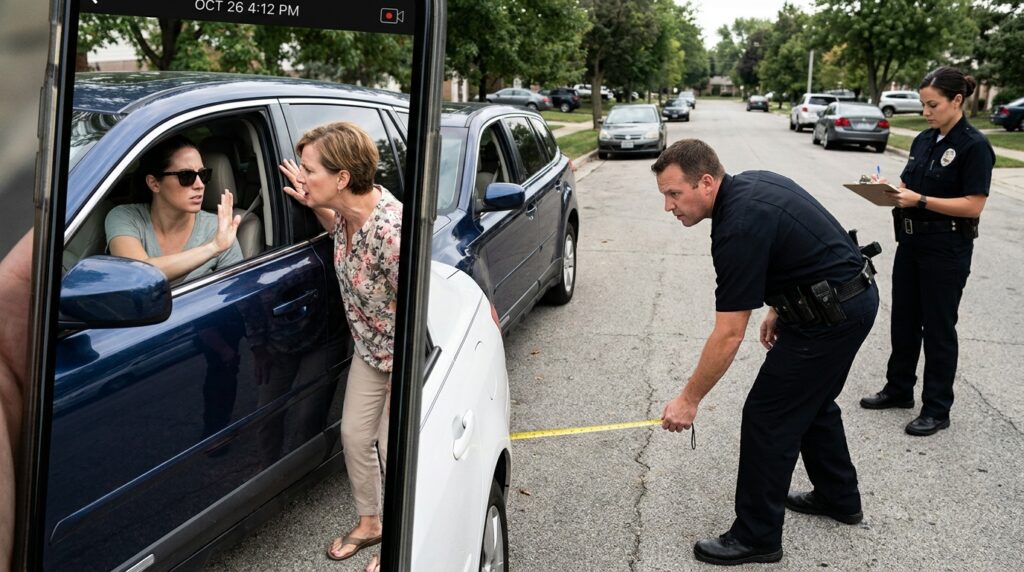
The bright yellow ribbon of steel whipped back into its plastic casing with a sharp, heavy snap that signaled the absolute end of the municipal calculation.
The lead officer straightened his blocky frame, his dark uniform absorbing the brutal glare of the afternoon sun as he stepped cleanly off the scattered pink papers. He didn’t pick up the self-inking stamp. He let it remain half-buried in the loose gravel, a physical artifact of a fraudulent authority that had completely lost its structural integrity under the weight of the county numbers. He looked past Evelyn Vance, his gaze fixing on the wide porches across the street where the pale faces behind the raised blinds suddenly, collectively retreated, the soft clack of closing vinyl slats rippling down the block like a small, domestic retreat.
“The measurement is definitive, Ms. Vance,” the officer delivered, his voice dropping into a transactional, ice-cold rumble that left no room for bureaucratic pivot. “The resident’s crossover vehicle maintains full clearance. Your driveway apron, however, extends exactly thirty-six inches into the municipal fire easement. If an engine blows a tire on this concrete radius during an access run, the county surveyor’s report logs this address as the primary point of obstruction.”
Evelyn didn’t shift her weight back to her heels. Her sandals stayed jammed against the raw edge of the concrete flare, her hands clutching her torn canvas tote bag with a frantic, waxy grip that made her knuckles look like dry bone. The crispness of her floral blouse had entirely dissolved under the heavy, radioactive lawn dust and the thick heat coming off my crossover SUV’s hood. Her short hair, previously sprayed into a rigid, defensive block, looked damp and frayed at the temples.
“This is an established property line,” she whispered, her voice cracking, stripped of the clinical drone she had used to terrorize the street for three decades. She looked at the documenting officer, whose cheap blue ballpoint pen had ceased its rapid scratching to simply rest against the composite clipboard, tracking her every expiration. “My husband hired the independent grading crew. We paid the subdivision assessment in full. The neighborhood board verified the clearance before the topcoat was poured.”
“The association doesn’t override the municipal grid, ma’am,” the documenting officer muttered from the midground. She didn’t offer an ounce of neighborhood sympathy. Her fingers adjusted her heavy duty belt, her eyes pinned strictly to the formal entries on her sheet. “Using a simulated city seal to enforce private driveway setbacks is a code violation that goes straight to the city attorney. You need to gather these papers and clear the right-of-way.”
I stood motionless by my open driver-side door, my sunglasses masking the cold, methodical assessment of her collapse. Evelyn wasn’t just losing a parking dispute; her entire thirty-year fortress—built on forged citations, fake sectors, and the passive-aggressive weaponization of city ordinances—had been reduced to a non-compliant slab of pouring concrete. The sovereign protector of the block had become its primary municipal liability.
Slowly, with a heavy, uncoordinated movement, Evelyn sank to her knees on the scorched grass. Her hands, dry and covered in gray limestone powder, began fumbling through the weeds, scooping up the fluttering pink carbon slips that had scattered around her sandals. The confidence that had defined her silhouette was completely gone, replaced by the broken posture of an administrator whose ledger had been declared a fraud in front of the very block she claimed to govern.
The lead officer turned his back to her, his large shoulders cutting off her remaining visual lane as he stepped toward my position on the asphalt. The texture of the setting was shifting; the blistering white glare remained, but the psychological pressure had broken away from my vehicle, settling entirely onto the cracked foundation of the garage behind him.
“You’re clear to disengage,” he said to me, his tone low, sparse, and flatly professional as he reached for his radio. “We’ll be holding the scene to log the code warning for the encroachment.”