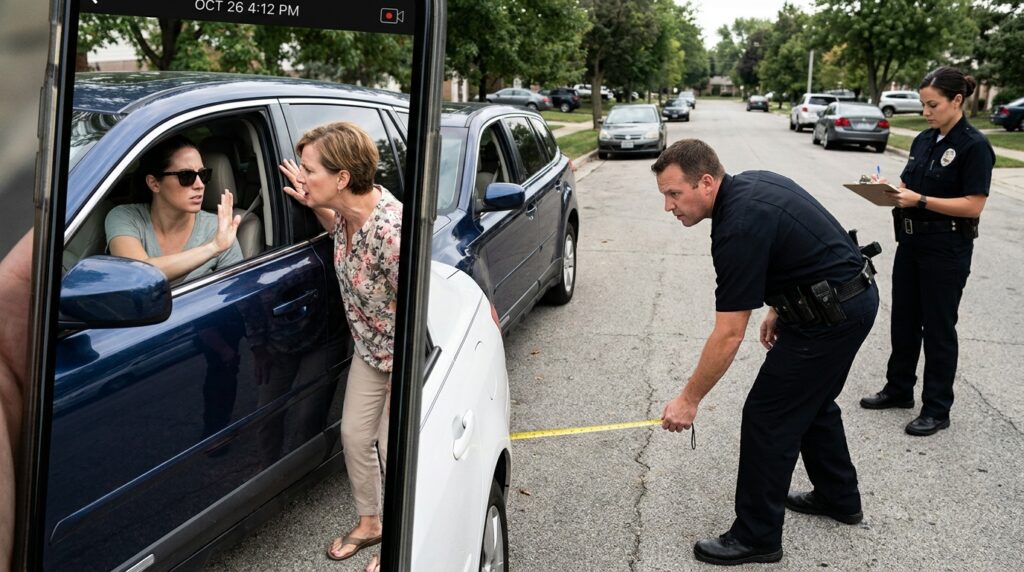
CHAPTER 4: THE STEEL VERDICT
The yellow steel ribbon pulled out with a long, metallic hiss, its curved blade catching the brutal glare of the midday sun.
The lead officer kept his left knee anchored in the dry dirt strip, his thumb pinned against the heavy plastic locking toggle of the tape case. The mechanical scrape of the blade against the rough concrete edge of the curb was the only sound left on the block. He didn’t look up as he dragged the metal end toward my front tire, his uniform shirt darkening with a broad crescent of sweat between his shoulder blades.
“Hold the zero mark right on the flange edge,” he directed over his shoulder, his voice completely flat.
The second officer moved in seamlessly. Her heavy utility boots made a quick, gritty crunch on the loose pebbles as she stepped into the dirt, anchoring the flat brass hook of the tape measure against the notched center of the iron utility cap. She kept her clipboard clamped under her arm, the cheap blue pen clicking twice against her thumb as she stabilized the line.
“Zero locked,” she reported.
Evelyn Vance didn’t stay on her designated square of sidewalk. Her sandals slapped against the concrete as she lunged forward, her forward-leaning stance reasserting itself. She brandished her contractor’s notebook like a shield, her knuckles turning a bloodless, waxy white against the cheap cardboard backing. The canvas tote bag slung over her arm swung out, hitting the side panel of my crossover SUV with a dull, hollow thud.
“You’re tracking from the wrong datum line!” she insisted, her voice vibrating with a high, defensive register that shattered the quiet of the block. A stray bead of sweat broke from her short hair, tracing a line through the heavy powder on her cheek. “The ninety-two ordinance clearly adjusted the municipal apron by three degrees to account for the cul-de-sac radius. If you don’t reference the subdivision ledger, your baseline is legally non-binding!”
I watched her through the three-inch gap in my window, my hand resting motionless near the ignition lock. My calculation remained absolute: every syllable she dropped was an anchor dragging her deeper into an institutional void. She wasn’t just arguing numbers anymore; she was trying to rewrite the physical layout of the asphalt to fit the perimeter she had spent three decades patrolling.
The lead officer didn’t stop pulling the tape. He let out another six feet of steel, the yellow blade vibrating under the tension. “Ma’am,” he said, his thumb snapping the locking toggle down with a sharp, heavy click. “I am measuring from the brass survey pin stamped by the county recorder in two thousand fourteen. This is the only legal anchor for this right-of-way.”
He shifted his weight, his boot heel grinding into a patch of dried crabgrass as he brought his eyes level with my front tire. He looked at the black rubber sidewall, then down at the black numbers etched onto the yellow steel.
“Eighteen inches clear of the municipal transition,” he muttered, his voice echoing off the wheel well. He stood up slowly, his joints popping with a dry, organic snap that matched the heat of the afternoon. He let the tape retract, the metal ribbon screaming as it whipped back into the housing with a heavy, spring-loaded slam. “The vehicle is perfectly compliant with the standard curb allowance. It’s not even close to the restriction.”
“That’s impossible!” Evelyn’s voice didn’t just rise; it split. She took two aggressive steps closer, her hand diving back into the interior pocket of her canvas tote bag with a frantic, desperate velocity. “I have the official warning slip right here! Signed by the code enforcement supervisor during the spring audit!”
She pulled a folded sheet of bright pink carbon paper from the worn leather folder, thrusting it directly toward the lead officer’s face.
The action was too fast, too erratic. As she jerked the document out, the frayed edge of her old leather folder caught on the metal zipper of her bag. The spine split completely with a dry, tearing sound, spilling its internal contents directly across the scorched asphalt between her sandals and the officer’s boots.
A dozen pink and yellow citation sheets scattered across the gravel, fluttering in the hot updraft from the SUV’s radiator.
The lead officer didn’t reach for the paper she was holding. His eyes dropped instantly to the sheets covering the ground. Even from my position inside the cabin, looking through the narrow window gap, the anomaly was glaringly obvious. The bright pink carbon sheets weren’t official city issue; they were standard commercial receipt pads available at any local office supply store. But across the top of each page, a purple ink stamp had been repeatedly pressed—a crude, slightly off-center imitation of the municipal city crest.
Beside one of the scattered sheets lay a small, self-inking rubber stamp mechanism, its plastic base stained with the exact same shade of fresh purple ink.
The documenting officer stepped forward, her cheap blue ballpoint pen immediately moving to her clipboard. She didn’t write a measurement. She knelt, using the tip of her index finger to flip one of the pink sheets over, exposing the blank, unprinted backing of a generic retail form.
“Ms. Vance,” the lead officer said, his voice dropping into a dangerous, clinical quiet as he looked up from the rubber stamp on the asphalt. “Where exactly did you say you received this municipal ledger?”
Evelyn froze, her floral blouse suddenly dropping its forward lean as her hands remained suspended in the dead air, her fingers still clutching the single forged citation slip.