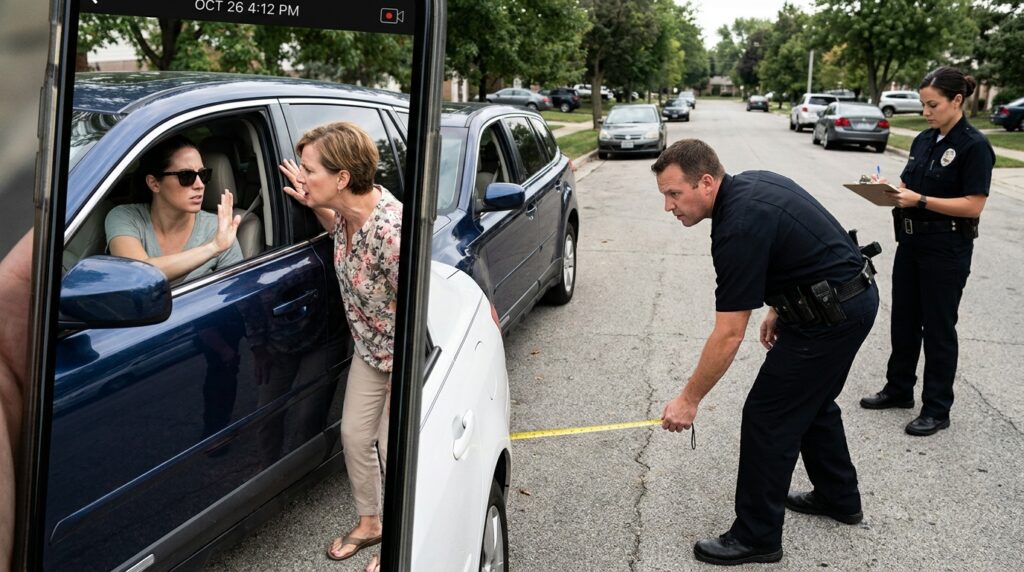
CHAPTER 2: THE GRIT OF THE CURB LINE
The heavy, mechanical rattle of the diesel engine vibrated right through the floorboards of the crossover SUV, humming upward into the soles of my sneakers. It wasn’t the sound of an ordinary commuter car. It was the low, industrial idle of a municipal cruiser, the suspension squeaking subtly as its tires ground against the loose gravel and dried mud gathered at the mouth of the cul-de-sac.
Behind the mirrored surface of her sunglasses, my neighbor’s eyes did not widen. Instead, her jaw set into a rigid, defensive block, the muscles along her neck tightening like cables under the faded floral pattern of her blouse. She didn’t pull her hand off my car door. Her short, light-brown hair remained perfectly static in the dead midday heat, but her fingers pressed down harder against the paint, leaving tiny, smudged crescents of oil and suburban grime on the blue metallic finish.
“Good,” she muttered, her voice dropping into a flat, raspy register that barely cleared the three-inch gap in my window. “They’re finally here. I told the dispatcher this was an active blockade. I told them you were obstructing the residential right-of-way.”
I didn’t break my gaze. Through the dark tint of my lenses, I watched the white reflection of the local police cruiser expand across the hood of the white sedan parked across the street. The cruiser slid into the curb lane with a slow, grinding friction, its tires kissing the concrete line with practiced precision. The engine cut out with a heavy, metallic sigh that sent a puff of hot exhaust across the scorched asphalt.
Inside the SUV, I kept my right palm raised, a steady three inches from the glass, holding the boundary line. My skin felt dry, coated in the fine, invisible silt that rose off the lawns every time the summer wind died down. Every instinct in my body calculated the space between her knuckles and the door handle. She was leaning so close now that if I cracked the door, the steel edge would catch her right in the midsection. She knew it too. It was a tactical placement—using her own heavyset silhouette to pin me inside the cabin, forcing me to negotiate from a position of physical disadvantage.
The cruiser doors opened simultaneously. The sound of two heavy utility belts clicking and shifting broke the immediate quiet of the block. From the driver’s side, a tall, blocky officer in a dark, non-branded uniform stepped out into the heat. His short dark hair was damp at the temples, his face settled into the dull, exhausted focus of a man who spent his afternoons untangling civil complaints in identical cul-de-sacs. Behind him, a younger female officer emerged, already unclipping a rigid city clipboard from her equipment vest.
“Ma’am,” the lead officer said, his boots crunching on the loose gravel as he rounded the front bumper of his car. He didn’t look at me first. His eyes locked on the position of my neighbor’s body, which was still wedged tightly against my driver-side panel. “Step back from the vehicle.”
My neighbor didn’t move. Instead, she reached down with her left hand, her fingers diving into the canvas tote bag slung over her shoulder. “Officer, thank God. I’m the neighborhood coordinator for this quadrant. This vehicle has been parked outside the permissible easement for over forty minutes. I have the municipal code indexed right here.”
As she pulled at the strap of her bag, the canvas shifted, exposing the interior pocket. My eyes caught the worn, yellowed leather edge of a standard city-issue document folder tucked deep inside—the corner stamped with a faded municipal seal that didn’t match the current county layout. It was a minor detail, an old piece of official stationery that had no business being in a civilian’s tote bag, but the leather was frayed, split along the spine from repeated, obsessive handling.
“I said step back, ma’am,” the officer repeated. His voice wasn’t loud, but it possessed the cold weight of a man who didn’t negotiate with neighborhood coordinators. He stepped into the midground, his shadow falling over the SUV’s hood, effectively cutting the noon glare in half. “We’re documenting the curb and the vehicles first. Let go of the door frame.”
A tight, resentful twitch pulled at the corner of her mouth. Slowly, with deliberate reluctance, she lifted her fingers off my paint, leaving five distinct ovals of moisture on the blue metal. She took a single step back onto the raw concrete edge of the curb, her sandals scraping against the grit, her hands clamping tightly around her tote bag as if she were guarding a piece of classified turf.
I didn’t lower my palm until the officer’s dark uniform filled the space completely, his body forming a physical wedge between the driver-side window and her floral blouse. The texture of the street had changed; the quiet was no longer the empty silence of a suburban afternoon, but the heavy, expectant pause of an official record beginning to turn.
“Keep your hands where I can see them,” the lead officer said, turning his head slightly toward my neighbor, though his eyes remained fixed on the yellow contractor-grade tape measure already dangling from his left hand. “We do the tracking by the numbers, not the phone calls.”
Behind him, the second officer adjusted her clipboard, the heavy steel clip snapping down onto a fresh sheet of white paper with a sound like a small pistol shot.