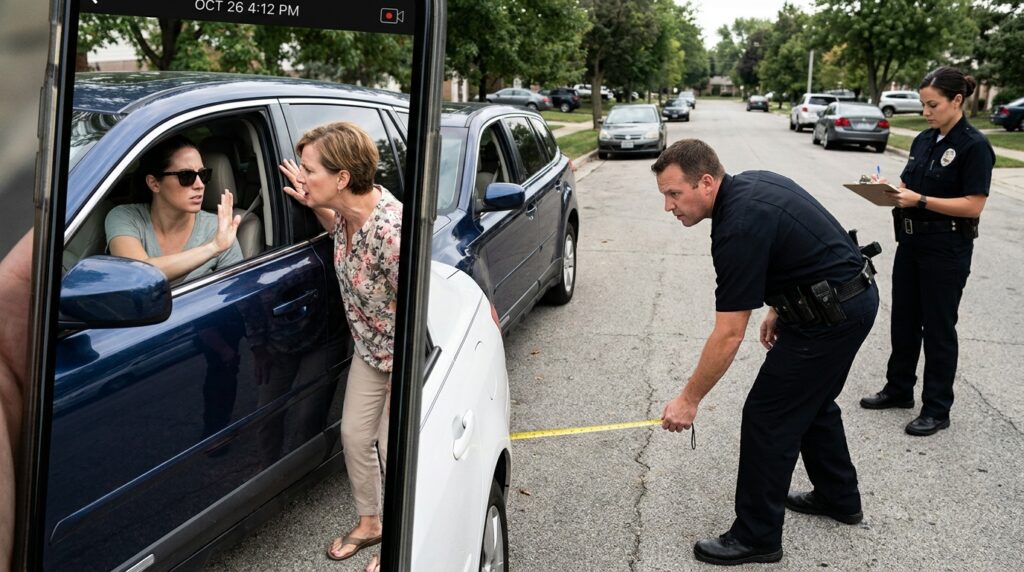
CHAPTER 3: THE ARRIVAL OF THE CHRONICLE
The heavy steel clip of the second officer’s clipboard snapped down onto a fresh sheet of paper with a sharp, dry report that didn’t just echo off my SUV’s chassis—it cut clean through the dense, suburban humidity.
With the lead uniform now filling the entire space between my driver-side window and my neighbor’s floral blouse, the micro-climate of the block dropped into a tactical freeze. The sun beat down relentlessly, baking the dark asphalt until the smell of hot tar and old motor oil became a thick, industrial grease in the back of my throat. Across the street, the white sedan sat motionless, its hood throwing off a shimmering wall of heat that distorted the manicured hedges behind it.
“Identify yourself for the record, ma’am,” the lead officer said, his eyes dropping to the yellow tape measure coiled in his calloused palm. He didn’t pull the blade out yet. He just thumbed the brass locking mechanism, a faint, rhythmic click-click-click that sounded remarkably like a ticking fuse.
“Evelyn Vance,” my neighbor said, her chest heaving underneath her pattern dress. She shifted her canvas tote bag, her knuckles whitening around the strap as she pulled it tighter against her hip, explicitly shielding the yellowed leather edge of the old city folder I had spotted an instant earlier. Her sandals ground into the fine dust at the curb’s edge. “I am the designated neighborhood watch coordinator for Sector Four. I have held the municipal ledger for this block since ninety-eight.”
“Sector Four isn’t a city designation, Ms. Vance,” the documenting officer muttered from the midground. Her voice was flat, rhythmic, entirely devoid of neighborly deference. She didn’t look up from her page. Her pen—a cheap, blue plastic ballpoint—scrawled a single line across the sheet, the tip making a faint scratching sound against the grain of the wood-composite clipboard. “That’s an association boundary. We operate under county parcel codes.”
“It’s a recognized district easement,” Evelyn snapped back, her voice tightening, rising a fraction of an octave into that familiar, weaponized frequency she used whenever a delivery truck dared to let its rear tires touch the edge of her grass. She pointed a short, thick index finger toward my front bumper. “The public vehicle code states clearly that any crossover chassis exceeding sixty-five inches in lateral width must maintain a four-foot setback from the primary residential apron. She’s encroaching. She’s been notified three times this month alone.”
I leaned back into the worn fabric of my seat, my sunglasses remaining perfectly level as I tracked the interaction through the three-inch slit in my window. The internal monologue of my strategy was simple: say nothing that could be logged as an admission; let her exhaust her manufactured authority against the real thing. Evelyn wasn’t just defending a patch of asphalt; she was fighting for the sovereignty of her perimeter. She had spent thirty years using fake terminology—districts, easements, sectors—to build a bureaucratic fortress out of a standard residential block.
The lead officer didn’t answer right away. He took two steps forward, his heavy leather duty boots making a gritty crunch against the loose pebbles along the curb line. He stopped near my front left tire. He didn’t look like a man who cared about Sector Four. His face was weathered, lined with the deep creases of a civil servant who spent his days separating screaming adults over property lines and unpruned oak trees.
“We don’t measure setbacks by association rules, Ms. Vance,” he said, his voice dropping into a low, transactional rumble. He finally knelt, his left knee touching the scorched asphalt, his uniform trousers pulling taut across his frame. “We measure them by the official county marker. The brass pin is buried right under this utility cap.”
He reached down, his fingers brushing aside a layer of dry, dead lawn clippings that had accumulated over the iron water valve set into the dirt strip between the sidewalk and the curb.
Evelyn’s posture changed. The defensive block of her shoulders shifted, her weight transferring rapidly from one sandal to the other. She reached into her tote bag again, her hand disappearing past the yellowed leather spine of the document folder, her fingers fumbling with a smaller piece of paper. When she pulled her hand back out, she was holding a small, blue-lined notebook—the kind used by contractors—with a series of hand-drawn diagrams sketched across the grid paper. At the top of the page, a crudely stamped emblem resembled a city seal, but the ink was slightly blurred, the edges of the stamp showing signs of home-office wear.
“I have the verified measurements right here,” she insisted, her voice gaining a sharp, desperate edge as she stepped closer to the documenting officer, trying to force the notebook into her line of sight. “The baseline was established during the ninety-two resurfacing. The department of public works cleared the right-of-way for my driveway flare.”
The second officer didn’t take the book. She simply adjusted her stance, her body language forming an invisible but absolute wall that kept Evelyn exactly three feet away from her recording lane. Her pen hovered over the clipboard, waiting for the tape to speak.
“Let’s see what the steel says,” the lead officer muttered from the ground. With a sharp, metallic ring, he pulled the yellow contractor-grade tape measure from its housing, the bright yellow ribbon cutting through the shadow of my SUV like a wire.