CHAPTER 5: THE SEPARATION LINE
The plastic housing of the self-inking rubber stamp lay completely motionless on the coarse gravel, its raised purple pad glistening slightly with a dark, oily sheen under the relentless noon glare.
Through the narrow three-inch slit of my driver-side window, I watched the lead officer’s shadow stretch completely across the scattered pink sheets. The physical reality of the situation had fundamentally turned, but my calculus remained cold, unmoving. I finally cut the engine. The sudden silence that fell over the cabin was absolute, replacing the low vibration of the crossover SUV with a dry, static heat that pressed heavily against my chest. I unbuckled my seatbelt, pulled my sunglasses down firmly against the bridge of my nose, and pushed the door open.
The door hinge gave a stiff, mechanical creak as I stepped out onto the hot asphalt, planting my sneakers directly into the grit of the curb line. For the past hour, I had operated behind a defensive shield. Now, the space required an active driver.
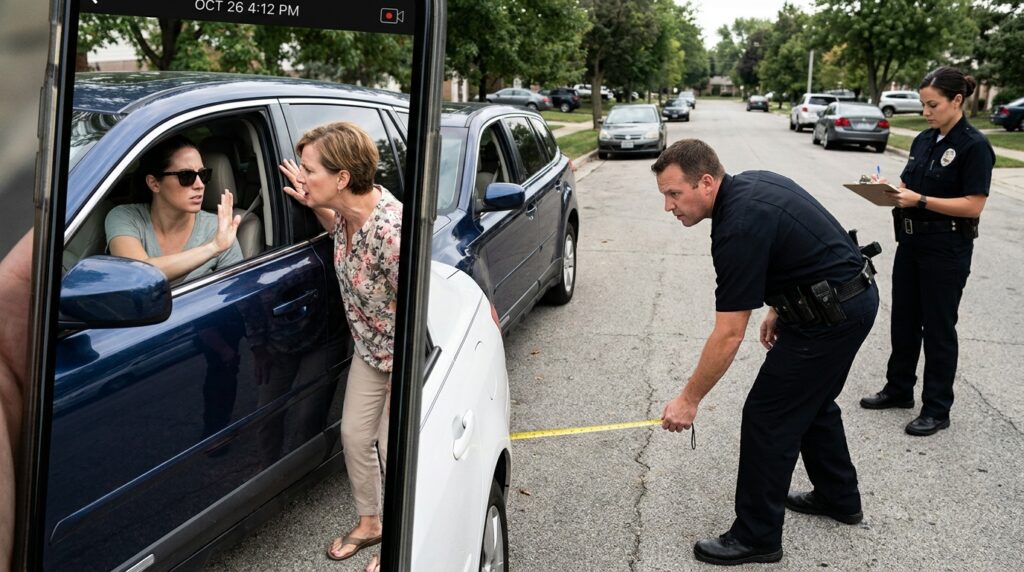
“Ma’am, step back, we’re documenting the curb and vehicles,” the lead officer delivered, his voice shifting cleanly from an objective municipal inquiry into a sharp, structural command. He moved his blocky frame directly between Evelyn Vance and the open window pane of my car, his heavy leather duty belt clicking as he shifted his weight to completely block her physical path.
Evelyn didn’t retreat to the sidewalk. Her fingers twitched against the strap of her canvas tote, her face flushing into a dark, blotchy crimson that made the bright floral pattern of her blouse look garish, almost skeletal in the bright sun. Her short, light-brown hair seemed to stiffen as she forced her chin upward, her sandals grinding down onto one of her own scattered retail slips.
“Those are private monitoring records,” she said, her voice dropping into a raspy, defensive register that lacked its previous bureaucratic velocity. She pointed her thick index finger toward the ground, but her hand was shaking, the skin dry and grayed by curb dust. “The city doesn’t have the personnel to monitor this cul-de-sac daily. As a property owner whose family cleared the original timber line for this development, I am legally authorized to preserve the visual right-of-way. The association bylaws permit self-issued notifications for persistent zoning violations.”
“This isn’t an association notice, Ms. Vance,” the documenting officer said, her cheap blue ballpoint pen scratching rapidly across the composite clipboard. She didn’t look up, but her left boot heel stepped directly over the small plastic stamp housing, pinning it to the gravel like an evidence marker. “You’re using an imitation of the municipal crest. That’s a class-one misdemeanor for criminal simulation under state code forty-four.”
“I am protecting the value of this block!” Evelyn’s voice split, a desperate, sharp edge cutting through the heavy suburban quiet. She took an unstable step toward the uniform, her hands rising in a frantic, pointing gesture that drew the attention of the front windows across the street. The blinds of the neighboring houses remained down, but the faint, rhythmic twitch of curtains proved the witness layer was tracking every single beat of her exposure. “If these vehicles are allowed to crowd the aprons, the fire lanes become non-compliant! The entire neighborhood infrastructure collapses!”
I took a slow, deliberate step forward, my boots coming to a halt near the edge of the iron utility cap. I looked down at the exposed dirt strip where the lead officer had brushed aside the dry lawn clippings. Beneath the layer of fine gray dust and dead crabgrass, right at the corner where Evelyn’s concrete driveway flare met the public curb, a faint streak of old blue surveyor’s paint caught my eye. It was weathered, half-flaked away by decades of rain and lawnmower blades, but it sat three feet inside what she claimed was her private boundary.
My strategy locked onto the physical discrepancy. Evelyn wasn’t just using fake stamps to clear the street; she was hiding a deeper structural failure under her feet.
“Officer,” I said, my voice low, sparse, completely level. I didn’t look at Evelyn. I kept my eyes fixed on the lead uniform’s weathered face. “If we’re documenting the legal boundaries by the numbers, we should look at where the driveway flare actually terminates. The county survey from fourteen doesn’t just measure the curb allowance—it logs the encroachment line.”
Evelyn froze. Her hands dropped out of the air, her fingers curling into tight, bloodless fists against her beige pants. The forward-leaning confidence that had defined her silhouette for thirty years seemed to contract, her weight sagging back toward the concrete apron of her own garage.
The lead officer looked at me, his eyes narrowing slightly behind his lenses as he registered the tactical placement of my prompt. He didn’t answer. He turned his head slowly toward the documenting officer, whose pen had suddenly stopped its rapid scratching across the clipboard page.
The heat off the white sedan’s hood continued to rise, a shimmering, distorted wall that separated our small circle from the pristine, fraudulent quiet of the rest of the block.