
CHAPTER 6: THE REGISTRATION OF VERITY
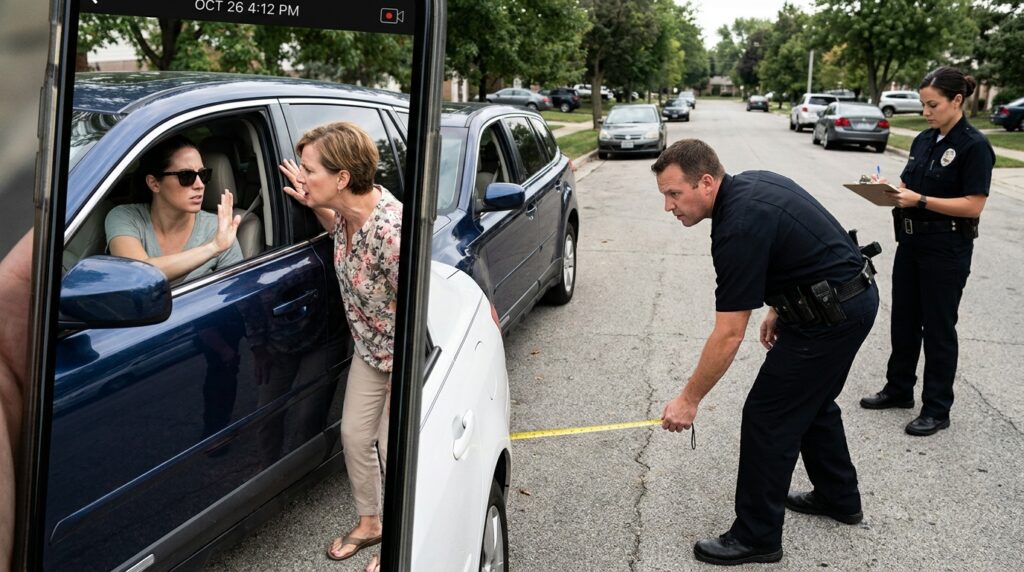
The documenting officer didn’t offer a word of commentary. Instead, her boots shifted with a firm, gritty slide, her weight transferring cleanly onto the concrete apron of the driveway as she brought her composite clipboard into alignment with the curb corner.
The sharp, rapid click of her cheap blue plastic pen was the only sound breaking the thick, static pocket of air between us. She knelt, her uniform trousers drawing tight across her knees, her eyes pinning themselves directly to the faded blue line I had uncovered under the layer of parched yard clippings. With the blunt plastic tip of her pen, she scraped back a calcified layer of limestone powder from the broken edge of the concrete, tracing the straight line where the municipal easement cut straight into the foundation of Evelyn Vance’s custom driveway flare.
“Marker identified,” she reported. Her tone was clinical, deadpan, completely detached from the local history of the subdivision. Her pen point left a small, dark indentation in the crumbling moss beneath the curb’s lip. “The code-enforcement parcel reference from two thousand fourteen logs this boundary as an unmaintained public drainage path. The setback isn’t violated by the vehicle. The driveway concrete is what encroaches.”
Evelyn’s hands didn’t drop back to her canvas tote. Her fingers stayed frozen in the air, curled into stiff, trembling claws that looked remarkably like the dead roots she spent her mornings ripping out of her immaculate flowerbeds. Her floral blouse seemed to lose its remaining crispness, the fabric sagging against her frame as the hot wind coming off the SUV’s radiator rustled the scattered pink and yellow receipt papers surrounding her sandals.
“That’s a clerical error from the county mapping office,” Evelyn muttered, though her voice lacked the piercing, authoritative drone that had previously dominated the block. Her eyes darted toward the row of wide porches across the street, where three different sets of window blinds had now been raised by an inch, exposing the pale, silent faces of neighbors watching her jurisdiction dissolve into the dirt. “My husband poured this concrete according to the ninety-two civil plat. We paid the grading premium. The developer signed off on the clear-zone waiver.”
“Developers don’t own city land, Ms. Vance,” the lead officer delivered, his voice dropping into a transactional, low rumble as he stepped across the scattered papers to stand directly between Evelyn and the exposed surveyor’s mark. He didn’t pick up the plastic stamp housing beneath his heel, but he didn’t move his boot off it either, holding it trapped against the asphalt like an old shell casing. “The city doesn’t honor developer waivers that extend into an active fire-access lane. If this curb line is out of compliance, the liability doesn’t sit with the residents parked on the street.”
I watched her face from my position near the iron utility cap, my strategy focusing completely on the kinetic collapse of her stance. Evelyn was no longer an institutional protector; she was an overextended occupant whose own border was suddenly subject to a code-compliant inquiry. Her entire identity had been constructed around the meticulous enforcement of rules she had invented, and now the actual numbers were turning against her with the weight of a physical wall.
“We need to log the lateral distance from the iron valve to the concrete seam,” the lead officer continued, turning his blocky frame toward his partner without checking Evelyn’s reaction.
The second officer nodded, her hand already moving down to the bright yellow tape housing at her belt. The steel blade gave a short, metallic squeak as she prepared to draw the line once more, its yellow reflection cutting through the hot, desaturated shadow of my car frame. Evelyn didn’t step back onto her lawn. She remained pinned between the curb and the dark uniform, her sandals resting on the edge of a fraudulent boundary that was shrinking by the second.








