
CHAPTER 6: THE CHANNEL INTERCEPT
The cold spray off the hull tore over the low fiberglass windscreen, hitting Vance squarely in the face with the force of thrown gravel. The launch took a heavy, shuddering leap over a massive, unlit wake left by an inbound tugboat, its twin outboards screaming as the propellers briefly cleared the black water before biting down again with an iron jar. The steering wheel thrummed violently against Vance’s calloused palms, but his grip remained frozen into a locked, tactical brace.
Beside him, the mechanic clung to the aluminum grab rail, his knuckles stark white under the passing sweep of the outer breakwater beacon. “The primary radar sector is going to flag us!” the younger man yelled, his voice torn apart by the rhythmic, deafening thrum of the engine wall at full throttle. “Harris controls the port terminal transponder feed! He’ll have the intercept boats waiting before we clear the inner lane!”
Vance didn’t adjust his course. His eyes were focused three miles ahead, where the sprawling, illuminated grid of the Coast Guard sector command pier rose out of the dark water like a floating fortress. Between them lay the deep-water shipping channel, congested with the massive, towering shadows of three stacked container vessels waiting for their harbor pilots.
He glanced down at the small, glowing marine radar screen on the dash. A sharp amber dot was closing fast from the starboard quarter—a heavy-duty twin-hull interceptor vessel belonging to the private yard’s corporate response team. It didn’t flash blue lights; it moved with a silent, aggressive momentum that meant Harris had cut the safety limit overrides entirely.
“Look at the transponder frequency on the screen,” Vance barked, his low, gravelly voice effortlessly dropping beneath the vibration of the fiberglass deck plates.
The mechanic squinted at the small liquid-crystal panel. “It’s showing seven-four-zero. That’s… that’s an outdated naval civilian auxiliary channel. It doesn’t register on the primary port authority manifest.”
“Harris isn’t running his communications through the municipal port grid,” Vance said, his gaze returning to the black water ahead as he cut the wheel hard to port, ducking the launch beneath the massive, rusting overhang of an anchored grain ship’s stern. The hull scraped against a trailing mooring line with a sharp, screaming hiss that tore a strip of white gelcoat from the gunwale. “He’s tracking us using a legacy military frequency loop left over from the old sector command. He thinks I don’t know the dead zones in my own basin.”
Vance reached down, his thumb striking the toggle switches on the launch’s navigation panel. He cut the running lights, the anchor light, and the digital instrument backlights with three rhythmic, heavy clicks. Instantly, the boat became a silent, desaturated shadow running blind through the towering corridors of steel hulls.
Behind them, the amber dot on the screen began to zigzag erratically, its internal tracking loop scrambled by the massive magnetic mass of the anchored grain vessel. Harris’s private security team had the speed, they had the weapons, but they didn’t have forty years of navigating the thermal drafts and shallow shoals of this specific channel.
But the victory was a false flag. As Vance brought the launch around the final marker buoy, his chest tightening within his black fitted shirt, a sudden, piercing white light erupted from the Coast Guard sector pier. It wasn’t a standard harbor beacon; it was a high-powered searchlight that pinned the launch against the dark water with absolute, blinding precision.
Over the public address system across the water, a voice boomed, amplified by three horn speakers until it shook the air inside Vance’s chest. “Vessel approaching sector pier nine, cut your engines and prepare for immediate boarding by regional port authority order. You are in violation of a restricted channel closure.”
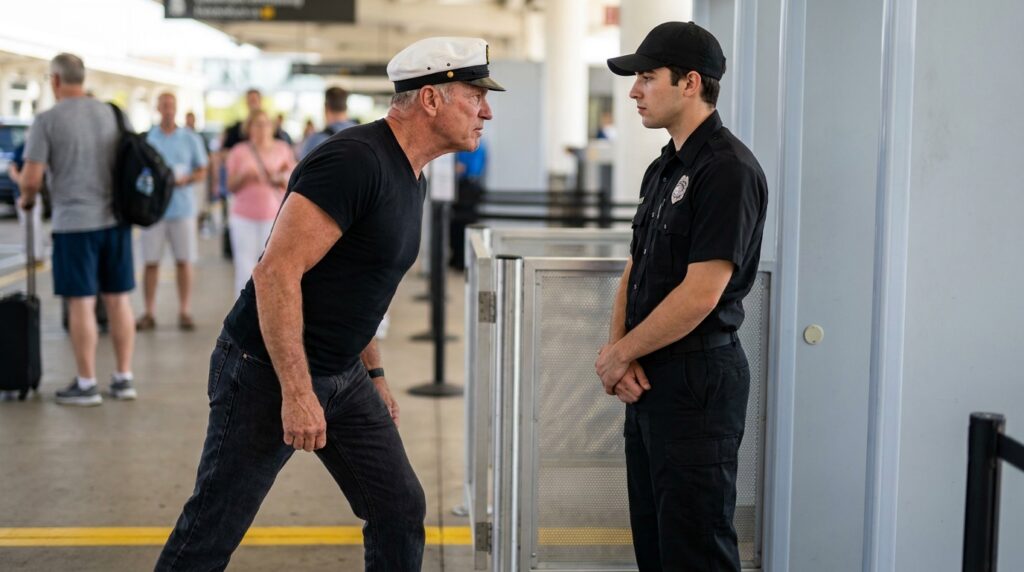
Vance looked at the pier. Standing at the edge of the concrete walkway, surrounded by three uniformed federal officers who had their sidearms unholstered, was Commander Harris. The Port Director’s immaculate white cap was pulled low, his arms crossed over his chest with the cold, self-assured stance of a man who had already rewritten the official narrative before his targets could even touch dry land. He had used his own administrative authority to flag Vance’s launch as a stolen civilian asset, turning the base’s own security grid into an iron wall of defense for his infrastructure cover-up.
“We’re done,” the mechanic whispered, his hands dropping away from the rail as his knees buckled against the deck plates. “He’s got the whole sector locked down. There’s nowhere left to run the hardware.”
Vance didn’t slow the throttles. He kept his fingers clamped to the vibrating wheel, his eyes fixed on the young contract guard who was standing just behind Harris’s shoulder—Miller, the twenty-year-old kid from the gate, brought along as a witness to validate the false flag report. The final boundary wasn’t just a physical gate anymore; it was the institutional memory of the base itself.
Vance’s internal stopwatch let out one final, cold click inside his head. He had the physical evidence of the sabotage on his drive, but to make them look at it, he would have to slam his momentum straight into the center of the base’s active defense zone, risking everything on the one factor Harris couldn’t control: the absolute discipline of the ranks.








