
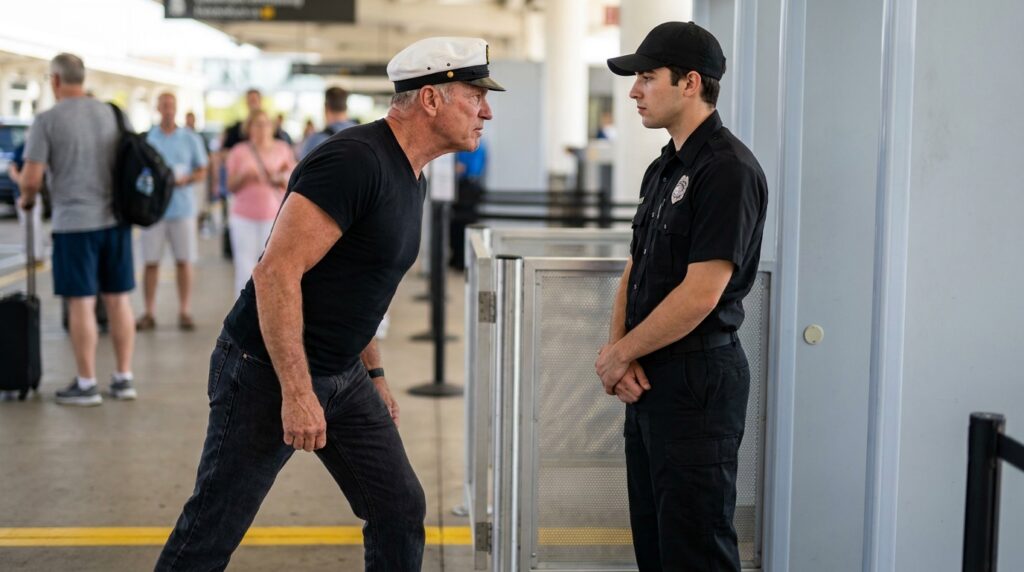
CHAPTER 4: THE ULTIMATE BOUNDARY
“The hatches don’t cycle from below, Captain,” the mechanic said. The heavy spanner wrench in his hand shifted an inch lower, its cold iron weight a clear extension of the ship’s own locked architecture. “Harris didn’t just walk back to the administration building to check a logbook. He walked back to wash his hands.”
Thomas Vance didn’t flinch as the echo of the pneumatic locks settled into a dull, vibrating silence across Deck Four. He let his fingers release the pocket stopwatch. The internal ticking in his mind didn’t stop, but it grew cold, translating the structural rhythm of the ship into a fluid matrix of immediate risks. He had spent half his life trapped in iron hulls under three hundred atmospheres of black ocean; a locked maintenance gate on an uncommissioned vessel was just another perimeter to cross.
“The three-mile limit wasn’t the delivery point, was it?” Vance asked, his voice cutting through the hiss of the auxiliary steam line with a flat, predatory resonance. He didn’t look at the wrench; he kept his eyes on the mechanic’s greasy forehead, tracking the micro-expressions under the yellow cage lights. “The hull isn’t meant to sink in international waters. It’s meant to settle right here across the primary deep-water shipping lane. One catastrophic structural failure during the harbor trials. The entire port grid gets choked for six months.”
The mechanic’s mouth tightened into a hard, defensive line, his posture stiffening as he realized the old commander wasn’t calculating a retreat—he was calculating an assault. “You’ve got the drive, Captain. You know about the steel. If the yard uses sub-spec contractor plates, the company takes the hit, the insurance covers the maritime write-off, and everybody gets a clean ledger.”
“The ledger isn’t clean if Harris signed the maintenance override before the inspection manifest even crossed my desk,” Vance countered. He took a slow, calculated step forward, the leather of his boots biting into the grit on the steel floor plates. He let his broad, muscular chest crowd the narrow companionway space, using the exact spatial dominance he had deployed against the young guard at the outer boundary. “A budget deficit doesn’t get resolved by scrap steel insurance payouts. It gets resolved when a foreign commercial carrier pays a premium to redirect their container fleet to a private terminal twenty miles up the coast while this channel is blocked.”
A sharp, metallic hiss rattled through the overhead pipes as the auxiliary line pressure surged. The cold truth stripped away the final layer of the decoy. The fraudulent steel manifest wasn’t a corporate cutting of corners; it was the physical mechanism for an intentional infrastructure sabotage, orchestrated by the one man who held the keys to the entire sector. The young guard at the gate hadn’t been an arrogant kid protecting a corporate perimeter; he had been the first line of an intentional delay protocol, ordered to keep Vance from seeing the hull stress signatures until the auxiliary lines were fully pressurized.
“You’re an old man, Vance,” the mechanic muttered, his knuckles whitening around the iron shaft of the wrench as the distance between them shrank to less than three feet. “You don’t have a command anymore. You don’t have a crew. You’re just a name on a retirement plaque in the administrative quad.”
“I am the man who designed the internal compartment protocol for this exact class of hull,” Vance said. The words were quiet, but they carried the crushing weight of forty years of unyielding naval absolute. “Every isolation valve behind that bulkhead responds to a mechanical bypass that doesn’t run through Harris’s digital terminal.”
With a sudden, explosive shift of his weight that drove a flare of heat through his damaged knee, Vance didn’t move away from the mechanic—he slammed his mass directly into the man’s center of gravity. His broad shoulder caught the canvas jacket, the sheer physical momentum of his veteran frame pinning the technician against the main manifold of the ballast pump. The iron spanner wrench clattered against the deck plates with a loud, ringing strike, sliding into the dark pooling water of the bilge below.
Vance didn’t strike. He held the man fixed against the vibrating pipe with one calloused, unyielding hand locked onto his collar, his gray hair catching the harsh glare of the sodium bulb above. With his free hand, he reached into his shirt, extracting the small black drive and pressing it flat against the mechanic’s chest.
“You’re going to open the manual auxiliary line to the primary sea chest,” Vance commanded, his breath steady and cold against the man’s face. “We drop the pressure in the forward tanks before the weld seams reach critical load. Then you and I are going to have a conversation with the base commander’s internal affairs unit.”
The mechanic stared into the unshakeable, slate-gray eyes beneath the white captain’s hat. The defiance in his face dissolved, replaced by the profound, panicking realization that the legendary commander standing over him couldn’t be broken by an environmental trap or an iron tool. The authority wasn’t in the locked hatches or the security uniforms; it was in the absolute, terrifying discipline of the man who knew every rib of the ship he was prepared to save.
“The bypass valve is behind the secondary collector panel,” the technician whispered, his head sinking back against the structural iron. “The override code… it’s the same one stamped on Harris’s private log. Seven-two-zero.”
Vance let the man down slowly, his fingers remaining near his pocket as the mechanic reached for the manual wheel. The metal plates beneath their feet groaned as the internal pressure began to bleed back into the harbor basin, the structural stress on the brittle hull receding with a long, metallic sigh. The trap had failed. The true boundary had been held.








