
CHAPTER 2: THE ANCHOR EXCLUSION
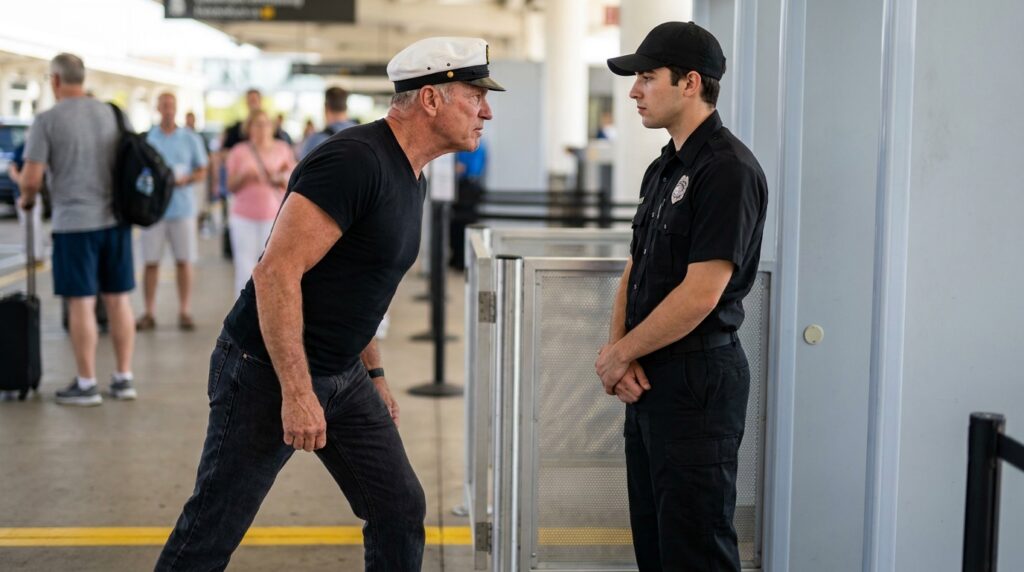
“Stand down, guard. You’re blind to the weight of the silver on his cover.”
The voice cut through the damp harbor fog like a heavy-gauge cable snapping under tension. It came from the gravel walkway behind the security kiosk—sharp, military-crisp, and carrying the unassailable weight of true institutional power.
Miller’s thumb froze on the polymer retention hood of his holster. The microscopic tremor in his eyelid ceased, replaced by a sudden, draining pallor that turned his jaw the color of wet sailcloth. His splayed hand, still hovering inches from Vance’s chest, dropped instantly to his seam.
Vance didn’t turn his head. He didn’t break eye contact with the boy. He kept his boots fixed to the weathered asphalt, letting the cold shadow of his white brim remain planted across Miller’s face until the boots behind them ground to a halt on the yellow paint line.
Commander Harris, the Port Director, stepped into the floodlight’s cone. His uniform was immaculate, the gold braid on his sleeves catching the sharp edges of the sodium glare, but his chest was heaving slightly from a hurried march across the administrative quad. His eyes weren’t on the guard; they were locked onto Vance’s broad, unyielding shoulders with an expression that balanced professional panic with ancient, deeply drilled deference.
Harris snapped his hand upward, his fingers locking into a flawless, rigid salute that vibrated with a lifetime of conditioning. “Captain Vance, sir. The gate manifest was delayed at the primary terminal. My apologies for this security breakdown.”
The silence that followed was heavy, broken only by the low, subterranean rumble of a container ship clearing the outer breakwater. The civilian worker with the clipboard stood completely still, his eyes darting between the legendary commander in jeans and the senior base official holding a salute on the damp concrete. Miller’s chest rose and fell in shallow, terrified cycles; his rigid posture had dissolved into a panicked slump, his ears flushing dark crimson against the black band of his security cap.
“Your sentry is thorough, Harris,” Vance said, his gravelly voice dropping an octave as he finally shifted his gaze away from the boy. He didn’t look at Harris yet. He looked down at the guard’s small stainless-steel desk inside the open kiosk window. Resting on top of the digital terminal was a physical, leather-bound paper logbook—an archaic secondary backup used for commercial steel shipments. Stamped across the active page was an indigo ink seal: a double-ringed maritime anchor with a central serial number that had been crudely struck through with a red grease pencil.
The sight of that struck-through seal sent a cold, familiar calculation through Vance’s mind. It wasn’t standard port bureaucracy. It was an exclusion mark.
“The boy was following directives, Captain,” Harris said, lowering his hand only after Vance offered a terse, nominal nod of acknowledgment. Harris stepped forward, his leather shoes clicking sharply on the iron drain cover between them. He reached past Miller without looking at him, his fingers striking the hydraulic gate toggle. “The new vessel is moored at Pier 9. The engineering team is waiting for your inspection. We can bypass the biometric scan entirely.”
“No,” Vance said. The word was a flat iron bar. He reached into his fitted black shirt, his thick, calloused fingers extracting a small, unlabeled black aluminum casing no larger than a cigarette lighter. He laid it flat on the paper logbook, directly over the struck-through anchor seal. “We run the credentials. We log the access. I don’t move through side doors on a federal contract, Commander.”
Harris’s eyes twitched down to the aluminum drive. For a fraction of a second, the Port Director’s professional mask slipped, revealing a tight, defensive muscle bunching at the corner of his jaw. “Of course, sir. Miller, scan the Captain’s hardware. Now.”
The young guard’s hands shook as he took the drive, his fingers fumbling with the USB interface on the side of the ruggedized terminal. The machine let out a short, high-pitched chime, and a series of encrypted code blocks began cascading across the green monochrome screen. Vance watched the reflections in the glass. He didn’t care about the clearance status; he was watching Harris’s reflection. The Port Director was staring at the terminal screen with the rapt, desperate intensity of a lookout watching a torpedo wake in a dark sea.
“Clear, sir,” Miller whispered, his voice cracking slightly as he handed the drive back to Vance. He wouldn’t look the old man in the eye. “Lane four is… logged. My apologies, Captain.”
Vance took the drive, the cold metal edges sliding back into his palm. “Authority isn’t given by a black uniform, kid,” he said, his voice level and devoid of anger, which only made the weight of it heavier. “It’s earned by the lives you protect. If you’re going to hold a line, make sure you know exactly what’s behind you.”
He stepped past the barrier, his boots striking the gravel beyond the yellow paint. Harris immediately fell into step beside him, matching the older man’s deliberate, slightly uneven stride as they headed down the long, unlit corridor of shipping containers toward the black water of Pier 9.
The shadows here were longer, sharper, cast by the massive gantry cranes towering overhead like iron skeletons against the gray sky. The salt spray was getting thicker, carrying the distinct, oily stench of a vessel fresh out of dry dock—paint solvents, burnt zinc anodes, and the clean, terrifying scent of unprimed iron.
“You didn’t mention the vessel’s registration was flagged under the domestic material exclusion act, Harris,” Vance said after they cleared the hearing range of the gate. His internal stopwatch clicked again, the rhythmic clink keeping time with his steady steps.
Harris cleared his throat, his hand coming up to adjust the brim of his dress cap. “A minor administrative hiccup with the supplier, Captain. Nothing that affects the hull integrity. The shipyard supervisor has the full structural certification waiting in the wardroom.”
Vance kept his eyes fixed on the dark silhouette of the ship rising at the end of the pier. The hull was massive, a matte-black wall of steel that seemed to absorb the light from the facility’s perimeter floods. But as they drew closer, his eyes—trained by decades of identifying structural stress in submarine bulkheads—caught the slight, uneven ripple along the seam of the second strake. The weld line was too wide, the metal pitted with microscopic fissures that had been hastily covered by a thick layer of industrial gray primer.
It wasn’t a minor hiccup. It was the physical signature of cheap, high-sulfur domestic scrap steel—the kind that brittle-fractures when the hull hits four degrees Celsius in a heavy swell.
“We’ll see what the wardroom says,” Vance murmured, his fingers tightening around the encrypted drive in his pocket. The decoy secret was already in his hands, but as he looked at the tense, rigid posture of the commander walking beside him, he knew the real threat hadn’t even shown its face yet.








