
CHAPTER 5: THE QUADRANT ESCAPE
The emergency pressure lever on the secondary terminal hatch resisted with the stubborn, grinding friction of ungreased iron. Vance threw his shoulder against the crossbar, using the full leverage of his muscular frame to break the hydraulic seal. With a sharp, metallic clack, the heavy circular door swung outward into the midnight air, letting the biting, salt-rimed wind of the outer harbor flood the dim ladder well.
The mechanic, his face pale underneath the graphite grease, scrambled out onto the gravel walkway first, his boots skidding on the loose stones. Vance followed him with a deliberate, smooth step, his eyes sweeping the administrative quad before his boots even settled on the pavement.
The shipyard had changed during the two hours he had been in the bilge. The yellow sodium floods were gone, killed at the main breaker. In their place, the cold, sweeping white beams of high-intensity halogen spotlights cut through the low-hanging fog from the roofs of the surrounding container offices.
“Movement by the electrical substation,” Vance muttered, his gravelly voice dropping below the roar of the distant harbor generators. He grabbed the mechanic’s canvas collar, pulling him back into the deep shadow of the auxiliary intake housing.
Fifty yards across the open asphalt, three white utility trucks were parked in a tight, defensive wedge blocking the primary road to the administrative building. The men moving between them didn’t wear the standard black contract uniforms of Miller’s shift. These men wore desaturated gray tactical vests over unmarked dark clothing, their faces obscured by the brims of low-pulled baseball caps. They carried short, compact sub-carbines on tactical slings—not standard port security gear.
Vance focused on the closest figure. Attached to the man’s shoulder strap was a tactical radio, its small digital screen flashing an amber frequency loop: 462.575. It was an unencrypted commercial band used by private maritime logistics contractors—the kind hired to move high-value, off-the-books cargo through federal channels.
“Those aren’t port authority boys,” the mechanic whispered, his teeth clicking together from a mix of freezing spray and raw adrenaline. “Harris brought in his own line handlers. If they find us out here with that drive—”
“They won’t find us,” Vance said. His hand reached into his jeans, his calloused thumb testing the edge of the encrypted drive before shifting back to his brass stopwatch. Click-clink. The steady, rhythmic strike inside his pocket was a tactical counterweight to the frantic flashing of the amber radio screens across the quad. “Harris knows the bilge pressure dropped. He knows the hull didn’t fracture on schedule. He’s running out of minutes before the dawn shift arrivals.”
Vance looked toward Pier 9’s secondary slip. Moored against the creosote-soaked pilings was a twenty-six-foot harbor patrol launch, its twin diesel outboards idling with a low, wet chug that was masked by the larger ship’s generator. The boat’s navigation lights were dark, but the high-gloss fiberglass of the console caught the sweeping glare of the roof-mounted spot.
“The launch,” Vance said, his finger pointing through the sharp edges of the iron crane supports. “The key switches on those commercial hulls are mechanical rotary systems. They don’t run through the gate’s biometric network.”
“We’ll have to cross twenty yards of open asphalt,” the mechanic protested, his eyes tracking the sweeping halogen beam. “The moment that light hits the gravel, they’ll have the carbines on us.”
“Then don’t look at the light,” Vance said.
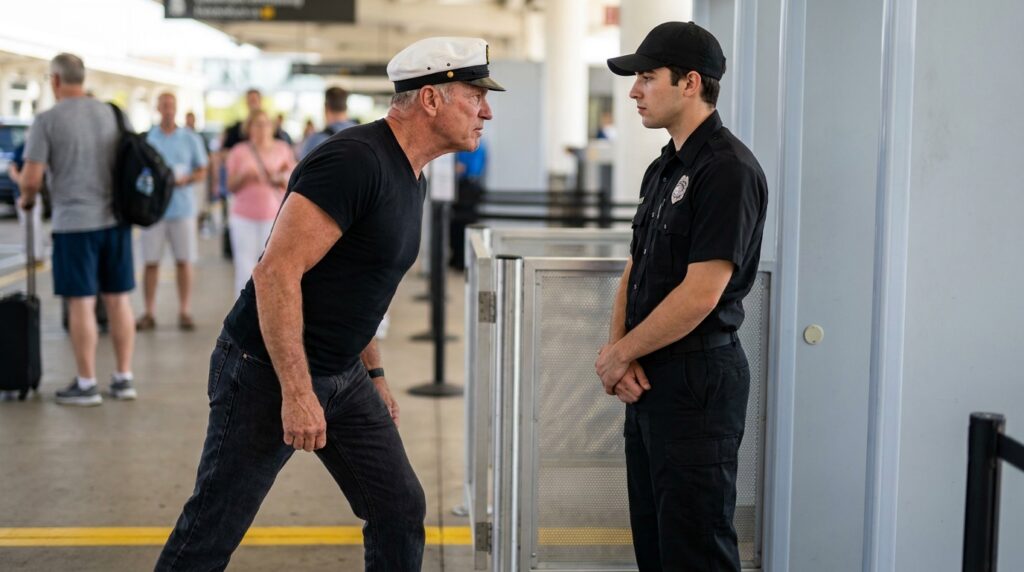
He didn’t wait for the mechanic’s nerves to settle. Vance adjusted the bill of his white captain’s hat, dropping his center of gravity into his heels as he stepped out from the shadow of the intake housing. He didn’t run—running created an erratic silhouette that caught the periphery of a sentry’s vision. He moved with a heavy, rhythmic stride, keeping his broad shoulders parallel to the shipping containers, using the massive iron structures as a physical shield against the trucks.
The halogen beam swept across the gravel three feet behind his heels, illuminating the crushed white stone with a blinding, clinical glare.
“Hey! Lane four exit! Hold position!”
The shout came from the utility trucks. A car door slammed with a loud, hollow crack. Vance didn’t turn to look. He caught the mechanic by the arm, propelling him forward through the narrow gap between the pier deck and the launch’s gunwale.
Vance dropped down onto the rubber-matted deck of the boat, his bad knee taking the impact with a hot, sickening flare of pain that he crushed down through sheer force of will. He reached the helm console in a single, fluid extension of his arms, his thick fingers bypassing the digital ignition screen and reaching under the molded plastic dash to find the heavy copper emergency starter solenoid.
Behind them, the gravel exploded into small fountains of dust as the first warning shots struck the edge of the pier. The sharp, whip-like cracks of the carbines echoed off the iron hull of the uncommissioned ship, followed by the frantic shouting of Harris’s private security detail running toward the water.
Vance twisted the solenoid wires together. The twin diesels roared to life with a thick cloud of blue exhaust, the props biting into the black harbor water before the mechanic could even find a cleat to untie.
“Cut the lines!” Vance roared over the engine wine, his hands slamming the mechanical throttles forward into the hard stop.
The launch leaped forward into the dark channel, its bow lifting as it tore through the oily surface, leaving the sweeping lights and the flashing amber radios behind in a wake of white foam. The hunt was no longer contained within the gate; the entire harbor was now the board.








