
CHAPTER 6: THE BLACKWOOD INTAKE
The tires hit the corrugated iron decking of the main gate with a sharp, repeating rattle that jarred the steering column. Miller tapped the brakes, the brake pads squealing with a high, metallic pitch against the rusted drums. Outside, the chain-link perimeter fence was choked with river debris and yellow foam from the estuary flats, its lower section reinforced with fresh concrete barriers that looked wet under the fine gray mist.
Arthur kept his right hand balanced against the door armrest, his skin recording the precise vibration of the diesel block as the vehicle cleared the guard post. The post was empty, its glass windows cracked and patched with heavy silver duct tape. There were no municipal police vehicles, no environmental agency decals on the utility trucks parked along the levee. The personnel standing in small groups near the pump house wore the same desaturated gray field coats as the man in the jump seat.
The van rolled to a stop beside a low-slung containment dike built from salt-crusted limestone blocks.
“The secondary reservoir is rising six inches an hour,” the man in the gray coat said, leaning forward between the front seats. His hand reached past Arthur’s shoulder to tap the glass, pointing toward a line of three submerged valves near the water line. “The pressure gauges on the primary cap aren’t registering the shift. The system thinks the volume is static.”
Arthur unlatched the passenger door, the damp sea air hitting him with a cold, chemical sting that immediately cleared the stale smell of coffee from his nose. The ground beneath his boots was a slick slurry of gray mud and crushed limestone gravel. He stood upright, his olive field jacket absorbing the fine drizzle, his eyes automatically panning across the concrete infrastructure he had helped bury fifteen years ago.
The facility had grown older in his absence, its edges rounded by the aggressive salt air, its iron fittings weeping thick orange tracks down the gray vertical faces of the sumps. But the layout remained identical. The architecture of a cover-up didn’t change with time; it merely hardened.
Miller stepped out from the driver’s side, swinging a heavy iron valve wrench down by his hip. “The contract team tried to drop an auxiliary plug into the lower intake at midnight, Arthur. The line rejected the seal. The back-pressure blew the seals out of the primary manifold.”
Arthur walked toward the edge of the limestone dike, his boots sinking two inches into the salt mud. He did not look at the rising water; he looked at the concrete seam where the reservoir met the bedrock. A fresh line of bright yellow industrial wax had been smeared across the auxiliary drainage conduit, its surface pristine, unmarred by the gray silt that coated everything else in the compound.
The micro-mystery was tiny, a localized detail that would have escaped anyone who hadn’t designed the internal baffle system. The wax wasn’t there to seal a leak; it had been applied to keep a mechanical sensor from registering a manual bypass.
“The underwriter didn’t order the proximity test because of an insurance review,” Arthur said, his voice level, gravelly, catching the sharp hum of the drainage pumps behind the levee. He did not turn to look at Miller or the man from the van. “The test was meant to ensure I wasn’t already talking to the group that applied that wax.”
The man in the gray coat stepped up beside him, his boots crunching on the wet limestone. His hands remained tucked into his deep pockets, his posture relaxed but positioned precisely to block Arthur’s route back toward the van. “The footage from the park went to a private server in Munich four minutes after it was uploaded, Arthur. The people who bought it weren’t looking at your reaction time. They were verifying that the original project engineer was still within the state line before they initiated the final pressure spike.”
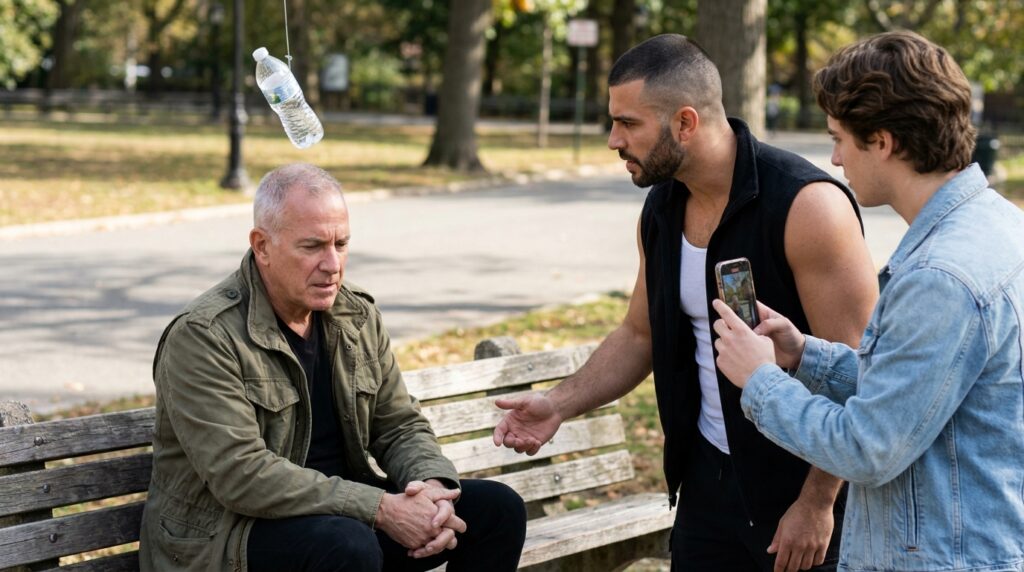
The decoy of a simple structural failure or a disgruntled corporate rival dissolved into the gray mud. The prank in the park, the muscular aggressor with the sleeveless vest, the shattered phone on the counter—they weren’t part of an exposure channel or an insurance audit. They were the opening moves of a coordinated asset liquidation. The competitor hadn’t hacked the network; they had bought the old blueprints and were using the viral distraction to force the security firm to bring the one man who could open the primary sump directly into the kill zone.
Arthur looked down at his left wrist, at the scratched, inert watch face that had recorded fifteen years of dead time. The machinery below the estuary wasn’t just leaking; it was being driven toward a catastrophic venting cycle by a manual override he had hidden in the primary control block in 1996.
“You have twenty minutes before the lower manifold reaches critical stress,” Miller said from behind them, his fingers tightening around the cold iron handle of the valve wrench. “The barge keys are in the locker, Arthur. Let’s go down.”
Arthur did not answer. He turned his face toward the dark mouth of the subterranean intake tunnel, where the smell of sulfur and old concrete rose from the wet dark like a cold exhalation from a tomb.








