
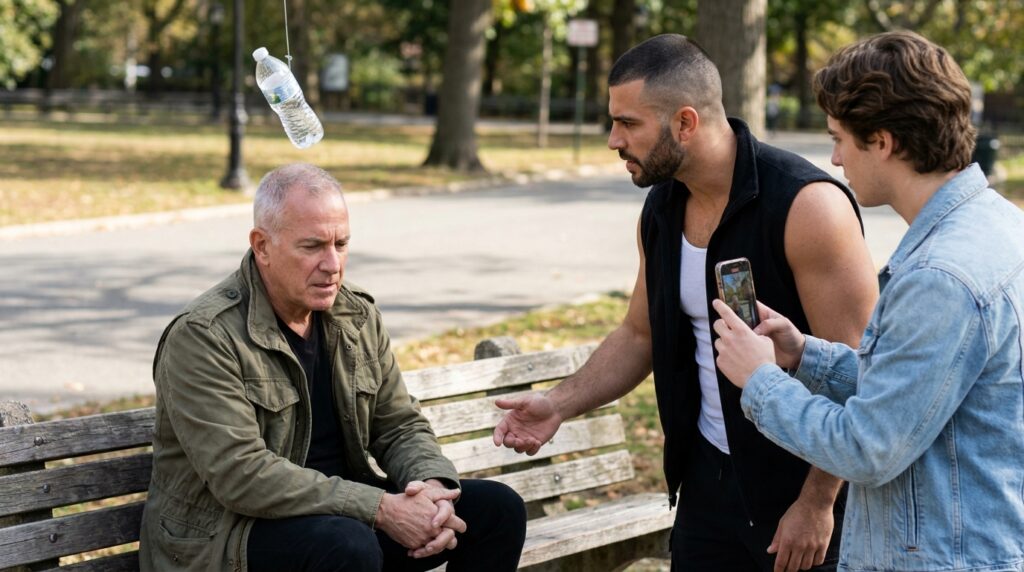
CHAPTER 2: THE ANCHOR CABLE SNAPS
The key didn’t turn because the lock cylinder had already been pushed three millimeters past its housing. Arthur kept his thumb flat against the cold, pitted brass of the deadbolt, feeling the slight rattle of loose pins inside the mechanism. The scent of rain-wet asphalt behind him mixed with something metallic and immediate—the sharp, unmistakable smell of oxidized iron where a crowbar had chewed through the green weather-stripping.
He didn’t pull his hand back. A withdrawal was an admission of panic, a variable that changed the spatial equation of the landing. Instead, he allowed his weight to lean forward, using the bulk of his shoulder to press the swollen oak door into the frame until the fractured latch clicked open.
The apartment was dark, save for the desaturated gray light cutting through the kitchen window from the alleyway. The air inside smelled of linoleum, cabbage, and the cold, static dust of a room that had remained undisturbed for months. But the rhythm of the space was wrong. A single sheet of yellowed newspaper, used to line the boot tray near the threshold, had been kicked two inches to the left, its edge curled back like a dead leaf.
Arthur stepped into the narrow hallway, his boots making no sound on the worn wool runner. His right hand remained in his jacket pocket, his fingers curled loosely around his keys, using the heavy brass rings as an improvised knuckle-weight. He didn’t look for a weapon; the flat-rimmed cast-iron skillet on the stove or the heavy glass salt cellar on the counter were variables, and variables took time to calculate. His mind was already rendering the floor plan as a series of tight intersection lanes.
The small kitchen counter was clear, except for a square shape resting precisely between the toaster and the bread box.
It was a smartphone. The glass screen was a spiderweb of silver fractures, the identical impact pattern Arthur’s boot heel had delivered to the gravel twenty minutes prior. The younger accomplice’s device had been harvested from the park, cleaned of dirt, and placed in the exact center of Arthur’s domestic perimeter. The display was dead, black and reflective, but as Arthur approached, the haptic motor inside the chassis gave a brief, mechanical buzz that vibrated against the Formica.
A single line of text illuminated beneath the shattered glass. It wasn’t a social media notification. It was an encrypted network link, followed by a localized seven-digit string—his old employee identification number from the salt-reclamation facility at Blackwood Estuary.
Arthur’s gaze remained flat. The watch on his left wrist felt heavier now, an inert bracelet of cold iron that seemed to drag at his forearm. The number on the screen belonged to a dead man; it had been buried fifteen years ago beneath three hundred pages of non-disclosure clauses, insurance waivers, and a monthly wire transfer that arrived from a blind trust in Delaware. That money bought the silence. It bought the green field jacket, the flour in the pantry, and the right to sit on a park bench without a past.
The phone buzzed a second time. The text vanished, replaced by a fresh transmission from an unlisted area code.
The footage has an executive buyer, Arthur. You haven’t lost your stride.
The subtext was loud enough to fill the small kitchen. The interaction in the park hadn’t been an accident of the algorithm; it had been a proximity test. The two younger men were merely the grease on the tracks, low-level operators used to draw out a specific physical reflex that could be cross-referenced against an old corporate database. The predatory digital subculture wasn’t the antagonist—it was the cover.
Arthur reached out and picked up the broken device. The plastic casing felt greasy against his palm, carrying the residual heat of a lithium battery that had been forced to run an unindexed background script. He didn’t check the call history. He knew the software architecture; it was an old corporate communication loop that used localized relays to mask the origin point. The private security firm that handled the post-incident containment at Blackwood fifteen years ago used the exact same three-node encryption setup.
He walked to the window, his eyes scanning the alley below. A rusted delivery van was parked by the dumpsters, its engine idling with a low, wet rumble that shook the exhaust pipe. A single man sat in the passenger seat, the glow of a dashboard tablet illuminating the sharp angle of a jawline that Arthur recognized from a different lifetime—a lifetime of corporate non-disclosure and buried cement trucks.
The van didn’t move. It was an anchor, a physical reminder that the perimeter was no longer his own. Arthur watched the exhaust smoke rise into the desaturated gray air, his thumb pressing into the shattered glass of the phone until the screen went dark forever, the slivers of crystal biting small, clean crescents into his skin.








